A fatal chain on a high‑speed roadway rarely turns on a single mistake; it is usually a sequence. On the Brooklyn-Queens Expressway before dawn, that sequence began when a rear passenger came into the travel lane of a moving highway vehicle and ended seconds later with a suspected impaired driver striking her—an all-too-familiar pattern in urban traffic trauma and in how New York prosecutes vehicular deaths tied to intoxication.
At a Glance
- A 37-year-old woman in the rear of an SUV came into the westbound BQE’s right lane near Exit 28 around 2:25–2:30 a.m. and was fatally struck.
- Police say the SUV and the striking car never collided; the victim entered the roadway before impact, and EMS pronounced her dead at the scene.
- The striking driver, identified by police as 29-year-old Destiny Mendez, was arrested on vehicular manslaughter and DWI-related charges.
- Why the passenger’s door opened—intentional, accidental, or otherwise—remains unspecified in initial reporting.
What Happened On The BQE
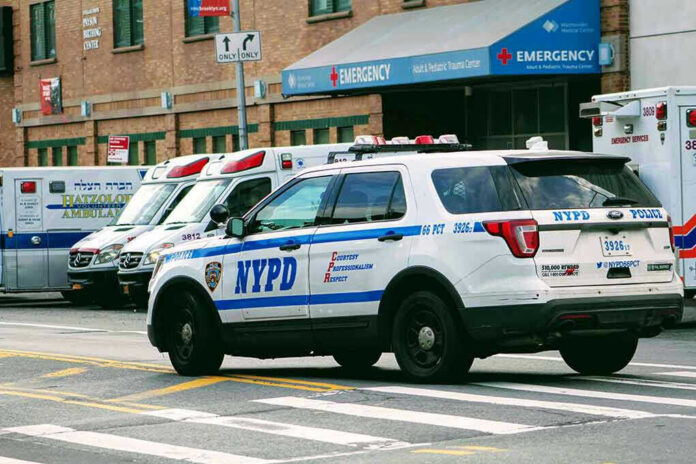
Shortly after 2:25 a.m., on the westbound lanes of the BQE approaching Exit 28 near the Brooklyn Bridge, 37-year-old Chasna Thelemaque was in the rear passenger area of a moving Toyota SUV when the rear door opened and she entered the right lane, according to police accounts conveyed through multiple outlets. Emergency responders found her with severe trauma and pronounced her dead at the scene. Officers reported that the SUV transporting her and the other vehicle, a Hyundai, did not make contact with one another before the fatal strike; the roadway entry preceded the impact and both drivers remained on scene. The basic chronology and location are consistently reported across independent outlets, including the time window and the stretch of highway involved.
Police identified the striking driver as 29-year-old Destiny Mendez and took her into custody on suspicion of operating while intoxicated; charges reported include vehicular manslaughter, vehicular assault, and DWI offenses. While those are allegations that will be tested in court, they establish the impaired-driving dimension of the case that prosecutors often regard as central in charging decisions for highway deaths tied to alcohol or drug use.
Key Factual Elements The Investigation Has Established
Three components of the record are settled by early reporting. First, the place and time: westbound BQE, near Exit 28 by the Brooklyn Bridge, around 2:25–2:30 a.m. Second, sequence: the rear passenger came into the travel lane from the SUV, then was struck in the right lane by the Hyundai, with no direct collision between the two vehicles involved beforehand. Third, consequence: catastrophic injuries consistent with highway-speed impact and on-scene pronouncement by EMS. Each element is reflected in consistent police-attributed accounts carried by regional outlets and television affiliates, which match on the roadway segment and the narrow time window.
Two details remain undefined in those initial accounts. The first is the precise mechanism of how the door opened and how the passenger entered the lane—whether an intentional exit, a loss of balance as the door opened, or some other interaction inside the vehicle. The second is the exact identity of the transporting vehicle as a commercial service; some reports label it an Uber and others a taxi, and early dispatches use different Toyota model names. Those distinctions may be clarified by formal NYPD collision and arrest reports, which typically document VINs, plate numbers, and service affiliations, but they do not change the established sequencing on the roadway.
How Prosecutors Think About Causation In An Impaired-Driving Death
Cases like this are not unusual in one respect: New York courts evaluate causation as a chain rather than an isolated moment. The standard is whether the defendant’s impaired operation was a sufficiently direct cause of the death—not the only cause. In vehicular manslaughter prosecutions brought under Penal Law § 125.12 and Vehicle and Traffic Law § 1192, appellate decisions explain that once intoxication and operation are proved, a causal link between impaired driving and the fatality can be established even where other acts contribute to the outcome, so long as intoxication was not a mere backdrop but part of the operative risk that materialized.
That principle sits alongside a separate requirement: intoxication must relate to dangerous operation, not just exist in the abstract. In prior New York cases involving ejections or roadway entries, courts have scrutinized whether the manner of driving—speed, lane discipline, reaction, vehicle positioning—combined with impairment to set the fatal results in motion. The upshot is practical: where a sober driver might have avoided an impact through earlier hazard recognition or controlled evasive action, evidence of impairment can anchor liability; where physics leaves no avoidance window, causation is harder to prove. Those are reconstruction questions resolved with scene measurements, lighting conditions, stopping distances, and reaction-time analysis, work the NYPD Highway Investigation Squad routinely performs.
The Collision Mechanics On A Limited-Access Expressway
On a limited-access highway, a pedestrian or prone person in a live lane is among the most dangerous scenarios a driver can face. At typical BQE night-time speeds, the available sight distance and headlight illumination cone translate to a narrow detection-to-impact interval—often a couple of seconds or less depending on curvature, grade, and lane position. If the person enters the lane from a vehicle abreast of the right lane, the hazard can emerge from the near-field to the passenger-side headlight quickly, leaving minimal lateral escape room given the barrier to the right and other traffic to the left. Those dynamics explain why roadway entries, whether from disabled vehicles or opened doors, so often end in catastrophic outcomes.
Investigators will analyze three physical questions. First, where along the right lane the victim came to rest, which can often be inferred from biological material, debris fields, and first-contact scuff marks. Second, the striking vehicle’s path and speed, reconstructed from event data recorders when available, skid or ABS imprint, and post-impact resting positions. Third, lighting and conspicuity—whether the driver had a realistic opportunity to perceive and avoid, given luminance and contrast at that hour. Those answers, not speculation about intent, typically determine how prosecutors and juries evaluate both causation and the role of impairment.
Why The Labels Matter Less Than The Behaviors
Early headlines in similar incidents often fixate on whether the transporting vehicle was a rideshare or a taxi, and whether a passenger “exited” or “fell.” Those labels can imply agency or fault, but in court they are less dispositive than the sequence and the drivers’ conduct. If the transporting driver was operating lawfully in lane and the door event precipitated a pedestrian hazard, the striking driver’s impairment and response become central; if, by contrast, the transporting driver created an unreasonable hazard—say, by stopping partially in a live lane—that could shift how fault is apportioned in civil litigation without altering the criminal evaluation for the striking driver. Here, initial reporting emphasizes that the two vehicles did not collide, reinforcing the frame that the roadway entry preceded the Hyundai’s impact.
New York’s statutory architecture reflects that distinction. Vehicular manslaughter in the second degree hinges on operation in violation of VTL § 1192—per se BAC, common-law intoxication, or certain drug impairment—and a resulting death. Courts have articulated what “impairment” means in practice and how jurors may infer the causal role of intoxication from driving behavior and the physics of the event; jury instructions capture those definitions and the linkage the People must prove.
What To Watch As The Case Moves Forward
The evidence that will matter most is routine but decisive: the Highway Investigation Squad’s scene diagram and measurements; any event data from the Hyundai; toxicology results and processing times; and body-worn camera or roadway-camera footage that clarifies detection distance and maneuvering room. Those materials will answer whether impairment plausibly affected hazard recognition, lane-keeping, or braking; they will also resolve the precise vehicle identities on scene. For the public, the core takeaway is less about rideshare labels and more about preventable risk: intoxication and high-speed environments do not forgive errors—whether a door opens or a driver fails to perceive what appears ahead.
Sources:
1stheadlines.com, bronx.news12.com, hudsonvalley.news12.com, ground.news, nycourts.gov, law.justia.com