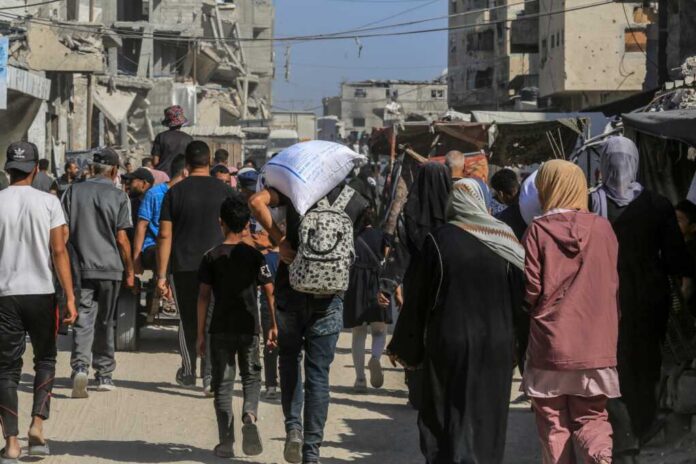
Conflicting reports over deadly violence at Gaza aid sites are fueling fresh scrutiny of who is pulling the trigger—and whether U.S.-backed operations are protecting civilians or putting them in the crosshairs.
Story Snapshot
- Human Rights Watch and United Nations officials cite witness and medical reports of killings near Gaza aid distribution sites [1][6][14].
- Israeli Defense Forces and the Gaza Humanitarian Foundation deny unlawful shootings at at least one site, challenging the allegations [2].
- Doctors Without Borders describes mass-casualty influxes tied to violence around U.S.- and Israeli-backed aid hubs [5].
- Attribution remains contested, underscoring the need for transparent, verifiable evidence before policy or legal judgments [13].
Documented Allegations From Witnesses and Aid Groups
Human Rights Watch reported it interviewed multiple people who said Israeli forces repeatedly fired on civilians near or at aid access points in Gaza, describing lethal incidents that left adults and children dead or wounded [1]. United Nations statements added that hundreds of Palestinians have reportedly been killed in recent weeks while attempting to reach food, reflecting a surge of violence around distribution corridors [6]. A subsequent United Nations update put the number at 875 confirmed deaths tied to attempts to source food, showing the scale of civilian peril [14].
Doctors Without Borders stated that hospitals in Gaza repeatedly received mass-casualty influxes following violence at aid sites linked to a U.S.- and Israeli-backed network, arguing that the model of militarized distribution increased risk rather than reduced it [5]. This pattern—initial witness and medical reporting, followed by official pushback—tracks with how civilian-harm cases often emerge in modern conflict zones before independent verification can occur [13]. The dispute hinges on where force was used, by whom, and whether actions met legal standards for distinction and proportionality.
Official Denials and Disputed Responsibility
The Israel Defense Forces and Gaza Humanitarian Foundation publicly rejected claims that troops shot civilians at one specifically reported site, with initial statements asserting the allegations were false and that no fatalities occurred there that day [2]. This direct denial challenges the narrative of indiscriminate fire and highlights contested incident details. Israeli officials have also emphasized security protocols intended to prevent armed theft of aid and diversion, offering a rationale for deployments near distribution points even as external observers question the resulting risks [9].
Broadcast and online reports have amplified both sides, with some coverage alleging deliberate shootings near hubs and others citing official imagery or investigations that dispute those accounts [10][15]. This information tug-of-war leaves policymakers and the public sorting through serious claims without a single, universally accepted record. For Americans who expect accountability from all U.S.-backed partners, the core demand remains consistent: release evidence, verify chain of command decisions, and ensure any security measures do not convert food lines into danger zones.
Why This Matters for U.S. Policy and Conservative Priorities
United States support for aid logistics and regional security places our country’s credibility on the line when allegations of civilian harm surface, particularly if U.S.-linked entities are involved in planning or oversight [10]. Conservative principles demand clear rules of engagement, transparent reporting, and consequences if standards are violated—without ceding moral ground to politicized narratives. Concrete data, including time-stamped video, radio logs, and ballistic forensics, should be disclosed to confirm or refute specific shootings before legal labels are affixed [13].
Who is living in a fantasy world now?
This is well documented.
IDF officers and soldiers told the Israeli newspaper Haaretz that they were ordered to fire at unarmed crowds near food distribution sites in Gaza, even when no threat was present.— Stefann Hopkins (@StefannMargot) May 30, 2026
Americans deserve policy that protects innocent life while defeating terrorism and preventing aid diversion. That starts with restoring disciplined oversight and rejecting opaque, globalist-style arrangements that blur lines of responsibility. The path forward is straightforward: independent forensic review of each contested incident; public release of corroborating evidence; and a hard requirement that any U.S.-supported aid operation be structured to keep civilians off the line of fire. Accountability is not an attack on allies—it is how serious nations uphold their values.
Sources:
[1] YouTube – The IDF’s Unspeakable Brutality
[2] Web – Gaza: Israeli Killings of Palestinians Seeking Food Are War Crimes
[5] YouTube – Stampede at aid distribution centre in Gaza leaves 20 dead
[6] Web – US-backed aid distribution points in Gaza are sites of orchestrated …
[9] Web – Human rights in Israel and the Occupied Palestinian Territory
[10] Web – Violence around aid distribution in Gaza surges as Israel’s … – …
[13] Web – War crimes in the Gaza war – Wikipedia
[14] Web – OPT: Attacks around aid distribution site in Gaza | OHCHR
[15] Web – Gaza: 875 people confirmed dead trying to source food in recent …