

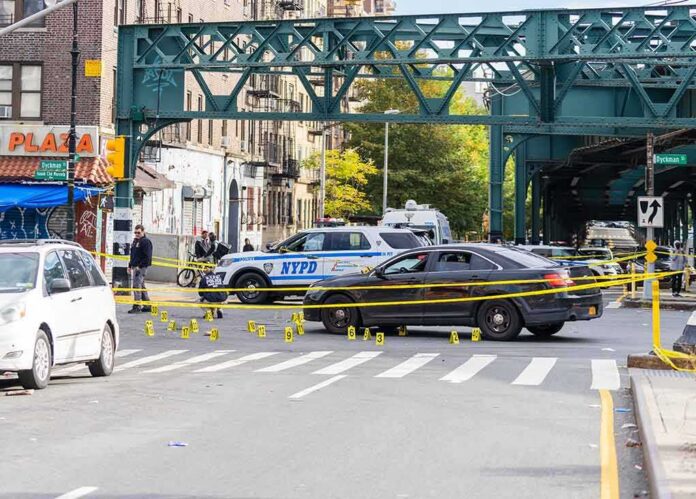
When federal immigration detainers meet New York City’s sanctuary framework, the deciding question is not sentiment but authority: what power, if any, did the city have to keep someone in custody or to alert ICE once the local criminal basis for detention ended—and what follows for public safety when it does not.
At a Glance
- DHS and ICE say NYPD released Alpha Bah after an October 7 arrest despite an ICE detainer; he was later apprehended by federal officers.
- New York City law generally bars holding or notifying on civil immigration matters absent a judicial warrant and certain prior convictions.
- ICE detainers are requests, not judicial warrants; New York courts and the Attorney General have underscored that distinction.
- DHS cites a broader pattern—over 16,000 detainers declined in New York—while city officials argue sanctuary rules protect due process and community cooperation.
What happened in the Bah case, and why it matters
Homeland Security and ICE publicly alleged that Alpha Bah, a Guinean national, was arrested in New York on October 7 on charges including aggravated assault on a police officer with a deadly weapon, resisting arrest, obstructing governmental administration, and fare evasion. ICE says it lodged a detainer with Queens Central Booking that same day; NYPD released Bah without honoring the detainer or notifying ICE. According to subsequent reporting attributed to DHS officials, federal officers later located and arrested him in New York City. These are specific, on-the-record agency claims, not generalized talking points, and they anchor the case narrative. The charges themselves remain allegations until adjudicated, but the custody sequence—arrest, detainer, local release, federal re-apprehension—is the crux of the policy dispute.
Why it matters is twofold. First, it is a clean test of how the city’s sanctuary rules operate at the point of release, when federal and local authority intersect. Second, DHS is using the case to argue pattern, not anomaly, pointing to thousands of detainers New York has declined to honor. Even if one takes care not to treat accusation as proof of dangerousness, the underlying institutional clash—what New York may or must do when a detainer arrives—drives public-safety consequences far beyond a single booking.
How detainers, warrants, and New York’s sanctuary laws actually work
An ICE detainer is a civil request asking a local jail to either continue custody for up to 48 hours beyond the time the person would otherwise be released or to notify ICE of the impending release. It is not, standing alone, a judicial warrant. That distinction is decisive in New York. The state’s Attorney General has instructed law enforcement that detainers do not create a legal obligation to hold someone; without a judicial warrant, extending custody for immigration purposes can exceed local authority. New York case law, including a 2018 appellate ruling, aligns with that position. In parallel, New York City ordinances adopted since 2014 restrict both honoring detainers and providing release notifications unless two conditions are met: a judicial warrant and specified qualifying convictions within a recent time window.
Within this framework, the city’s baseline is noncooperation on civil immigration enforcement. There are exceptions—precisely the circumstances sanctuary critics say should apply more often—but they are intentionally narrow. The Comptroller’s recent letter summarizes current policy: agencies generally may not use city resources for civil immigration enforcement, may not admit ICE to nonpublic facilities without a judicial warrant, and may not share certain identifying information. Where the statutory exception is satisfied, cooperation is permitted—but that is the exception, not the rule.
DHS’s broader pattern claim—and what it does and does not prove
DHS has publicized data asserting that New York authorities have refused to honor more than 16,000 ICE detainers—a figure used to argue that Bah’s release fits a larger institutional posture. The public release, however, does not include the underlying methodology: how “refused” is defined, the deduplication approach, offense categories, or whether the count represents detainer requests or unique individuals. As a directional indicator, it signals scale. As a dispositive measure of public-safety impact, it is an opening claim that requires the underlying dataset to be audited case-by-case to determine legal authority at release and whether the city could have cooperated under its own law.
That distinction matters. The policy stakes are not about whether ICE asked; they turn on whether local officials legally could hold or notify, and if not, whether state or city law should change. Conflating “declined detainer” with “unlawful release” erases the central legal constraint New York decision-makers operate under. Conversely, pointing to legal constraints does not resolve whether those constraints are wise from a public-safety standpoint—only that they are binding unless lawmakers revise them.
The public-safety argument on both sides
DHS frames sanctuary rules as a risk multiplier: individuals charged with serious crimes may be released to the street rather than transferred to federal custody pending immigration proceedings. In the Bah matter, the department emphasizes the assault-on-officer charge and the missed transfer opportunity. That resonates with a common-sense fear: if someone is dangerous, why not coordinate custody at the jail door? The practical answer under New York law is that the jail door is governed by criminal, not civil, authority unless a judicial warrant and qualifying conviction are present; within that lane, ICE must then find and arrest the person on the street, which introduces operational risk and community friction.
City officials defend sanctuary constraints as public-safety tools of a different kind: they argue that separating criminal processing from civil immigration enforcement preserves trust, making immigrant residents more willing to report crimes, serve as witnesses, and seek help. They also ground their stance in due-process values—avoiding unlawful detention for civil purposes. The Attorney General’s guidance and the city’s ordinance architecture reflect those priorities: limit civil immigration cooperation to tightly defined cases, maintain access to services and courts, and prevent commandeering of local resources for federal aims. Empirical work on crime impacts of sanctuary policies is mixed across contexts, but research has found no broad crime increase attributable to sanctuary rules; that macro picture cannot answer any one case, but it challenges the claim that sanctuary status, as such, drives crime waves.
What the Bah file can actually resolve—and what would settle it
Three records would turn rhetoric into audit: the October 7 ICE detainer form, Queens Central Booking’s custody and release log, and any judicial warrant presented. If the local criminal authority to hold Bah had expired, no judicial warrant was presented, and the statutory conviction criteria were not met, then New York law likely foreclosed extended custody or notice; the release would reflect adherence to local rules, not discretionary leniency. If, on the other hand, a qualifying judicial warrant existed or the city otherwise had lawful authority to transfer custody and simply declined, the sanctuary critique would land more squarely. At present, the public case rests primarily on DHS and ICE statements about the detainer and on city-side descriptions of the legal framework rather than on the case file itself.
One further point warrants emphasis. Even when local noncooperation is legally compelled, the operational result is the same: ICE must re-apprehend the person. In Bah’s situation, federal officers did exactly that. The interval between jail release and federal arrest is where public-safety risk concentrates; whether that interval produced additional harm is an empirical question answerable by incident and court records, not by extrapolation from the initial charge.
Implications going forward: aligning authority with policy aims
If policymakers want jail-door transfers in serious-charge scenarios, the cleanest path is legal, not rhetorical: pair federal judicial warrants with narrowly tailored local cooperation statutes keyed to adjudicated violent offenses and due-process guardrails. New York has already defined such exceptions; the practical bottleneck is often the absence of a judicial warrant at the moment of release. Improving judicial-warrant throughput for priority cases would reduce street arrests, shorten the risk window, and keep city workers within their lawful remit. Conversely, if city leaders judge that the present framework best balances trust and rights, they should invest in the downstream reality it creates—more field arrests—and in joint deconfliction protocols that minimize risk to bystanders and officers during those operations.
Sources:
thegatewaypundit.com, dhs.gov, ice.gov, csmonitor.com, nycbar.org, governor.ny.gov, ag.ny.gov, thehill.com, nycourts.gov