The essential fact is not in dispute: a lone gunman drove into Kraków’s Main Market Square and opened fire on bystanders, killing six people and injuring roughly fifteen more; what demands careful treatment is everything that follows—how the attack unfolded minute by minute, how early numbers settled, and how officials are approaching motive, including indications of ultranationalist views.
At a Glance
- Authorities say a Polish gunman drove into Kraków’s Main Market Square around mid‑afternoon and fired at random, killing six and injuring about fifteen.
- Police shot the suspect and took him into custody; officials later linked him to ultranationalist or far‑right beliefs.
- Early casualty counts varied, a common pattern in mass‑casualty incidents before figures are reconciled across agencies.
- Mass shootings are rare in Poland; investigators separated three questions early: what happened, who was harmed and how, and why the attacker acted.
What happened in Kraków’s Main Market Square
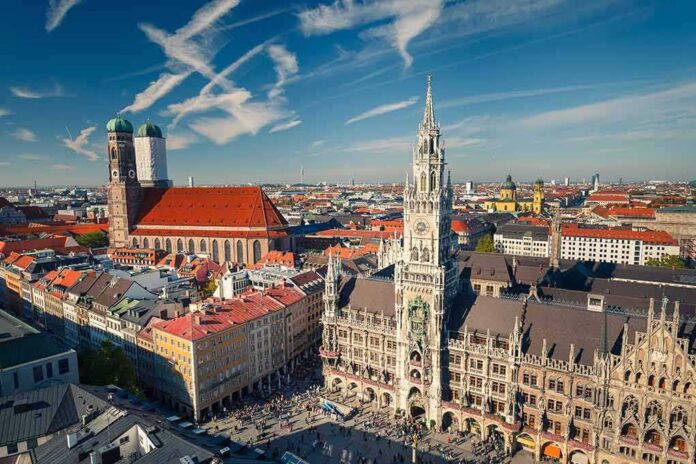
Shortly after 3 p.m. local time, a man drove into Kraków’s historic Main Market Square—a dense pedestrian zone that anchors the city’s Old Town—and began shooting at people from his vehicle. Police and regional authorities reported six dead and approximately fifteen injured; at least some of the injured were police officers who engaged the attacker. Officers shot the suspect and took him into custody near the scene. This sequence—vehicle entry, random fire, police gunfight, suspect shot and detained—comes directly from contemporaneous statements by Kraków police and regional officials carried by major outlets, whose accounts align on the core facts despite routine variations in early numbers and descriptors of injuries.
Within hours, multiple outlets cited officials describing the attacker as a Polish citizen wearing military‑style clothing and using a long gun, with additional weapons and ammunition recovered from his vehicle. Authorities emphasized that he acted alone; police said they were not seeking other suspects. As the evening progressed, casualty reporting converged upward from initial “about a dozen” injuries and five deaths to six fatalities and fifteen wounded, with police identifying the deceased as both women and men—an adjustment that reflects the standard, unfortunate arithmetic of reconciling hospital, police, and emergency‑services tallies amid trauma care.
Why early numbers move—and why that does not change the core event
In the first hours after any mass‑casualty event, the most visible uncertainties concern counts: how many dead, how many wounded, whether one attacker or more. Those figures are fluid because they are assembled from different systems with different clocks—paramedics triage and transport, hospitals admit and reclassify, police canvass witnesses and process the scene. Coverage of mass shootings routinely reflects this drift before settling; it does not create doubt about whether the attack occurred, but it does counsel caution when treating the earliest counts as final.
Officials in Kraków and Warsaw adopted the right investigative sequencing: establish what happened, secure the scene and the city, and only then address attribution and motive. That order matters. Causal reconstruction—who inflicted which wound, which rounds were fired from where, and the ballistic match to a given weapon—requires forensic work that cannot be rushed. The same goes for motive: investigators weigh digital traces, writings, purchase histories, and personal networks before drawing conclusions robust enough to withstand scrutiny.
What investigators have indicated about motive so far
From the outset, police and senior officials treated the case as a grave public‑safety and criminal matter; as briefings accumulated, references to the suspect’s far‑right or ultranationalist beliefs entered public reporting. NBC News, citing officials, described the attacker as having “ultranationalistic” views; Poland’s defense minister publicly characterized the shooting as a terror attack in initial statements, pointing to ideology as a potential driver pending full investigation. That attribution carries real implications under Polish law—terror classification affects prosecutorial posture, investigative tools, and victim support—so it is unsurprising that authorities moved carefully and signaled basis for the label rather than declaring a fully resolved narrative on day one.
The distinction is not semantic. “Why” claims have to be built on recoverable facts—communications, affiliations, items seized from vehicles or residences—rather than retrofitted to match a pattern. Reporting that three additional bodies were later discovered at the suspect’s home raised the stakes of that evidentiary trail and broadened the crime scene footprint, a development authorities themselves disclosed to the press as they expanded the inquiry.
Poland’s security context: rarity, response, and public trust
Poland is an outlier in Europe for the infrequency of mass shootings, a function of strict firearms regulation, relatively low community prevalence of guns, and historically strong social cohesion around public squares and communal spaces. That rarity cuts both ways: the shock is deeper when such an attack pierces the civic heart of a city, and the response—from patrol officers to ministers—becomes a referendum on institutional readiness. In Kraków, two elements stand out. First, front‑line officers closed with the suspect quickly and decisively, limiting dwell time in a crowded venue. Second, national leaders communicated in disciplined increments: confirm deaths and injuries; confirm the suspect’s status; and only then address motive and legal characterization as evidence matured.
That cadence matters for public trust. It balances the need for timely facts with the obligation to avoid overreach—particularly with ideology. When investigators publicly surface an ultranationalist through‑line, they tie it to a prosecutable theory and available evidence, not to speculation. The emerging picture in this case fits that discipline, with ideology referenced by named officials and carried by mainstream outlets, while acknowledging the investigation’s ongoing status.
Media patterns in mass‑shooting coverage—and how to read them wisely
Two recurring media dynamics often shape how readers experience the first days of coverage. First, high‑casualty events draw intensive attention that can inflate the perpetrator’s prominence relative to victims; empirical work has documented that visual and narrative emphasis can skew toward the assailant unless newsrooms consciously correct for it. Second, the question of “contagion”—whether saturation coverage increases the likelihood of subsequent attacks—remains contested in the literature; some studies find minimal short‑term effects, while others report a transient increase correlated with publicity spikes. The prudent reader should take from this not a blanket indictment of reporting but a caution about over‑interpreting early details and an appreciation for why responsible outlets temper perpetrator amplification.
Applied to Kraków, the practical guidance is straightforward. Treat the core facts as established: a single attacker, random fire in a central square, six dead, about fifteen injured, suspect shot and detained by police. Expect—and accept—numerical reconciliation over the first news cycle. When officials point to an ultranationalist motive, note the attribution and watch for the evidentiary scaffolding that follows in court filings or detailed briefings; that is where a preliminary label hardens into a legal account.
Poland: Kraków Attack Suspect Dies After Shooting That Killed 6 and Injured 15
Polish police announced today, Monday, the death of the suspect in the shooting attack that took place in Kraków's Main Market Square on Saturday, November 7, killing six people and injuring 15… https://t.co/CjhSRVdN92
— وصل للأخبار (@waslnew) November 9, 2026
What comes next
For Kraków’s victims and families, the priorities are medical care, identification, compensation, and dignified public remembrance. For investigators, the work is forensic and digital: weapon tracing, ammunition sourcing, vehicle exploitation, device extractions, and interviews across the suspect’s personal and online circles. For policymakers, there will be debate at the margins—around event‑security posture in open squares, police interdiction training, and the monitoring of extremist milieus—without confusing the exception for the rule in a country where such attacks remain rare. The measure of a competent system is not whether it prevents every aberrant act; it is whether it responds with speed, evidence, and candor. In this case, the record supports that it did.
Sources:
cbsnews.com, nbcnews.com, cbs12.com, inquirer.com, us.cnn.com, apnews.com, abc7.com, journals.sagepub.com, criminology.fsu.edu, journals.library.wustl.edu