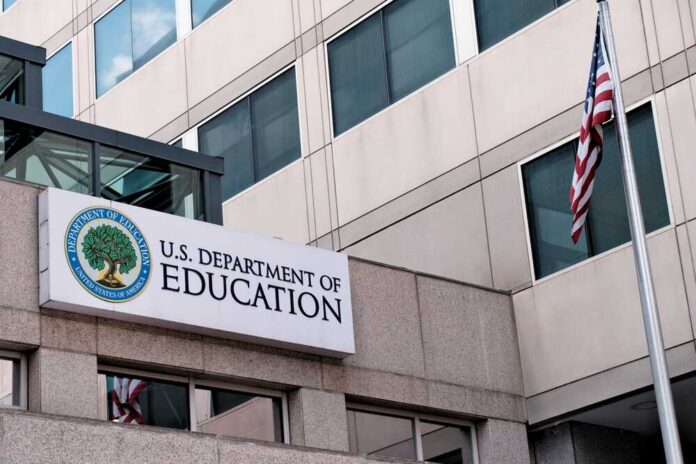
After years of chaos in Washington’s student-loan system, the Trump administration just shifted defaulted debt collections to the U.S. Treasury—raising big questions about taxpayer protection, borrower rights, and whether the federal government can manage a $1.7 trillion portfolio without breaking trust.
Quick Take
- Treasury and the Education Department created a new Federal Student Assistance Partnership that moves defaulted federal student-loan collections to Treasury operations.
- The shift targets a system described by officials as mismanaged, with fewer than 40% of borrowers in repayment and about 25% in default, according to the administration.
- The change begins with defaulted debt and may expand to non-defaulted accounts only “to the extent practicable and permitted by law.”
- The popular claim that President Obama “tried this and failed” is not supported by the provided source set, which finds no confirmed Obama-era Treasury operational takeover.
Treasury takes the wheel on defaulted student loans
The U.S. Department of the Treasury and the U.S. Department of Education announced a formal interagency partnership that immediately transfers operational responsibility for collecting defaulted federal student-loan debt to Treasury. The portfolio totals roughly $1.7 trillion and touches tens of millions of borrowers, with the initial phase focused on defaults rather than a full system-wide handoff. Officials framed the move as a management fix for a program that has grown into something resembling a major financial institution.
Education Department operations were never designed to function like a large-scale bank, and that reality has collided with modern federal lending volumes. Treasury Secretary Scott Bessent said Treasury has unique experience to impose “financial discipline,” language that signals a stronger collections posture as well as more standardized financial controls. For conservatives, the core policy tension is familiar: accountability for borrowers must coexist with guardrails that prevent bureaucratic overreach and arbitrary hardship for families.
What changes now—and what remains uncertain
The administration’s plan is phased. Treasury takes over default collections first, while future expansion to non-defaulted debt is explicitly limited by practicality and the law. That matters because “Treasury takes over millions of accounts” can be heard as an immediate, total transfer, when the actual rollout starts with defaults and then proceeds only as permitted. The agencies said they will communicate timelines to vendors, institutions, and other stakeholders as implementation advances.
That ambiguity will shape real-world outcomes. Borrowers who are already behind may see faster and more consistent collection actions, but the partnership also highlights an official intent to “return borrowers to repayment,” not simply to punish them. The research provided does not include operational specifics like new repayment terms, new dispute procedures, or changes to interest calculations. Until those details are disclosed, sweeping claims about payment shocks or blanket relief should be treated cautiously.
Why Republicans are calling it “discipline” and Democrats are calling it “cruelty”
Republicans have long argued that sprawling federal programs fail when they chase political goals without clean accounting, clear incentives, and consequences for nonpayment. The sources describe a system where fewer than 40% of borrowers are in repayment and roughly 25% are in default—numbers that strengthen the argument that the status quo is unsustainable for taxpayers. Treasury’s involvement fits a broader GOP governing theme in Trump’s second term: run federal programs with tighter financial controls.
Democrats and progressive advocates typically focus on borrower vulnerability and the risk that stronger collections can push households into deeper distress. The Economic Times coverage flags repayment and default-risk concerns for 42 million borrowers, which reflects why the issue remains politically explosive even under a GOP-controlled federal government. With Washington’s credibility already low across the political spectrum, the public will judge the change less by press-release language and more by whether errors, delays, and arbitrary enforcement actually decline.
The Obama “tried and failed” claim doesn’t match the current record
Social media has circulated the idea that President Obama attempted a Treasury takeover and it didn’t succeed. The provided research explicitly notes that no sources in this set confirm an Obama-era Treasury operational handover of Education Department student-loan responsibilities. Instead, the background cited here describes Obama-era expansions to forgiveness and income-driven repayment approaches while leaving day-to-day portfolio operations under Education’s Federal Student Aid structure. Based on these sources alone, the “Obama tried this” line is unverified.
Trump's Treasury is taking over millions of student-loan accounts. Obama tried this, and it didn't succeed. https://t.co/N83EzROsWN
— Automation Workz (@AutomationWorkz) April 12, 2026
That doesn’t mean past administrations didn’t try different restructuring ideas—it means this specific claim isn’t supported by the documentation provided. For readers who distrust the “deep state” and see endless bureaucratic reshuffles, the more grounded takeaway is that federal lending has become so large that administrations of both parties keep searching for a workable governing model. The immediate test for Trump’s team will be whether Treasury’s added muscle improves competence without sacrificing fairness and due process.
Sources:
Student loans could change fast as Trump’s Treasury takes over
Trump Administration Begins Moving Student Loan Responsibilities to Treasury Department