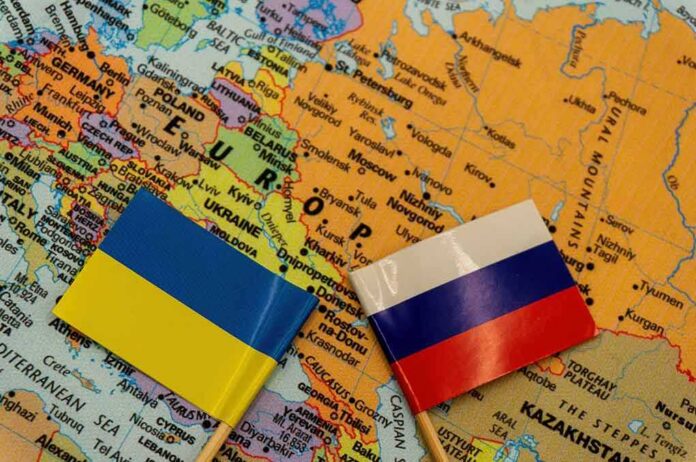
The core dispute is not a single line about Ukraine’s “different shape” but whether any territorial bargain can anchor a durable peace when sovereignty, security guarantees, and enforcement remain unsettled; territory is the visible trade, credibility is the difficult one.
At a Glance
- President Trump has said Ukraine will likely emerge from the war with “a little bit different shape,” a formulation he linked to active U.S.-mediated diplomacy rather than an idle prediction.
- Public and reported private signals point to territorial elements under consideration, yet no authoritative public map, legal mechanism, or enforcement design has been released.
- Kyiv’s position rejects concessions and insists on full restoration of internationally recognized borders; that baseline shapes any negotiation’s political limits.
- History and comparative conflict resolution show that territorial clauses succeed only when paired with credible, enforceable security arrangements; absent that, they fail on relapse risk, not cartography.
What Trump said — and what it does and does not commit
In a 60 Minutes interview, asked whether Ukraine would remain free and independent, President Trump said the war would be concluded and that Ukraine would have “a little bit different shape.” He placed the remark amid active, U.S-involved diplomacy, not as a thought experiment. On separate occasions, he suggested “land swapping” might figure in a deal while adding that Washington would try to recover some “very prime territory” Russia had taken — a tension that underscores how little is publicly defined about the pathway from lines on a map to a binding settlement. Reporting attributed to senior European officials went further, describing a push for ceding the remainder of Donbas, including areas not then occupied by Russia; that account, however, rests on unnamed sources and no released transcript.
Two things are clear in the record. First, the United States has not published any specific territorial framework or enforcement design; no official annex of districts, a demilitarized-zone schema, or sanctions–security snapback ladder has been made public. Second, the phrasing “different shape” is elastic. It might connote de facto front lines hardening into an armistice line, reciprocal swaps, temporary international administration, or formal sovereignty transfer. Without a disclosed mechanism, it cannot be read as a definitive endorsement of permanent cession — or dismissed as mere atmospherics.
Kyiv’s red lines and the political-legal landscape
Ukraine’s position is categorical: restoration of territorial integrity within its internationally recognized borders, with complete and verifiable withdrawal of Russian forces, is the foundation for any durable peace. That position has been stated repeatedly by President Volodymyr Zelenskyy and embedded in joint declarations with European partners, including references to borders as of 1991. Kyiv also frames sovereignty and territorial integrity as prerequisites for democratic statehood, not bargaining chips, and rejects any revival of great-power sphere-of-influence arrangements.
This posture reflects more than rhetoric; it is a political constraint with legal and constitutional implications. Even if a mediator designed a technically elegant swap, the settlement would have to survive Ukrainian domestic legitimacy tests and harmonize with international law’s core prohibition on altering borders by force. Scholarship in international law allows for hard cases in war termination but flags the normative and precedent costs of concessions extracted under aggression — the precise worry animating Kyiv and many of its backers.
The mechanism problem: why territory is the easy clause
Territorial provisions are common in peace treaties; what keeps them stable are the less visible parts: reciprocal restraints, monitoring, guarantor commitments, and credible penalties for breach. Comparative analyses of modern conflicts and war-termination frameworks are blunt on this point — settlements that trade tangible land for intangible assurances collapse when the enforcement architecture lacks bite or ownership by the primary belligerents. In the Ukraine context, any map-linked deal would raise immediate design questions: who mans and funds monitors, what triggers defensive aid resupply or sanctions snapback, how air and missile defenses are postured to deter renewed salami-slicing, and whether third-party guarantors accept obligations with timelines and thresholds rather than hortatory pledges.
Those details are not afterthoughts; they determine whether a settlement is a ceasefire with a timer or a peace with a lock. The public record to date does not disclose such an architecture in U.S. proposals, leaving outside observers to infer aims from fragmentary statements and unnamed-source summaries — an environment in which both critics and supporters can project preferred outcomes without having to reconcile trade-offs.
UKRAINE WILL HAVE A DIFFERENT SHAPE! TRUMP HINTS AT TERRITORIAL CHANGES IN PEACE DEAL
.@POTUS expresses confidence that a Russia-Ukraine peace agreement is within reach, but signals that any settlement could involve changes to Ukraine’s territory, raising questions about… pic.twitter.com/nGqcJ2HwC8
— EuroPost Agency (@EuroPostAgency) November 9, 2026
Where the credible disagreement actually lies
The sharpest dispute is not about whether lines might shift — wars often leave altered frontiers — but about the direction and legitimacy of change. Trump’s comments, and parallel reporting, suggest openness to territorial components; Kyiv and multiple partner statements insist on restoration to recognized borders. These are not easily harmonized. Bridging them would require one of four hard moves: redefining “restoration” to accept provisional lines under international administration; deferring sovereignty questions while embedding heavy security guarantees; engineering swaps Kyiv can defend as net-recoupment; or designing a phased settlement with contingent sanctions relief and defense integration that makes any future violation prohibitively costly. Each demands political capital domestically and among allies.
There is also a credibility gap between public signaling and reported private proposals. The reported Donbas concession claim is specific but sourced anonymously; conversely, the on-record presidential phrasing is nonspecific but politically consequential. The prudent reading is to credit the public statement as a real diplomatic signal while treating detailed territorial allegations as unverified inputs to the analytic picture — relevant, not dispositive.
Implications for any Abu Dhabi–style track
A viable track must solve five design problems at once: a map that is tolerable to the Ukrainian public; a ceasefire regime with verification muscle; a sanctions and aid architecture whose triggers Moscow believes; a pathway for Kyiv’s long-term security integration short of commitments that Moscow views as casus belli; and a sequencing plan that avoids rewarding aggression while giving each side a politically defensible “win.” If any one of these is unconvincing, relapse risk rises — and with it, the danger that territorial concessions become down payments on future demands rather than a capstone to a settled conflict.
The lesson from comparable settlements is unglamorous but reliable: clarity beats cleverness. Unless and until the United States publishes a negotiated framework with enforceable terms, “different shape” will function as a high-signal phrase in search of a mechanism — powerful enough to frame expectations, too vague to bind outcomes. Ukraine’s stated red lines and the international norm against conquest ensure that any settlement built around cartography alone will be contested from day one. The work that matters is less about lines on the map than the locks on the door.
Sources:
nytimes.com, cbsnews.com, reuters.com, president.gov.ua, rand.org