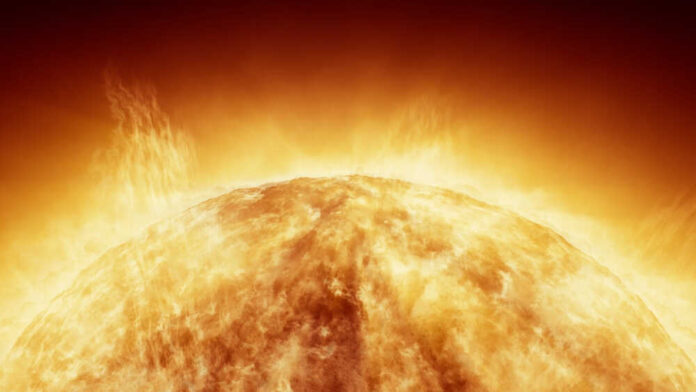
NASA’s groundbreaking maps of the sun’s spiky outer boundary promise to shield America’s power grids and satellites from devastating solar storms, vindicating bold investments in space exploration over wasteful globalist spending.
Story Highlights
- Scientists produced the first detailed maps of the Alfvén critical surface using NASA’s Parker Solar Probe data, revealing a pufferfish-like structure that expands during solar maximum.
- These maps enable precise predictions of solar storms that threaten U.S. infrastructure like power grids, GPS, and communications satellites.
- Direct measurements confirm long-held models, protecting American assets and astronauts from radiation risks without relying on unproven international schemes.
- Amid Solar Cycle 25 peak in 2025, the findings bolster self-reliant U.S. space leadership under President Trump’s pro-America agenda.
Parker Probe Delivers Historic Breakthrough
NASA launched the Parker Solar Probe in 2018 to probe the sun’s corona. The spacecraft first crossed the Alfvén surface in 2021 at 13 million kilometers from the sun’s surface. By December 2024, it achieved 16 crossings, with the closest at 6.1 million kilometers. Lead author Sam Badman at Harvard-Smithsonian Center for Astrophysics analyzed this data. Published December 11, 2025, in Astrophysical Journal Letters, the maps integrate SWEAP instrument readings on plasma density, speed, and temperature with remote observations from ESA Solar Orbiter and NASA Wind.
Alfvén Surface: Sun’s Point of No Return
The Alfvén critical surface, named after physicist Hannes Alfvén, marks where solar magnetic fields lose control over plasma, birthing the solar wind. Theorized since the 1940s, it evaded mapping due to extreme proximity. Pre-Parker estimates came from distant spacecraft at Earth’s distance. Now verified, the surface appears corrugated and spiky, resembling a pufferfish. It expands and disorders during solar maximum in the 11-year cycle, peaking around 2025 in Solar Cycle 25. This shift addresses corona heating mysteries, where the atmosphere grows hotter outward.
Protecting American Infrastructure from Solar Threats
Solar storms from this boundary disrupt satellites, power grids, and aviation, echoing the 1859 Carrington Event that fried telegraphs. New maps refine space weather forecasts, safeguarding GPS, communications, and electrical systems vital to U.S. security. Astronaut health benefits from radiation predictions, ensuring safe space operations. Economic savings mount by averting billions in blackout damages. Badman notes the shape grows larger and spikier, confirming predictions and enabling navigation of these dynamics for resilient grids.
Long-Term Wins for Science and National Strength
Short-term gains include better storm tracking during solar maximum decline toward minimum around 2030. Long-term, maps template exoplanet habitability studies, revealing how close-orbit worlds endure stellar winds. Heliophysicists praise validation of solar cycle dynamics and clues to wind origins. President Trump’s emphasis on American innovation shines here, prioritizing practical defenses over bloated foreign aid. Parker continues missions, promising fuller cycle data without government overreach.
The systems name is Francis. As to its subtropical nature. Well, ASCAT (sorry for low quality) didn't appear to show any fronts. Phase diagrams show it in a grey area of sorts but the core is certainly warm and the mid-level moisture signature is not that of Shapiro-Keyser. https://t.co/X5T1UdEvWl pic.twitter.com/XozeunYdQt
— Sausiuswx (@Sausius_wx) January 4, 2026
Sam Badman stated, “Before, we could only estimate… now we have an accurate map.” Researchers agree the jagged form challenges old smooth-sphere ideas, unlocking corona enigmas. Consensus holds on maximum-phase spikiness, with no major conflicts. Minor publication date variances exist between December 11 and 20, likely preprint differences.
Sources:
First maps of the sun’s outer boundary may help predict solar storms
First Map of the Sun’s Outer Edge Demystifies the Escape Route of Solar Wind
Astronomers Create First Map of Sun’s Outer Boundary
Scientists Map the Sun’s Magnetic Surface