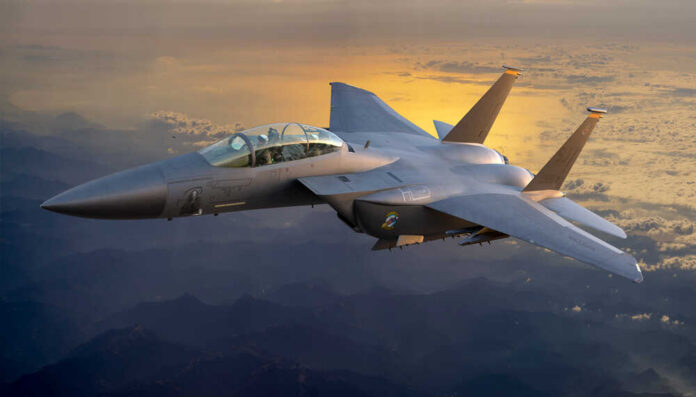
Boeing’s F-15EX Deal COLLAPSES: What Went Wrong?
Indonesia just walked away from what should have been a landmark U.S. fighter-jet deal—proof that State Department approvals mean little when politics, budgets, and “diversify suppliers” math take over.
Quick Take
- Boeing confirmed at the Singapore Airshow (Feb. 3–4, 2026) that Indonesia’s F-15EX bid is no longer an active campaign.
- The proposed purchase—built around a 2023 memorandum of understanding—never became a binding contract.
- Indonesia is moving forward with other aircraft lines, including Rafale deliveries that began in January 2026 and a planned KF-21 pathway.
- Jakarta’s choice highlights a hard reality for U.S. defense sales: approvals and press events don’t replace financing, schedules, and final signatures.
Boeing’s F-15EX push ends publicly at the Singapore Airshow
Boeing’s defense unit confirmed in early February 2026 that Indonesia will not proceed with the F-15EX Eagle II, closing out a pursuit that had lingered for roughly two years without reaching contract stage. The confirmation landed at the Singapore Airshow, where aerospace deals are often showcased—and where failed campaigns are sometimes quietly buried. Boeing’s message was blunt: the Indonesia effort is no longer being pursued as an active sale.
The backstory matters because this was positioned as a major export breakthrough. Indonesia had been expected to become the first foreign operator of the F-15EX, an aircraft marketed as a high-capacity, modernized evolution of a proven platform. The U.S. government had already cleared the path in February 2022 by approving a potential Foreign Military Sale package that could have reached as high as 36 aircraft, but momentum never translated into a signed deal.
Indonesia Abandons F-15EX, Selects M-346F to Replace Hawk
Boeing confirmed that the deal for 24 F-15EX will not proceed, with Indonesia meanwhile signing a Letter of Intent to replace the Hawk with the M-346F Block 20.
Story: https://t.co/iA34msESos
— The Aviationist (@TheAviationist) February 4, 2026
No contract, no jets: the deal stayed in “limbo” after the 2023 MOU
Indonesia and Boeing did sign a memorandum of understanding on August 21, 2023, centered on 24 jets, after talks that were pushed forward by Indonesia’s defense leadership at the time. An MOU, however, is not a procurement contract, and the reporting across defense outlets converges on the same core point: pricing, schedules, and financing never locked in. By August 2025, Indonesian defense officials were still describing the process as ongoing, with no binding agreement executed.
That gap between announcement and contract is where many international arms deals die. The U.S. Foreign Military Sales framework is structured, regulated, and heavily documented—great for oversight, slower for buyers who want flexibility. In Indonesia’s case, the aircraft also appeared to be drifting in designation and configuration discussions, with multiple potential naming conventions reported. Those details might sound minor, but they reflect a purchase that never matured into a finalized, legally committed program.
Rafale deliveries and the KF-21 partnership changed Indonesia’s calculus
Indonesia’s broader modernization path helps explain why the F-15EX couldn’t cross the finish line. Jakarta already ordered 42 Dassault Rafale multirole fighters from France, and deliveries began in January 2026 with the first three aircraft arriving. Once a new aircraft type starts arriving, the practical burden shifts to training pipelines, spare parts, weapons integration, maintenance crews, and basing—real-world costs that quickly punish “just add one more fighter type” thinking.
Indonesia is also tied into South Korea’s KF-21 Boramae program through PT Dirgantara Indonesia, with reports describing a 20% stake and expectations that Indonesia would eventually procure around 50 aircraft. At the same time, reports point to financial strain and changing quantities, including discussion around securing a smaller number of KF-21 Block 2 jets to keep pace in the production queue. That uncertainty reinforces the central theme: Indonesia is juggling multiple big-ticket aviation commitments under real budget constraints.
Leonardo’s M-346F LOI shows Indonesia prioritizing specific gaps over prestige buys
While Boeing’s campaign ended, Indonesia didn’t “stop shopping.” On February 4, 2026, Leonardo announced a Letter of Intent involving Indonesia’s Ministry of Defense and PT ESystem Solutions Indonesia for the M-346F Block 20. The stated purpose is straightforward: replace aging Hawk aircraft used in trainer and light fighter roles. Compared to high-end multirole fighters, a trainer/light fighter purchase can look less glamorous—but it directly targets readiness, pilot production, and near-term operational needs.
This is the practical side of airpower that headlines often ignore. A country can buy advanced fighters, but without a sustainable training ecosystem and affordable platforms for certain missions, readiness suffers. Indonesia’s move toward the M-346F suggests procurement officials are trying to balance capability with affordability and role fit. It also underscores why adding a fourth advanced type—on top of Rafale, KF-21 ambitions, and other needs—may have looked like an unnecessary long-term support burden.
What this signals for U.S. influence and defense sales after the Biden years
For American readers watching from the Trump era, the Indonesia decision is a reminder that influence isn’t automatic—especially after years when allies and partners watched Washington project uncertainty and bureaucratic drift. The research does not show a single definitive statement from Indonesian officials explaining the cancellation, so motives should not be overstated. Still, the documented facts show that even with U.S. approval and high-profile engagement, a buyer can pivot when competing aircraft, industrial participation, and financing realities align elsewhere.
The key takeaway for U.S. policymakers is accountability and follow-through. If America wants to compete in the Indo-Pacific, it has to offer deals that are not only technically attractive, but also executable—clear timelines, sustainable support, and terms partners can actually carry. Indonesia’s choice to prioritize a diversified fleet—despite acknowledged logistics complexity—shows how many countries now hedge between suppliers. That makes consistency, speed, and credibility as important as any airframe on the tarmac.
Sources:
Boeing abandons Indonesia F-15 bid
Indonesia Abandons F-15EX, Selects M-346F
Why the F-15EX Eagle II Fighter Won’t Fly for Indonesia (Blame the Dassault Rafale and KF-21)
Indonesia drops Boeing F-15EX deal
F-15EX Buy Dropped By Indonesia
Indonesia Cancels F-15EX Boeing