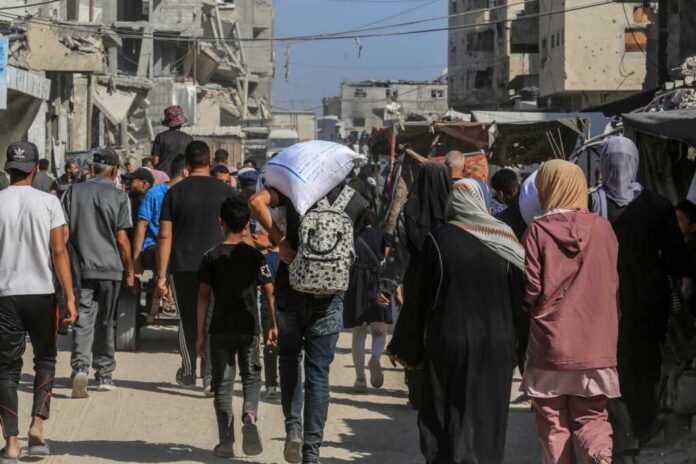
By sealing almost every road into a West Bank town in the name of “security,” the Israeli military has turned thousands of civilians’ daily lives into collateral damage that looks less like protection and more like control.
Story Snapshot
- The Israeli army has closed most entrances to at least one West Bank town, leaving residents funneled through a single, tightly controlled gate.
- Military officials say the closures and hundreds of new gates are needed to stop attacks and protect nearby Israeli settlements.
- United Nations data and human rights reports show these measures severely restrict Palestinian movement, hurt local economies, and may amount to collective punishment.
- This town’s story fits a wider pattern of nearly 1,000 new barriers across the West Bank since the Gaza war, deepening a system many critics call apartheid.
Town sealed in the name of security
Local officials report that Israeli forces recently sealed off the town of Sinjil in the central West Bank by closing its last main road link to nearby villages. Only one entrance now remains, heavily guarded by soldiers who control who comes in and out. Israel says the move is needed to protect nearby Israeli settlers, casting the closure as a defensive measure against possible attacks from militants who may hide among the local population. For residents, though, an entire town now moves through a single military choke point that can be shut at any time.
This closure is not an isolated case but part of a broader web of gates and checkpoints that has tightened since the Gaza war. A Palestinian government body says Israel has installed 916 new gates, barriers, and walls across the West Bank since the October 7, 2023 Hamas-led attack, bringing the total close to 1,000. Many of these gates sit at the entrances of towns and villages like Sinjil, cutting off side roads and forcing all traffic through narrow, militarized crossings. Israel argues these barriers help “root out militancy,” claiming fighters embed themselves among civilians and can use open roads to launch shootings and bombings.
How daily life is disrupted on the ground
Residents describe these closures as turning once open communities into “big prisons,” where even simple tasks like getting to work, school, or the doctor require passing a gate that may or may not be open. Gates often have erratic hours; locals say some stay locked for days without warning, leaving workers unable to reach jobs and children stuck at home. United Nations mapping shows hundreds of fixed obstacles and a permit system that block access to around 20 percent of the West Bank, including farmland and border areas. These rules hit ordinary families first, not armed groups, because they interrupt basic movement long before any threat is proven.
The economic impact is sharp and measurable in many towns. United Nations field work has documented dozens of shops and small businesses losing customers when traffic is diverted away from their streets by new barriers. Those closures hurt income for more than a hundred households tied to those stores, pushing already fragile communities closer to poverty. The United States State Department has also reported that “internal closures” inside the West Bank lower Palestinians’ employment prospects, wages, and days worked each month, and make it harder for their children to commute to school. When the army can close a town’s entrance with a few metal bars, the cost is paid not just in lost time, but in food, rent, and opportunity.
Security claims versus international law
Israeli military statements frame the closures and new gates as vital for security at a time of rising violence. Officials point to dozens of Israelis killed in attacks in Israel and the West Bank since October 2023 and argue that tighter control of roads and town entrances helps prevent shootings and car bombings. Analysts who back strong Israeli defenses say militants can exploit the West Bank’s high ground and road network to threaten major Israeli cities and infrastructure. In that view, gates at town entrances are a hard but necessary shield against real dangers in a long-running conflict.
International bodies and human rights groups accept the reality of security threats but question whether the current scale of closures is lawful or effective. United Nations guidelines say Israel must allow free movement for Palestinians in the occupied territory and can restrict it only for “imperative reasons of security” tied to specific threats. A United Nations fact sheet warns that large sections of the barrier and its gate-and-permit system inside the West Bank are unlawful and violate Israel’s duties under international law. A separate United Nations report has found that closing entire towns after attacks “may amount to collective punishment,” meaning whole communities are penalized for the acts of a few.
A decades-long structure of control
Researchers note that this latest town closure fits a decades-long pattern of using movement controls as a main tool of rule in the West Bank. Since the late 1960s, plans for settlements and security zones have gone hand in hand with policies that divide the land into smaller “cells” separated by checkpoints, earth mounds, and gates. During the Second Intifada, the number of barriers jumped from about 30 to as many as 600, breaking up travel between many towns. Some earth mounds were later removed, but they were often replaced by more formal checkpoints and “flying” roadblocks that can appear and vanish without warning.
📹 “This is part of Israel's escalation policy, which began with the siege and blockade of Palestinian cities and various governorates.”
Israeli forces raided the headquarters of the al-Tadamon Charitable Society in Nablus, in the occupied West Bank, and ordered its closure… pic.twitter.com/OaF2x9Gml8
— Paddystinian (@Paddystinian) July 2, 2026
Recent years have brought a new tightening of that older system. United Nations data from early 2023 counted 565 barriers in the West Bank even before the latest wave of gates. An Amnesty International report says that between 2023 and spring 2026, Israeli forces demolished hundreds of Palestinian structures and displaced thousands of people, while settlers carried out thousands of attacks on Palestinian communities. At the same time, Israel increased movement restrictions, administrative detentions, and military raids across the West Bank, often under the banner of “combating terrorism.” Critics argue this mix of closures, demolitions, and violence is slowly pushing Palestinians off key areas and locking those who remain into fragmented pockets.
Why this matters beyond the region
For Americans watching from afar, the picture raises familiar worries about power, rights, and who pays the price for “security.” Many conservatives distrust global bodies but also dislike endless wars and heavy-handed government control. Many liberals focus on human rights and fear systems that treat whole communities as suspects. In the West Bank, both instincts see red flags. A powerful military, claiming security, is reshaping daily life and land for a weaker population without clear public checks.
When nearly 1,000 barriers can be put up in a few years, and a town’s entrances can be closed almost overnight, it shows how easily authorities can control movement when there is little outside accountability. United Nations courts have already said parts of Israel’s barrier system inside the West Bank violate international law, yet the structure on the ground keeps growing. Whether one identifies more with Israeli fears of attack or Palestinian fears of displacement, the core issue is the same one many Americans feel at home: when security policy becomes a permanent way to manage people, it stops looking like protection and starts looking like a system.
Sources:
youtube.com, npr.org, palestine-studies.org, ochaopt.org, facebook.com, en.wikipedia.org, state.gov, btselem.org, britannica.com, amnesty.org, acleddata.com, un.org