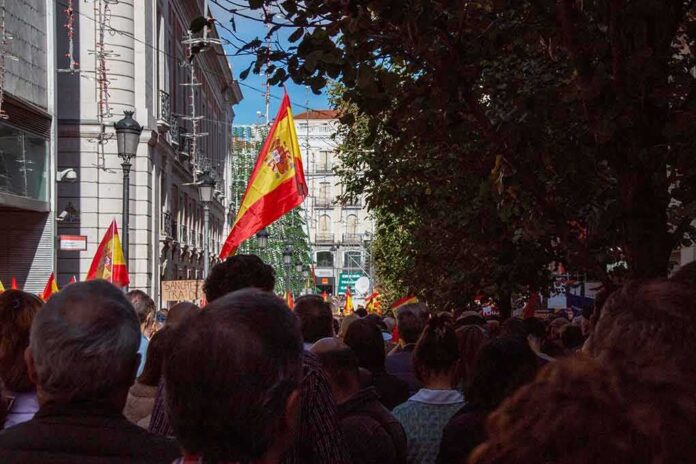
When two footballing nations collide in a World Cup final, the real contest begins days before kickoff — in the streets, plazas, and iconic landmarks of the host city, where fans transform public space into living declarations of belief.
At a Glance
- Hundreds of Spanish supporters staged a banderazo — a traditional flag-waving pep rally — outside Madison Square Garden on July 18, 2026, flooding midtown Manhattan with red ahead of the World Cup final against Argentina.
- Argentina’s fan mobilization was dramatically larger in scale: more than 15,000 supporters took over Times Square in a separate banderazo, reflecting the asymmetric but parallel nature of the two nations’ street presence.
- The dual gatherings illustrated a pattern now firmly embedded in World Cup culture — rival fanbases claiming different landmarks of the same city as symbolic territory.
- Mercado Little Spain and Hudson Yards served as additional gathering points, underscoring how Spain’s diaspora and traveling supporters spread across all five boroughs in the days before the final at MetLife Stadium.
The Banderazo: What It Is and Why It Matters
The word banderazo — from bandera, Spanish for flag — describes a pre-match rally built around collective display: flags unfurled en masse, drums pounding, scarves raised, chants rehearsed until they become muscle memory. It is less a spontaneous outpouring than a choreographed act of communal will, designed to generate energy that supporters believe travels, somehow, from street to pitch. Argentina’s football culture institutionalized the banderazo decades ago; Spain’s supporters have adopted the format with growing sophistication as La Roja’s international stature has risen since their 2010 World Cup triumph.
For a final of this magnitude — Spain versus Argentina, the two most decorated footballing nations of the modern era meeting for global supremacy — the banderazo ceased to be a footnote and became an event in its own right. Both sets of supporters understood that New York City, with its global media footprint, would amplify whatever they put into its streets. They delivered accordingly.
Spain’s Gathering: Red at the Garden
Several hundred Spanish supporters — estimates from multiple sources converge around 500 to 600 — assembled outside Madison Square Garden on the afternoon of July 18, 2026, the day before the final. The choice of location was deliberate: MSG sits at the intersection of Seventh Avenue and 32nd Street, one of midtown Manhattan’s most recognizable addresses, guaranteed to place Spanish colors in front of thousands of passing New Yorkers and international tourists regardless of whether anyone sought them out. Flags, scarves, and the red jerseys of Lamine Yamal — the tournament’s breakout star — turned the block into what Spanish media described as a marea roja, a red tide.
The atmosphere was festive and organized. Peñas — the formal supporter clubs that travel with Spain’s national team — provided the logistical backbone, bringing drums and trumpets that have accompanied La Roja since the tournament’s opening matches. CBS News New York confirmed the gathering independently, describing it as a full pep rally with chants and collective displays of confidence ahead of what supporters hoped would be Spain’s second World Cup star. Earlier in the tournament, over 800 compatriots had gathered at Mercado Little Spain — José Andrés’s sprawling food hall in Hudson Yards — to watch Mikel Merino’s goal seal the quarter-final berth, establishing that market as the unofficial emotional headquarters of Spain’s New York support base.
Argentina’s Counter-Presence: Times Square Overwhelmed
If Spain’s banderazo was impressive in its organization, Argentina’s was staggering in its scale. More than 15,000 Argentine supporters flooded Times Square on the same afternoon, transforming the most photographed intersection in the world into a heaving sea of sky blue and white. The Argentine banderazo has become one of international football’s most reliable spectacles — their supporters organized similar mass rallies before each match of the tournament, building in size and intensity with every round. By the time the final arrived, the infrastructure of Argentine fan mobilization in New York was fully operational: drums, flags the size of building facades, Messi jerseys layered three-deep in every direction, and chants that reportedly forced Times Square’s traffic management to close surrounding blocks for safety.
The asymmetry between the two gatherings — hundreds versus tens of thousands — reflects a structural reality that has nothing to do with passion and everything to do with demographics. Argentina’s diaspora in the New York metropolitan area is enormous, and the prospect of Lionel Messi’s final World Cup match drew supporters from across the Eastern Seaboard and beyond. Rain did not deter them; multiple reports noted the Albiceleste faithful remained through wet conditions, a detail that became something of a badge of honor in Argentine football circles. Australian broadcaster ABC described Argentina’s supporters as “one of the most vibrant and enthusiastic groups among all the fans” at the tournament, while acknowledging that Spanish supporters had engaged in their own parallel festivities across the city.
Two Cities Within One City
What made the pre-final weekend in New York genuinely remarkable was not either gathering in isolation but the simultaneous coexistence of both — rival nations’ supporters occupying different landmark districts of the same metropolis, each creating a version of their home country’s atmosphere within walking distance of the other. Spain anchored midtown around MSG and the Mercado; Argentina claimed Times Square and its surrounding blocks. The Miami Herald reported that tens of thousands of fans in both nations’ shirts descended on Manhattan over the weekend, with gatherings planned at Times Square, Central Park, Hudson Yards, Rockefeller Center, and fan festivals throughout the five boroughs.
This kind of geographic partition — organic, unplanned, yet somehow coherent — is a recurring feature of World Cup finals held in major international cities. Supporters self-sort by cultural gravity, clustering around spaces that feel symbolically legible to them. For Argentine fans, Times Square’s maximalist spectacle maps onto Buenos Aires’s own theatrical public culture. For Spanish supporters, the more contained, community-organized gathering outside a famous arena carried its own logic: intimate, purposeful, driven by the peñas that form the organizational spine of Spanish football fandom abroad.
The Broader Stakes: A Final That Paralyzed Two Nations
The 2026 World Cup final between Spain and Argentina was always going to generate scenes like these. Spain, seeking a second world title after their 2010 triumph in South Africa, arrived in New Jersey having dismantled Belgium 2-1 in the quarter-finals and navigating a tournament run that confirmed Lamine Yamal’s arrival as one of the game’s defining talents. Argentina entered as defending champions, with Messi — widely understood to be playing his last World Cup — providing an emotional gravity that no other player in the sport could match. Average resale ticket prices for the final exceeded $11,000 on platforms like SeatGeek as of July 17, a figure that captures how acutely the market registered the match’s historic weight.
For the fans in the streets of New York, the economics of ticket prices were largely irrelevant — the banderazo was its own form of participation, a way of being present for history even from the sidewalk. That impulse, the need to gather and declare allegiance in shared physical space, is one of football’s most durable features. No streaming service or social media feed replicates what happens when five hundred people in red or fifteen thousand in blue and white occupy a city block and make it, for an afternoon, entirely theirs.
Sources:
facebook.com, abc.es, instagram.com, tudn.com, youtube.com, blog.ticketmaster.com, amp.miamiherald.com