A rapid, armed police response to three suspicious vehicles heading toward RAF Fairford ended with five arrests under terrorism powers—an incident that underscores how US-linked bomber bases present attractive targets and why layered security around them now functions as a forward line of national defense.
At a Glance
- Five men were arrested near RAF Fairford after a late-night call about three vehicles traveling toward the base; explosives and terrorism laws were invoked.
- Counter-terrorism police took charge, evacuations were ordered, and Army bomb disposal teams examined multiple vehicles.
- Authorities escalated the case from Explosives Act offenses to suspected preparation of a terrorist act under UK terrorism law.
- RAF Fairford’s strategic role supporting US Air Force bombers makes it a credible, high-value target in today’s hybrid threat environment.
What Happened, and Why Police Treated It as Terrorism
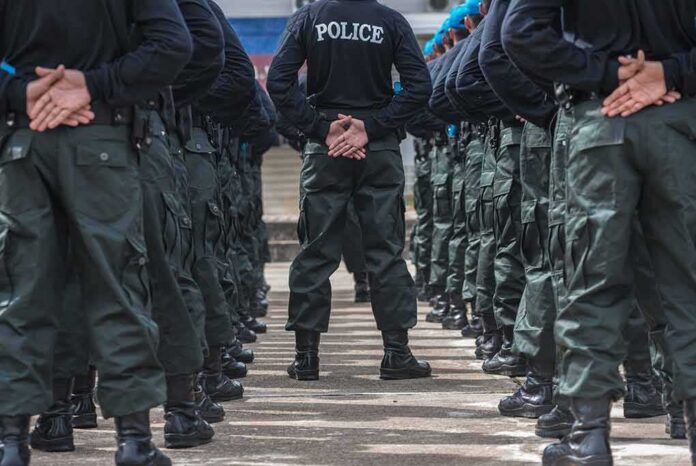
Shortly after midnight, police received a report that three suspicious vehicles appeared to be heading toward RAF Fairford in Gloucestershire. Armed officers intercepted the convoy in the Whelford area and arrested five men on suspicion of offenses under the Explosives Act. As the operation unfolded, the legal basis was elevated: the suspects were further arrested on suspicion of preparing a terrorist act under section 5 of the Terrorism Act, and UK counter-terrorism police assumed command. The local area was declared a major incident; residents in parts of Whelford were evacuated as Army explosive ordnance disposal (EOD) units examined the vehicles and surrounding ground for hazards.
This sequence—public tip, armed stop, immediate explosives suspicion, rapid handover to counter-terrorism policing, cordons and evacuations, and EOD on scene—tracks the established doctrine for responding to a potential plot near a sensitive military installation. RAF Fairford, used by the US Air Force and repeatedly highlighted in coverage for its connection to operations against Iran, magnifies the stakes: any anomaly near a runway or perimeter road is treated as a possible pre-attack action, not a traffic stop gone odd.
Why RAF Fairford Is a Magnet for Threat Actors
RAF Fairford is not a routine RAF station with episodic flying; it is a standby platform for US long-range bombers with a runway, munitions infrastructure, and security architecture configured for surge operations. In effect, it is an American power-projection node on British soil—one that can rapidly enable missions across Europe and the Middle East. That profile confers two things at once: hardened defenses and adversary interest. Reporting around the arrests consistently pointed to Fairford’s use by US forces and its alignment with operations linked to Iran, making proximity to the base a meaningful indicator of potential intent, even before investigators release granular evidence about materials or targeting.
From a threat-modelling perspective, bomber bases present multiple attack surfaces: approach roads, fuel and munitions logistics, flightline operations, and off-base housing clusters. Attack methods vary accordingly, from crude incendiary attempts to more sophisticated improvised explosive devices (IEDs) aimed at disrupting sortie generation. In recent years, European security services have also mapped a spectrum of “hybrid” or deniable actions—arson, sabotage, unmanned systems, and cutouts for state-aligned operators—broadening the menu of plausible plots an incident commander must consider within minutes of a call.
How the Response Works: From Patrol Stop to Counter-Terror Command
In the United Kingdom, any suspected explosives threat near critical national infrastructure triggers a multi-agency reflex. Local officers establish control of the scene and immediate public safety measures; EOD teams deploy for technical reconnaissance, including remote vehicles, x-ray, and render-safe procedures; and if indicators suggest intent beyond mere possession—route of travel toward a military site, observed behavior, or preliminary findings—Counter Terrorism Policing (CTP) assumes primacy. That is precisely what happened here: Gloucestershire Police executed the stop and initial arrests; CTP then led the investigation under terrorism legislation, while evacuations and cordons protected residents and preserved evidence.
Two details matter operationally. First, the escalation from Explosives Act to section 5 “preparation of a terrorist act” is not rhetorical flourish; it expands investigative powers, detention clocks, and evidential apertures for digital forensics and association mapping. Second, the decision to evacuate neighborhoods reflects both life safety and counter-IED tradecraft: if vehicles might be booby-trapped, distance and time are the EOD technician’s allies.
The Base, the Bombers, and the Geopolitics in the Background
Because RAF Fairford is a platform for US bomber deployments, any incident nearby is quickly read through the lens of wider confrontation with states that view those aircraft as central to Western coercive power. In this reporting cycle, outlets consistently referenced US operations against Iran when describing the base’s relevance—a factual linkage that clarifies why a small English village could sit on a geopolitical fault line. The logic of deterrence and contestation is simple: to degrade an adversary’s reach, strike its enablers—fuel points, runways, munitions flows, or even the political will to host them. That does not assign authorship to any actor in this case; it does explain why British and US force protection standards around bomber hubs are calibrated to assume intent until proven otherwise.
For local communities, this backdrop translates into visible security: controlled entry points, patrol density on approach roads, quick reaction forces on base, and close liaison between Ministry of Defence Police, local forces, and US security elements.
🚨 FIVE ARRESTED NEAR RAF FAIRFORD AS UK TERROR PROBE EXPANDS
WHELFORD, UNITED KINGDOM – The arrests placed two realities side by side: a military facility connected to active overseas operations and a domestic security system forced to respond to a possible threat on home soil.… pic.twitter.com/XLu6v5wXaa
— The Content Factory (@tcf_updates) September 28, 2026
What We Know Now—and What Carries Forward
The core facts are uncontested in mainstream reporting: five men were stopped and arrested near RAF Fairford after a call about three vehicles; explosives offenses formed the initial basis; terrorism preparation was then alleged; counter-terror police led the case; evacuations and EOD activity followed. Those points, reported independently by multiple outlets, establish why officials characterized the incident as a major terrorism matter rather than a routine public-order stop.
Beyond the incident, the lasting lesson is about posture. Bases that host US strategic aviation will continue to draw attention from hostile actors precisely because of their salience; that ensures that local vigilance—like the call that triggered this operation—remains a critical early-warning input alongside classified intelligence and routine patrols. The system worked as designed: a public cue, decisive tactical action, specialist exploitation, and an investigative handoff sized to the potential harm.
Sources:
humanevents.com, bbc.com, abcnews.com, standard.co.uk, reuters.com, oxfordmail.co.uk, independent.co.uk