

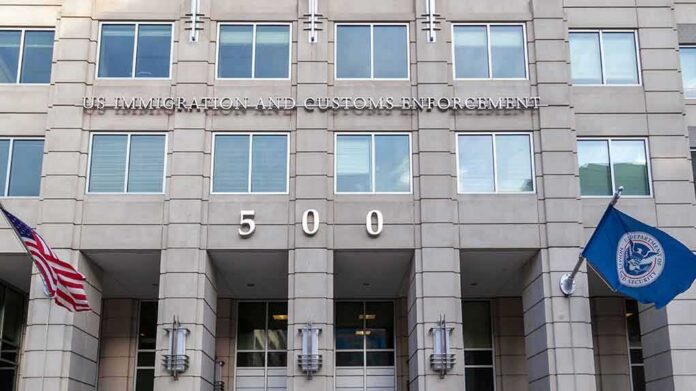
The fight over ICE in American life is not about whether laws should be enforced; it is about where enforcement power stops—what tactics a constitutional republic will permit its officers to use when the underlying offense is comparatively modest.
The Short Version
- Two questions keep getting conflated: the legitimacy of enforcing immigration law and the limits on how that enforcement may be carried out.
- Cuomo’s on-air proportionality argument—minor violations don’t justify major violence—tracks long‑standing constitutional constraints on policing.
- Recent ICE incidents involving vehicle encounters triggered state investigation and a federal pause on most traffic stops, underscoring real risk in current tactics.
- The caller’s critique—that laws must be followed—doesn’t answer the core question of method; in American law, ends and means are both regulated.
What the dispute is really about: authority versus method
Immigration enforcement often gets framed as a binary—either you support enforcing the law or you don’t. That elides the actual constitutional problem: the same Fourth Amendment that governs every police department also governs immigration officers. Reasonable suspicion is required for investigative stops; arrests demand probable cause; and force must be necessary and proportionate to a concrete threat, not merely to the existence of a violation. That is not novel doctrine but the through-line of modern search-and-seizure law as applied to immigration contexts, from roving patrol limits near the border to vehicle stop standards away from it.
This is why a television exchange can sound like ships passing in the night. A caller can say, correctly, that illegal entry is a crime and overstaying a visa violates the law; an anchor can respond, correctly, that even a valid arrest authority does not license gratuitous violence. Both propositions are true—and incomplete—without the connective tissue of constitutional method. The rule of law regulates the end (removal proceedings, criminal charges) and the means (how agents get you there).
Proportionality is the crux, not a rhetorical dodge
Cuomo’s pointed comparison—contrasting a misdemeanor-level immigration violation with the specter of physical beating—can sound theatrical. Substantively, however, it invokes a core policing principle: force is justified by imminent threat, not by the moral worth of the suspect or the abstract seriousness of the offense. Courts do not treat lesser offenses as immunities, but they do weigh the severity of the suspected crime when assessing reasonableness. In practice, that’s why traffic stops, warrant executions, and immigration arrests are all bounded by the same necessity-and-proportionality analysis, regardless of the political heat surrounding immigration policy.
Vehicle encounters have proven to be the flashpoint where theory meets physics. The risk profile is unforgiving; a poorly positioned officer, an accelerating car, and split-second perceptions of danger can turn an administrative arrest context into a lethal encounter. That hazard is not hypothetical. Maine’s Attorney General publicly confirmed an active investigation into a July 2026 fatal shooting by an ICE Enforcement and Removal Operations officer, highlighting unresolved factual disputes about whether the vehicle was moving toward the officer and whether the agent’s perception of threat justified deadly force. In parallel, after deadly shootings in Maine and Houston, the administration ordered ICE to suspend most vehicle stops—a tacit admission that the tactic, as then executed, carried unacceptable risk relative to its enforcement objectives.
The caller’s law-and-order claim and where it lands
Critics of Cuomo’s exchange argue that immigration laws must be enforced and that lawful immigrants followed the rules others chose to flout. As civics, that’s unobjectionable. It also misses the operative question. Constitutional criminal procedure is built precisely to prevent the syllogism “they broke the law, therefore anything done to catch them is lawful.” The Supreme Court’s immigration-stop jurisprudence rejects categorical carve-outs: roving patrols cannot stop vehicles based solely on apparent ancestry; away from the border, officers need articulable suspicion and are constrained in scope and duration; none of that dissolves when the badge says ICE rather than a municipal department. Ends do not swallow means in the United States; that is the system, not a loophole.
Even on the caller’s narrower point—what, exactly, is the offense—the law is variegated. Improper entry can be criminal; many overstays are civil. But the gradient of underlying violation is only one factor in any force analysis. The operative question during a stop is danger: Is someone about to be harmed? Is the vehicle weaponized in that moment? Those are the predicates that justify escalating force, not the mere fact of illegal presence. That is why continuing investigations and policy pauses around vehicle stops matter more than talk-radio jousting; they are government acknowledgments that tactics, not just targets, are at issue.
How we got here: a procedural constitution meeting polarized media
The doctrinal spine has been stable for decades. Cases addressing immigration stops have repeatedly threaded the same needle: immigration is a federal prerogative; officers have defined authorities; but the Fourth Amendment’s guardrails—individualized suspicion, reasonableness in scope, and proportional force—apply with full force off the physical border and away from its functional equivalents. The mechanism has not failed so much as our public conversation has. In a media ecosystem that rewards out-group antagonism and outrage signaling, the nuance between “may enforce” and “how to enforce” gets flattened—often willfully—into accusations of softness or cruelty rather than a debate about standards and training.
Against that backdrop, on-air clashes are destined to be clipped as “meltdowns” or “mic drops.” What matters for policy, however, are the institutional signals. A state attorney general opening a deadly-force probe into an ICE stop is not cable choreography; it is the state asserting its oversight role over any use of force within its jurisdiction. A federal directive to suspend most ICE vehicle stops after fatalities is not an ideological concession; it is a risk-management judgment that current practice does not align with mission or law.
What reforms have signal, not spin
Three levers meaningfully change outcomes in this space. First, camera accountability. Body-worn and dash cameras do not merely resolve after-action disputes; they tighten behavior in the moment, reducing the frequency of ambiguous “vehicle as weapon” scenarios because officers know poor positioning will be visible and reviewable. Second, training specificity. General firearms and arrest-control curricula are not sufficient for dynamic vehicle encounters in administrative enforcement; agencies need doctrine that prioritizes containment and de-escalation over interdiction angles that place officers in front of moving vehicles. Third, operational triage. When the underlying objective is civil arrest, leaders should ask whether a mobile surveillance and later pickup strategy achieves compliance with lower tactical risk than a roadside confrontation. The AP-sourced suspension of most ICE vehicle stops reflects this logic applied at scale.
How to read the next viral clip
When the next confrontation circulates, resist the reflex to pick a camp. Ask four questions instead: What was the precise enforcement authority at issue—criminal warrant, civil detainer, or administrative arrest? What specific facts justified the stop or entry—articulable suspicion, probable cause, or neither? Where were the officers positioned relative to the vehicle, and did their actions increase danger? Finally, what corroboration exists—video, reports, third-party witnesses? Those questions align with the law we already have and separate proportional enforcement from preventable tragedy.
Sources:
maine.gov, krgv.com, constitution.congress.gov, law.nyu.edu, supremecourt.gov, pnas.org, law.cornell.edu