

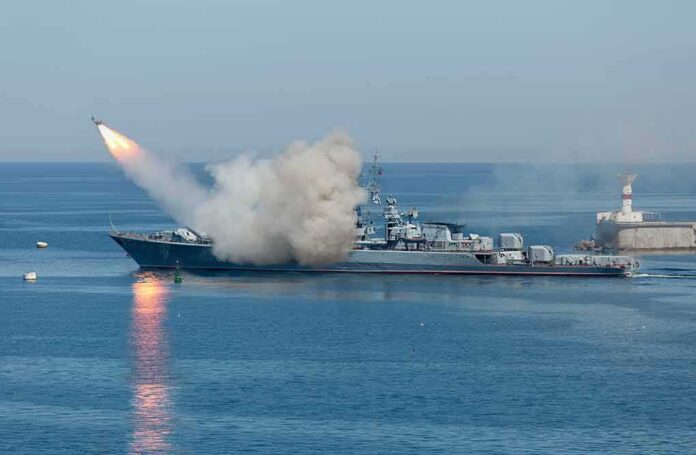
When a modern warship erupts in flame at a friendly foreign pier, the real story is not the footage; it is the problem it exposes: attribution in a drone age is hard, and the consequences of getting it wrong ripple across strategy, alliances, and maritime safety.
At a Glance
- The Benghazi blast that engulfed a Russian corvette sits at the intersection of contested attribution and expanding unmanned warfare.
- Initial Libyan emergency accounts pointed to an ammunition-depot explosion; later officials leaned toward a drone strike onboard the vessel.
- Open-source analysts identified the ship as the Russian corvette Merkury and judged it almost certainly destroyed; causation remains disputed.
- Inconclusive forensics are common in naval catastrophes; premature certainty usually ages poorly.
What we can say with confidence: a destructive shipboard fire, contested causation
The fire and explosions at Benghazi’s naval base were real, extensive, and involved a Russian warship widely identified by open-source naval analysts as the corvette Merkury; multiple satellite images and on-the-water video sequences support that the vessel burned severely, with several outlets assessing near-certain destruction even as the precise mechanism remained unresolved. Immediately after the incident, Benghazi’s civil defense framed the event as an explosion at an ammunition depot, not an attack, and said the fire was contained—an account that did not attribute responsibility or describe an external strike. Within hours, however, the eastern-based Libyan administration declared that the explosion occurred onboard a Russian vessel and characterized a drone strike as the likely cause, announcing a joint investigation with Russia to determine the source and the responsible party.
This shift—from an ammunition-depot explanation to suspected drones—anchors the dispute. Both accounts concede ammunition involvement, which is hardly surprising on a naval base; what remains unsettled is whether detonation began inside a nearby storehouse, inside the ship, or via an external munition. No public, technical investigation has been released that would close that gap with blast-direction analysis, fragment recovery, or residue signatures.
How attribution arguments were built: satellite pixels, official hints, and unnamed sources
Two kinds of evidence drove coverage. First, imagery-led analysis: OSINT practitioners compared mast forms, hull proportions, and pier geometry to identify the vessel as Merkury; fire and plume signatures suggested extensive onboard involvement. This line established what burned and roughly where, not who caused it. Second, official and semi-official statements: the eastern Libyan government’s “likely drone” framing propagated quickly through global outlets, and some reporting cited unnamed Libyan military officials alleging multiple Ukrainian uncrewed surface vessels launched from western Libya, with some intercepted and others striking the ship. The attribution case has surface plausibility given Ukraine’s documented use of sea drones and its campaign against Russian naval assets far from home waters, but the centerpiece remains anonymous sourcing rather than released forensics or a claimed operation with corroborating materials.
By contrast, the initial civil-defense account is public and on record, but it speaks to incident description under duress, not a completed causality judgment; it neither proves accident nor disproves attack. The most responsible conclusion, given what has been shared, is bifurcated: the corvette almost certainly suffered catastrophic damage; the initiating cause remains contested pending disclosed technical evidence.
Why this ambiguity persists: the mechanics and fog of unmanned strikes
Modern sea and air drones complicate first-response diagnosis. A small warhead or fuel-laden drone can ignite topside fires that propagate into ammunition spaces; secondary detonations then swamp the signal of the initiating event. Conversely, a mishandled or degraded munition can mimic the blast-fragmentation pattern of a compact warhead. Without recovered fragments, penetration mapping (inside-out versus outside-in), and chemical residue analysis, eyewitness audio of gunfire or reports of “secondary explosions” are suggestive, not dispositive. That is why seasoned investigators privilege chain-of-custody debris, not press statements, when distinguishing accident from attack.
History underscores the trap of early certainty. Naval disasters from Mare Island’s 1917 powder-magazine explosion to the 1944 Port Chicago catastrophe generated swift sabotage theories that inquiries could not substantiate; in the absence of conclusive forensics, official findings often stopped at “explosions in ammunition spaces,” not a named culprit. That is not a plea for agnosticism; it is a caution that high-confidence attribution requires more than plume videos and plausible motive.
Strategic context: why Benghazi matters beyond the pier
Libya’s east, aligned with Khalifa Haftar, has for years offered Moscow access to ports and airfields, facilitating Russian logistics to Africa. A modern Russian warship burning in Benghazi therefore raises two questions that matter to practitioners. First, sanctuary risk: allied harbors are no longer safe harbors when an adversary can push sea drones or low-observable aerial systems thousands of kilometers; the perimeter begins offshore, not at the boom gate. Second, alliance signaling: when a host government first cites an ammunition incident and then publicly suspects a drone strike, it telegraphs vulnerability and invites scrutiny of its security apparatus and political alignments.
For Russia, the operational implication is loss of escort capacity and reputational cost: if Merkury was indeed destroyed, that degrades protection for sanctioned logistics and complicates deterrence of follow-on strikes in the Mediterranean. For Ukraine—if later-confirmed involvement bears out—the demonstration effect is potent: Russian naval assets are targetable in friendly ports. For Libya’s eastern authorities, the incident is a sovereignty test: either an accident exposed munitions-safety failures or an attack pierced harbor defenses; both demand reforms.
What would settle the dispute: the evidence that actually distinguishes accident from attack
Three classes of material would move this case from contested narrative to resolved fact. First, a released joint investigative report with photographs, blast-physics reconstruction, and cataloged fragments—warhead liners, fuzing components, propulsion debris—tied to a transparent chain of custody. Second, time-synchronized sensor records: port CCTV, thermal cameras, radar tracks, air-defense logs, and pier access control, establishing approach vectors or the absence thereof. Third, comparative satellite time series before, during, and after ignition, geolocating the first luminous frame relative to shipboard compartments and any adjacent ammunition sheds. To date, public claims have outpaced such disclosures.
Working guidance for readers and policymakers: how to read incidents like this
When a high-value military target explodes in a geopolitically charged setting, expect three moves in quick succession: a local “fire or ammo” explanation grounded in what responders see, a politically salient attribution framing (often from a host authority), and an imagery-led OSINT verdict on the platform’s fate. Each answers a different question—what burned, who says why, and how bad—but none alone proves causation. Demand one strong thing for decisive judgments: technical evidence that a skeptical expert cannot easily reinterpret. Until then, a disciplined summary of Benghazi is this: a Russian corvette widely identified as Merkury almost certainly suffered catastrophic damage in port; authoritative actors in eastern Libya now suspect a drone strike; Ukraine’s responsibility remains asserted by officials and analysts but unproven in public with released forensics.
Two vessels were targeted in suspected drone attacks near Benghazi, Libya.
A Russian Navy corvette, the Merkury, capsized and largely sank after an explosion at the naval base. A Maltese-flagged commercial vessel was also struck offshore.#Libya pic.twitter.com/Tw4wiANRAt
— NEWSMEDIATV (@WorldNewsMediat) November 23, 2026
Bottom line
The unmanned era compresses distance but expands ambiguity. If Benghazi was an attack, it shows how far this maritime shadow war has traveled; if it was an accident, it shows how fragile forward-deployed munitions management can be. Either way, strategy now begins with hardening piers, clarifying host-nation roles, and insisting on investigations that trade rhetoric for recoverable metal and chemistry.
Sources:
thestate.com, latimes.com, situationroom.io, aljazeera.com, ilpoliticoweb.it, en.defence-ua.com, usni.org, washingtoninstitute.org, history.navy.mil, monitoring.bbc.co.uk