A heartwarming mission underscores U.S. military readiness in a moment of familial triumph.
Quick Take
- Twin Air Force pilots conduct a historic refueling mission over the Pacific.
- Captain Jordan Wesemann completes his final mission with the 18th Wing.
- The operation highlights U.S. strategic readiness in the Indo-Pacific region.
- No combat involved; purely a mission of coordination and skill.
Brothers in Arms: A Unique Military Milestone
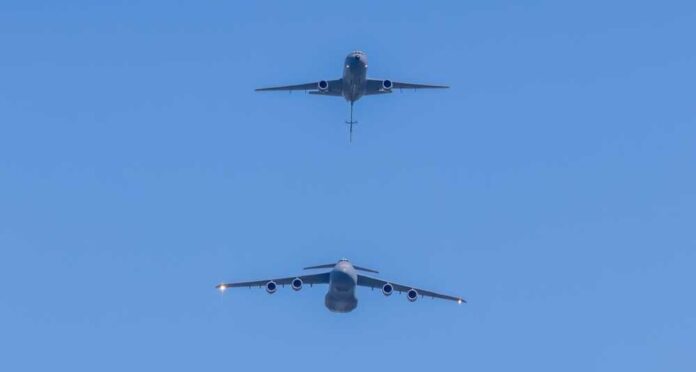
On December 4, 2025, twin brothers Capt. Jordan Wesemann and Capt. Jared Wesemann achieved a remarkable personal and professional milestone. Flying over the Pacific Ocean near Kadena Air Base, Japan, the twins—one piloting a KC-135 Stratotanker and the other an F-35A Lightning II—completed a night air-to-air refueling mission. This event marked Jordan’s final mission with the 18th Wing and was a unique moment, bringing years of parallel careers together in mid-air.
The mission was not just a personal victory but also a testament to the dedication and precision required for U.S. Air Force operations. The brothers’ flight was part of a standard training mission, emphasizing the importance of air-to-air refueling in extending the range of fighter jets like the F-35. This capability is critical for maintaining U.S. military presence and readiness in the Indo-Pacific, a region marked by strategic tensions and the need for rapid response capabilities.
Strategic Significance of the Refueling Mission
Air-to-air refueling plays a critical role in the U.S. Air Force’s operational strategy, particularly in the Indo-Pacific region. Kadena Air Base, a pivotal hub since World War II, supports these operations by hosting refueling squadrons like the 909th ARS. The Wesemann brothers’ mission highlights the seamless coordination between tanker and fighter units, a necessity for maintaining extended patrols and rapid deployment capabilities amid rising regional tensions.
The absence of combat in this mission underscores its training and coordination focus. It also serves as a metaphor for the brothers’ lifelong synergy, both in the cockpit and in their military careers. This operational harmony reflects the broader goals of U.S. military strategy—to ensure that forces can operate effectively across vast distances and in complex environments.
Implications for U.S. Military Operations
The successful completion of this mission holds both short-term and long-term implications for U.S. military operations. In the short term, it serves as a morale booster for the 18th Wing and the personnel based at Kadena. The human-interest aspect of the story also provides a recruitment tool, showcasing the U.S. Air Force’s commitment to excellence and its supportive environment for service members.
Twin Air Force pilots connect in refueling flight over the Pacific https://t.co/I2qSRsft9S
— Task & Purpose (@TaskandPurpose) January 13, 2026
In the long term, this mission reinforces the critical integration of tanker and fighter units in the Pacific theater. It highlights the ongoing modernization efforts, such as transitioning to the KC-46, ensuring the U.S. military maintains its strategic edge. The public narrative of the Wesemann brothers’ flight promotes a positive image of military service, emphasizing family values and dedication to duty, resonating with traditional principles cherished by many Americans.