As Beijing rolled out robot dogs, lasers, and long-range missiles during a headline military showcase, China signaled a race to master “intelligent warfare” that the United States cannot afford to misunderstand or ignore.
Story Highlights
- China used a major Beijing event to display robot dogs, drones, lasers, and unmanned sea systems as tools for “intelligent warfare” [2].
- State displays included multiple strategic missiles, underscoring nuclear deterrence and power projection messaging [2].
- Analysts warn some viral “robot army” clips were artificially generated, highlighting propaganda and deception risks [9].
- Experts note China’s robotics ecosystem is deepening, with significant industrial capacity and patent leadership [8].
Beijing’s Showcase Blends Robotics, Lasers, and Strategic Missiles
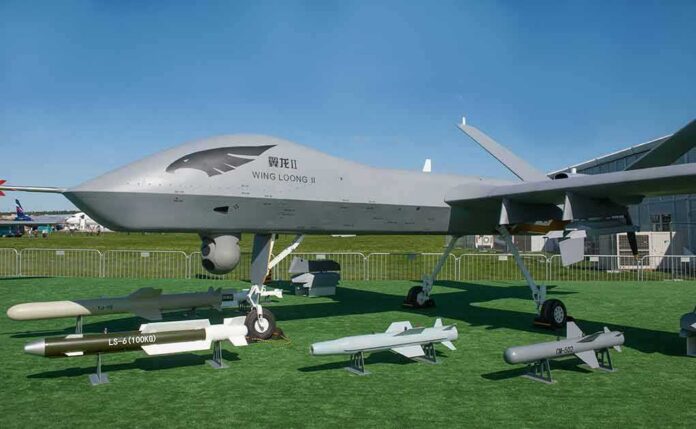
Forces News reporting describes China’s largest Beijing military parade and exhibition turning the capital into a showroom for unmanned warfare: robot dogs, underwater drones, lasers, and claims of artificial intelligence–enabled platforms featured alongside strategic missile forces [2]. Coverage emphasized how “robots and drones expand the battlefield,” a phrase that captures Beijing’s message to foreign militaries watching: China aims to compress decision time, extend reach, and reduce risk to its troops through autonomous and remote systems [2]. That mix presents both a deterrent signal and a procurement roadmap.
The same reporting detailed a rare public convergence of strategic capabilities and emerging tech, from intercontinental-range weapons to directed-energy systems positioned as counters to drones and surveillance [2]. The juxtaposition matters: pairing long-range missiles with uncrewed systems projects layered warfare ambitions, where electronic warfare, lasers, and swarming platforms screen or enable precision strikes. The optics—carefully staged and amplified by state media—aim to convince adversaries that China can mass-produce and field these tools at scale, shortening the gap between prototypes and formations [2].
Propaganda, Deepfakes, and the Fog of Modern Military Signaling
Agence France-Presse verification found a widely shared clip of armed Chinese robots marching was generated with artificial intelligence, not a real Beijing rehearsal, underscoring how synthetic media now pollutes assessments of foreign capabilities [9]. That finding matters for policymakers and citizens: viral spectacle can inflate or distort threat perceptions, while staged or fabricated content can also mask real advances. Separating demonstrator hardware from dependable battlefield systems requires disciplined sourcing, not engagement-driven social media feeds [9].
Conservative readers should treat glossy montages and dramatic edits with caution while still recognizing the strategic intent behind authentic displays. Beijing understands the value of narrative dominance: show momentum, seed doubt, and pressure rivals to spend reactively. The right response blends skepticism about unverified clips with urgency about validated progress. When official or reputable reports document unmanned systems and directed-energy platforms in the same venue as strategic missiles, the signal is deliberate and aimed at deterring American will and alliance cohesion if crisis comes [2][9].
Industrial Capacity and Patent Lead Indicate Enduring Competition
Policy analysis highlights China’s formidable robotics ecosystem, including a dominant share of humanoid robotics firms and an immense patent base, suggesting economic and industrial depth behind the parade-floor theatrics [8]. This foundation matters more than any single demo. Nations win tech races through suppliers, standards, and scaled manufacturing. If China’s factories can iterate faster on sensors, autonomy stacks, and power systems, the United States faces a compounding challenge in unmanned logistics, surveillance coverage, and attritable strike capacity that strains traditional defenses [8].
🇨🇳 The 11th Military Technology Exhibition in Beijing: a lineup of Chinese wheeled robots with grenade launchers, combat modules, small arms, and mines
china3army pic.twitter.com/HaLm7Koi06
— dana (@dana916) May 15, 2026
Washington conservatives should connect these dots to core priorities: secure supply chains, energy independence to power manufacturing, border security that reduces internal strain, and fiscal discipline that prioritizes defense modernization over bureaucratic excess. The Trump administration’s second term is judged by outcomes. That means accelerating testing ranges, counter-drone and counter-swarm tools, hardened communications, and layered air defense across bases and ports. It also means exposing propaganda—like debunked “robot army” parades—while funding programs that outmatch the real advances verified by credible reporting [2][8][9].
What Matters Next: Readiness, Resilience, and Rules of Engagement
Military planners should press for rapid fielding of counter–unmanned systems, including electronic warfare kits, directed-energy pilots, and kinetic interceptors integrated at the base, ship, and brigade levels. Exercises must simulate massed drones and surface swarms to refine rules of engagement and shorten sensor-to-shooter timelines. Congress should back acquisition reforms that cut red tape, reward American manufacturing, and hold agencies accountable for slippages. Clear-eyed realism is conservative common sense: acknowledge staged hype, but prepare for the capabilities that are already real—and growing [2][8][9].
Americans want a government that protects our people, our troops, and our sovereignty without falling for theater or wasting taxpayer dollars. Beijing’s displays serve a purpose: to suggest inevitability. Our answer is constitutional strength, free-enterprise innovation, and focused defense spending that restores deterrence. With vigilance, truth over spin, and an America First industrial strategy, we can meet China’s “intelligent warfare” push on our terms—grounded in facts, not viral fiction—and keep faith with the men and women who stand the watch [2][8][9].
Sources:
[2] Web – Nuclear missiles, robot dogs and laser weapons on display …
[8] Web – Beijing’s “Robot Army” Isn’t Science Fiction. It’s Already Here.
[9] Web – Video of armed Chinese robots is AI-generated