When a church knowingly places a convicted sex offender in proximity to children, the core failure is not a single bad decision but an institutional mindset that treats reputation and “dignity” as negotiable against child safety—a trade-off the law increasingly refuses to tolerate.
At a Glance
- Church leaders at Pawleys Island Community Church in South Carolina allowed a convicted sex offender, Warren Spence Perry, to volunteer near children despite parole conditions barring him from such contact.
- Leadership admits knowing Perry’s status for years and choosing limited disclosure and “strict supervision,” while parents, teachers, and congregants describe direct contact with children and silenced concerns.
- Perry was arrested for probation violations, and church leaders now face criminal charges including obstruction of justice and conspiracy, alongside a proposed multimillion-dollar class-action lawsuit.
- The case reflects a broader pattern in religious institutions: internal handling of risk, incomplete reporting, and prioritizing institutional image over transparent child protection.
The Core Allegation: Knowledge, Access, and a Breach of Trust
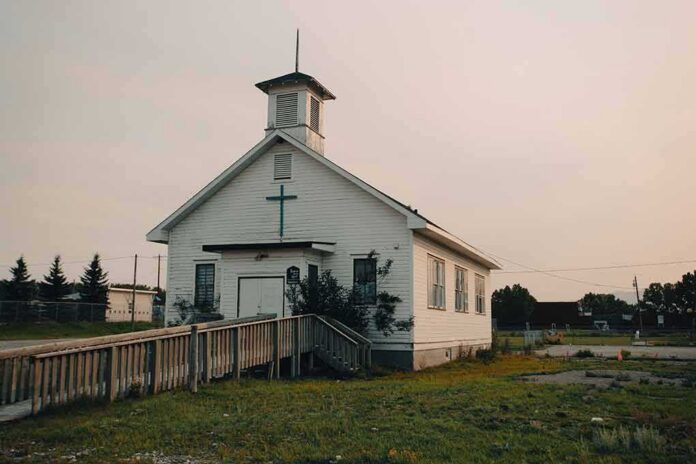
The Pawleys Island Community Church case centers on a stark allegation: senior leaders knew that Warren Spence Perry was a convicted sex offender, subject to strict probation conditions, yet permitted him to volunteer on a campus that included an elementary school, preschool, and daycare. Multiple accounts place Perry in roles as a volunteer and custodian in close proximity to children, a setting directly at odds with the restrictions attached to his 2023 conviction for sexual exploitation of a minor stemming from a 2020 offense.
Authorities and media reports converge on the same sequence. Local deputies and South Carolina Probation, Parole and Pardon Services say Perry violated probation by working at the church in close proximity to children, and by failing to disclose that the church also operated a school. He was arrested on campus and released on bond, while Georgetown County officials opened a broader investigation into not only his actions but the conduct of church leadership in facilitating his presence around children. As that investigation matured, the Georgetown County Sheriff announced criminal charges against church leaders, including obstruction of justice and criminal conspiracy, on the theory that they concealed or misrepresented Perry’s risk and his access to minors.
What Church Leaders Say They Did—and Why
To understand the institutional decisions, we have unusually direct access to leadership’s own framing. In a contentious 2023 meeting, Pastor Don Williams and other leaders laid out their version of events. They say Perry began attending in 2020, was known to have a sex offense conviction, and later expressed repentance and faith. Under that narrative, the church chose a “redemptive” path: allowing him to volunteer, but under what they described as strict safeguards. Those safeguards, according to Williams, included a rule that Perry was never to be alone with children, always under supervision, and allowed on campus primarily outside school hours.
Leadership also claims they informed county probation officials of Perry’s volunteer work, believing this satisfied their legal responsibilities. They emphasize two points: that their intent was to combine child protection with treating Perry “with dignity,” and that, as of their last public statements, they had “absolutely no evidence” that any child at the church or school was abused by Perry. In their account, the failure lay primarily in Perry’s deception—his assurances to them that he was complying with probation conditions—only later contradicted in a meeting with his probation officer, George Valdes.
The Silence Around Teachers and Parents
The most consequential decision admitted by church leaders is the choice not to inform teachers or parents of Perry’s status. Leadership has acknowledged that only select staff and overseers were told, on the theory that those responsible for direct supervision needed to know and that broader disclosure was unnecessary. That choice is now the fulcrum of both criminal and civil scrutiny.
A widely shared statement from ChurchLeaders, summarizing internal and media reporting, asserts that church leadership knew Perry was a convicted sex offender “as early as 2020,” yet the school’s teachers were never told. Teachers and volunteers interviewed by local television stations corroborate that they were kept in the dark. One teacher recounted being encouraged by the school director to have children sing “Happy Birthday” to Perry, and described being admonished by Pastor Williams—“You don’t want to be the type of Christian that would spread this information”—when she raised safety concerns. That phrase appears repeatedly in congregants’ accounts, and it encapsulates a familiar dynamic: spiritual language used to discourage internal whistleblowing.
Eyewitness Accounts vs. the “Strict Supervision” Narrative
The church’s assertion that Perry was never alone with children and was on campus only outside school hours is sharply contested. Parents describe seeing him regularly during pickup and drop-off times. One mother said, “My kids talk about him all the time and he’s always around when I pick up,” rejecting leadership’s claim that his presence was limited to low-risk moments. Another parent reported previously disclosing her own child’s molestation to a church official and being assured such a situation would “never happen”—a promise that now rings hollow against the decision to host a convicted offender in a school environment.
Volunteers likewise dispute the supervision narrative. A congregant interviewed in the Wake Up and Win podcast described leadership actively silencing her attempt to warn others, again invoking the idea that spreading information about Perry would be un-Christian. Multiple attendees at the church meeting demanded criminal accountability, with one declaring that Pastor Williams should “go to jail with him.” These reactions reflect more than anger; they signal a breakdown in trust over whether leaders’ descriptions of “strict safeguards” match the lived reality of daily life on campus.
The Power of Attorney and Allegations of Obstruction
One discrete piece of evidence that has attracted prosecutorial attention is a general power of attorney Perry signed in April 2026, naming Ginny (often reported as Jenny) Williams, the pastor’s wife, to handle his affairs. The 15th Circuit Solicitor, Jimmy Richardson, has publicly noted that power of attorney documents are typically granted to close family members, not church leaders, and that such a document does not create legal immunity or special privacy rights. Investigators are examining whether this arrangement is simply pastoral support for an aging congregant, or whether it has any bearing on how Perry’s probation was monitored and communicated to authorities.
Criminal charges of obstruction and conspiracy against church leaders hinge on a broader pattern: did they mislead probation officials about the nature of Perry’s volunteer work, fail to disclose the existence of the school, or otherwise impede accurate risk assessment? Deputies have already stated that Perry failed to advise probation that the church operated a preschool and nursery. If leaders knew both his conditions and the true scope of his access, their decision to permit that access—and to limit disclosure—moves from questionable judgment into potential criminal liability.
Legal Exposure: Criminal Charges and Civil Class Actions
The criminal process is unfolding alongside civil litigation. A proposed class-action lawsuit, seeking over $25 million in actual and punitive damages, alleges that the church “negligently retained a known sex offender” and “failed to notify parents,” among other claims. This dual track—criminal charges aimed at obstruction and probation violations, and civil claims focused on negligent supervision and emotional harm—is typical of institutional sex abuse cases.
South Carolina law, like the law in most states, allows victims and families to sue churches and religious schools when leaders knowingly permit dangerous individuals access to children or conceal abuse. The litigation against Pawleys Island Community Church will likely seek discovery of board minutes, internal emails, and staff communications from 2020 onward to trace exactly when leadership learned of Perry’s conviction, what safeguards were discussed, and why teachers and parents were excluded from those conversations. Those documents, rather than press conferences, will ultimately determine how courts view the balance of negligence, intent, and cooperation.
A Familiar Institutional Pattern in Church Abuse Cases
What makes this case particularly instructive is how closely it tracks patterns documented across multiple denominations. Investigations into church-based sex abuse have identified recurrent strategies: handling allegations internally, underreporting to law enforcement, relocating or reassigning accused individuals, and using confidential arrangements or euphemistic language to manage reputational risk. In Catholic contexts, grand jury reports describe a “playbook” of avoiding clear terms like “rape” in favor of phrases such as “boundary issues,” conducting inadequate internal inquiries, and prioritizing institutional continuity over disclosure.
The Pawleys Island case differs in detail—Perry’s convictions occurred outside the church, and there is no evidence yet of abuse on the church campus—but it sits squarely within the same matrix of decisions: an offender is treated as redeemable and manageable; risk is addressed through limited, informal supervision rather than formal boundaries; disclosure is confined to a small circle of leaders; and those who question the arrangement are discouraged with spiritual language. Researchers studying abuse in church settings describe grooming tactics that depend on precisely these institutional vulnerabilities: gaining access and isolation, trust-building with families, and gradual desensitization of boundaries. Even if no further harm is ultimately proven here, the environment created is one that offenders elsewhere have repeatedly exploited.
Redemption, Dignity, and Non-Negotiable Safeguards
At the heart of the leadership’s defense is a theological claim: that every person, including a convicted sex offender, bears the image of God and deserves dignity. For many congregations, that conviction is non-negotiable. Yet in practice, the question is not whether dignity is due but how it is expressed in environments with vulnerable children.
Child protection experts who work with faith communities consistently warn against informal “second chances” in roles that involve proximity to minors. They advise that offenders who wish to participate in congregational life do so under carefully structured conditions: no access to children’s programs or school property, explicit written covenants about where they may be, and full disclosure to staff, often including the parents of any children on campus. The Pawleys Island decision to combine probation-era school access with limited disclosure and partly unwritten supervision protocols runs directly counter to those guidelines.
What Accountability Looks Like Going Forward
In the aftermath of Perry’s arrest and the public meetings, the church has begun revising policies: restricting volunteer access to school property when children are present, requiring background checks and leadership approval, and promising a comprehensive review of supervision and communication practices. Whether these reforms are substantive or merely reactive will depend on whether they are codified, enforced, and accompanied by genuine transparency—especially toward teachers and parents, who bore the risk without informed consent.
For other churches, the case offers a clear set of lessons. First, knowledge of a congregant’s sex offense history is not merely pastoral information; it is risk data that must trigger formal boundaries. Second, “strict supervision” cannot be treated as a substitute for disclosure; parents and frontline staff have both a moral and practical right to know when an offender is on campus. Third, spiritual rhetoric that discourages reporting or discussion of safety concerns is itself a form of institutional harm, even if no abuse ultimately occurs. And finally, when leaders misjudge that balance, the law is increasingly prepared to treat those decisions not as unfortunate missteps but as potential crimes.
Implications for Faith Communities and the Law
As prosecutions and lawsuits proceed, Pawleys Island Community Church will become part of a broader jurisprudence around institutional responsibility for known offenders in religious settings. Courts will parse not only what leaders intended but what they reasonably should have foreseen: that placing a convicted sex offender in a school environment, under partial supervision and without full disclosure, creates an unacceptable risk.
For faith communities committed both to redemption and to child protection, the emerging message is uncompromising. Redemption can be pursued in ways that do not involve access to children; dignity can be honored without entrusting offenders with roles that depend on trust from families and staff. When those lines blur, the result is not only scandal and litigation but a profound betrayal of the very people churches claim to safeguard. In Pawleys Island, that betrayal is now being measured not just in anger and broken trust, but in indictments.
Where the Evidence Still Needs to Catch Up
Several important questions remain open. Investigators have yet to publicly detail the full communication trail between church leadership and probation officials: what exactly was disclosed, when, and by whom. Likewise, internal records—board minutes, staff emails, incident reports—have not been released, so our current picture of decision-making relies heavily on public meetings and media interviews.
Future discovery in the civil case and further filings in the criminal matter will likely clarify whether there was deliberate obstruction, negligent misunderstanding, or a mix of both. For the wider public, however, the essential point is already clear. When multiple teachers and parents independently describe feeling misled or silenced, and when offenders are granted roles near children under conditions that prove unenforceable, the institutional system is broken regardless of how the legal nuances eventually resolve.
CHARGED | A South Carolina sheriff announced criminal charges against leaders of the Pawleys Island Community Church and its Christian Academy.
— Queen City News (@Queen_City_News) July 21, 2026
Sources:
nypost.com, wpde.com, wfxb.com, youtube.com, facebook.com, abcnews4.com