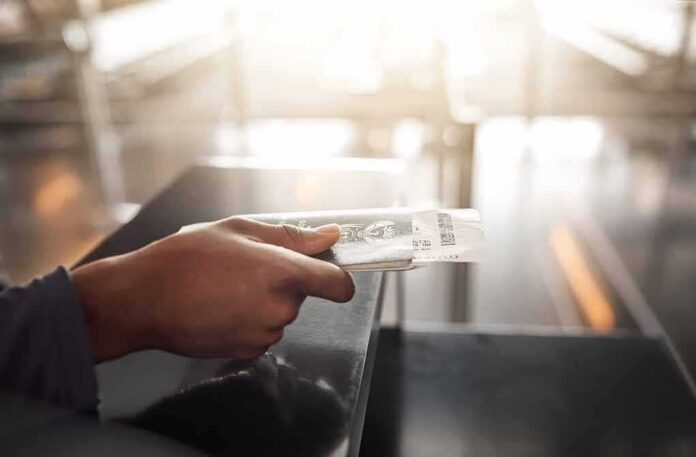
Border security today is as much about verifying identity as it is about policing geography; the thwarted use of other people’s U.S. passports at John Wayne Airport shows why facial biometrics have become a frontline tool and how they change the calculus of document fraud.
At a Glance
- Federal prosecutors charged two Chinese nationals who arrived from Mexico at John Wayne Airport with misusing U.S. passports belonging to real citizens.
- CBP’s facial recognition check flagged a mismatch between the travelers and the passport photos, prompting secondary inspection and arrests.
- The case aligns with CBP’s broader deployment of facial biometrics at air ports of entry to detect impostors using genuine documents.
- Passport misuse and false statement statutes provide the charging backbone for cases where authentic documents are used by impostors.
What Happened at John Wayne Airport
According to a Department of Justice filing in the Central District of California, two Chinese nationals presented U.S. passports that belonged to other people while attempting to enter the United States from Mexico through Orange County’s John Wayne Airport; both were charged via federal criminal complaint and taken into custody. The government’s account centers on a routine entry inspection that leveraged biometric facial comparison to verify that the person presenting the document matched the reference image tied to that document. When the algorithmic comparison indicated a discrepancy, CBP referred the travelers to secondary inspection, where investigators concluded the documents were not theirs and made arrests. John Wayne Airport is among the locations where CBP has fielded biometric entry/exit capabilities; that infrastructure is designed precisely for this kind of impostor detection.
The legal hook in such cases is well established. Even when a passport is genuine, using it in a false identity or supported by false statements can trigger federal liability. The Justice Department’s criminal resource manual highlights long-standing Supreme Court precedent upholding convictions for “innocent use” of a passport procured through false statements, under 18 U.S.C. § 1542. That provision and related passport misuse statutes supply prosecutors with a direct path to charge impostor scenarios where traditional counterfeit indicators are absent because the document itself is legitimate.
How the Biometric Check Works
CBP’s Traveler Verification Service (TVS) compares a live-captured facial image to authoritative reference photos—passport, visa, or airline manifest-linked gallery—to confirm identity at the border, creating an entry or exit record for noncitizens and supporting verification for citizens. At an air port of entry like John Wayne, cameras at inspection points capture the traveler’s face and transmit the template to CBP systems, which return a match/no-match determination within seconds. When a person presents a passport that belongs to someone else, the facial features typically diverge enough for the system to flag the mismatch, even if the document’s physical and electronic security checks pass.
This “authentic document, wrong bearer” problem is where biometrics add distinct value: traditional anti-counterfeit features cannot expose an impostor who is carrying a genuine credential. GAO’s review of CBP’s Biometric Entry-Exit program documented the expansion of facial matching at airports and the program’s intended role in verifying travelers and detecting fraud at speed and scale; while GAO also noted implementation limits, the core capability to surface impostors is now a routine part of air border processing.
Why Airports See These Cases—and Why They Are Hard Without Biometrics
Air travel compresses identity checks into minutes. Officers face high volumes, time pressure from aircraft schedules, and a traveler population that increasingly moves through automated gates. In that environment, impostors seek to exploit the strength of genuine documents: a stolen or borrowed U.S. passport can defeat many traditional inspections because it is exactly what it appears to be. Facial comparison inserts a second factor—biometric congruence with the known holder—that disarms the tactic. DHS and outside researchers have emphasized that, in the airport context, facial recognition provides a contactless, fast method that is particularly good at revealing mismatches between person and credential.
The Orange County incident tracks with this logic. A live image at primary inspection did not match the passport’s reference photo; that triggered a secondary review and subsequent charges. The operational storyline is plain: the biometric layer surfaced a fraud vector that would otherwise rely on subtler cues—behavioral anomalies, inconsistent travel histories, or officer intuition—all of which are valuable but less uniformly repeatable under volume.
The Legal Architecture Behind the Charges
Federal passport law draws a bright line between document authenticity and lawful use. The key statutes prosecute false statements in applications, use of passports secured by such statements, and possession or use of another person’s passport. The Justice Department’s guidance—rooted in Supreme Court precedent—makes clear that even if a user did not personally make the original false statement, using the resulting passport to represent a false identity can sustain liability under 18 U.S.C. § 1542. This framework is purpose-built for impostor cases, where the government does not need to prove the traveler forged the document; it needs to show the traveler used it to misrepresent identity. That is why biometric mismatch evidence and subsequent admissions or travel records become pivotal in charging decisions.
In practice, once CBP detects an identity mismatch, agents corroborate with biographic data, manifests, and device or baggage checks. Prosecutors then decide whether to proceed on misuse, false statement, or related counts based on the facts. In the John Wayne case, DOJ’s public description references misuse of passports belonging to real citizens—a formulation that aligns with § 1542 theory and focuses attention on the act of presenting another person’s credential to enter the country.
Program History, Performance, and Limits
CBP’s push into facial biometrics stems from a congressional mandate to implement a biometric entry-exit system for noncitizens—an effort that, in the air environment, matured first because airline manifests and controlled camera placement make matching feasible at scale. Over the last decade, CBP piloted, evaluated, and expanded facial matching across departure gates and arrival halls, integrating with airline partners and airport authorities. Independent oversight has cataloged both progress and constraints: GAO reported broad deployment by 2020 while calling out the need for performance metrics and privacy controls; DHS advisory bodies have detailed how TVS uses manifest data and existing photographs to drive matches.
Performance in impostor detection is not solely an algorithmic question. Lighting, camera angle, occlusions, and traveler cooperation affect match rates. CBP and TSA have shifted to modern cameras integrated into credential authentication devices and primary arrival systems to reduce these variables, while maintaining officer adjudication at the end of the chain. In short, the tech proposes; a human disposes. That blend is central to converting a biometric alert into a prosecutable case rather than a false alarm.
Two Chinese nationals were intercepted at a California airport after allegedly attempting to enter the United States using passports belonging to actual American citizens.
Jin Fu Wei and Xiaodan Lei were detained at Orange County’s John Wayne Airport on Aug. 26 after arriving…
— Spotlight on China (@spotlightoncn) September 30, 2026
What This Means Going Forward
The Orange County arrests are not an outlier; they are a case study in how airports will increasingly detect identity fraud that piggybacks on genuine documents. For travelers, the experience is mostly invisible—a quick photo and a green light. For impostors, the risk calculus has shifted: a perfect counterfeit is no longer the goal; access to someone else’s real passport will not suffice if the face does not match. That is the point. As CBP continues to close coverage gaps across ports of entry, expect more arrests that read like this one and fewer successful impostor transits at airports.
The legal system already has the tools to handle these prosecutions, and the operational system now has a reliable trigger. The John Wayne Airport case demonstrates both. The technology recognized what the credential obscured, and the law addressed the misuse that followed. That is how identity-first border security is supposed to work.
Sources:
nypost.com, justice.gov, singtaousa.com, kansascity.com, worldjournal.com, x.com, brookings.edu, congress.gov, gao.gov