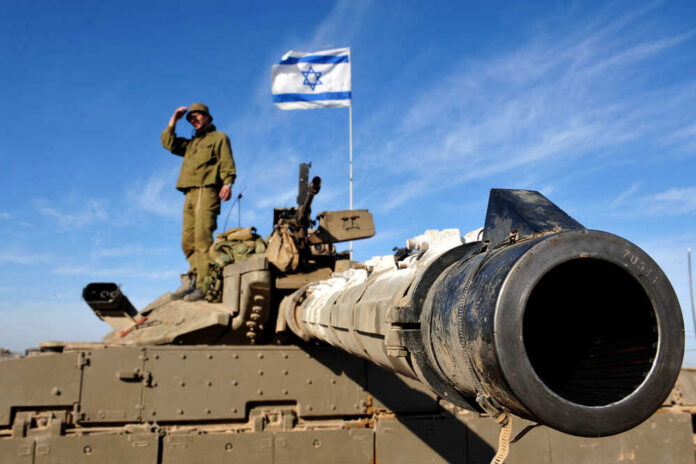
Israel’s deepest push into Lebanon in 26 years escalates the fight against Hezbollah and tests whether hard power can finally stop Iran’s proxy rockets from endangering civilians on Israel’s northern frontier.
Story Highlights
- Prime Minister Benjamin Netanyahu confirms Israeli troops crossed the Litani River to target Hezbollah positions in deeper Lebanese territory [7].
- Israeli forces report seizing the strategic Beaufort Castle, signaling control of high ground overlooking key routes in southern Lebanon [8].
- Lebanese leaders condemn the operation as a sovereignty violation amid civilian displacement reports, intensifying diplomatic pressure [4].
- The advance revives debate over buffer zones and deterrence after years of Hezbollah cross-border rockets and drones [13].
Netanyahu Confirms Deeper Incursion Beyond the Litani River
Prime Minister Benjamin Netanyahu confirmed Israeli troops crossed the Litani River and are operating in commanding areas of southern Lebanon, describing an expanded campaign against Hezbollah positions across multiple fronts. Israeli statements frame the operation as necessary to push rocket and drone launch sites farther from Israeli communities long under intermittent fire. Crossing the Litani marks a threshold not reached in decades, indicating a bid to change the battlefield geometry after deterrence failed to stop attacks from entrenched Hezbollah networks [7].
Israeli officials argue that sustained cross-border fire and first-person-view drone strikes from Hezbollah required action beyond the immediate border belt to protect civilians and restore freedom of movement in Israel’s north. By widening the operational envelope, the government seeks to degrade launch cells, logistics routes, and observation posts that enable near-daily harassment. The decision follows repeated warnings that Iran-backed forces had exploited terrain depth and civilian areas to shield munitions and operators from quick Israeli response times, complicating defense of border towns [7].
Seizure of Beaufort Castle Signals Control of Strategic High Ground
Reports that Israeli forces seized Beaufort Castle highlight a move to secure dominant terrain overlooking southern Lebanese corridors vital for Hezbollah maneuver and supply. Control of elevated positions historically shapes outcomes along this front, offering surveillance, fire control, and a platform to interdict movement. The capture underscores intent to impose a cost on Hezbollah’s battlefield calculus by denying sanctuaries previously considered safe. It also symbolizes the deepest Israeli advance in years, reinforcing the message that the status quo of sporadic attacks will not continue unchallenged [8].
The military utility of such high ground can be decisive when adversaries rely on concealed launch sites and rapid relocation among villages and wadis. Holding commanding heights limits those tactics and forces Hezbollah to either absorb attrition or risk exposure while relocating equipment. This approach aligns with Israel’s historical reliance on buffer concepts in southern Lebanon when deterrence erodes, seeking to push hostile fire beyond practical range and reduce the daily threat to Israeli families living in border communities under sustained stress and economic disruption [13].
Diplomatic Friction and Civilian Toll Complicate the Battlefield Gains
Lebanese officials condemned the incursion as a sovereignty violation and decried civilian displacement, elevating international scrutiny as operations continue. Media tallies cited thousands of deaths tied to the broader campaign, with reports of strikes near civilian infrastructure adding to the diplomatic headwinds facing Israel. These accounts amplify pressure in global forums and complicate talks facilitated by outside powers, which tend to intensify when images of damage circulate faster than verified battlefield evidence about Hezbollah’s positioning among civilian areas [4].
🚨 BREAKING: Israeli forces capture historic Beaufort Castle in southern Lebanon — the deepest ground incursion in 26 years.
Netanyahu calls it a "decisive shift" against Hezbollah as troops push past the Litani River. The Israeli flag is now flying over the Crusader-era… pic.twitter.com/RQ38PeGsRT
— NewsYarn (@NewsYarnHQ) May 31, 2026
Israel’s case rests on the claim that deeper operations are a constrained form of self-defense against an Iran-backed militia that embeds launch capabilities inside populated zones and exploits Lebanon’s geography. Critics argue the expansion risks a larger war while overburdening civilians who have little influence over Hezbollah’s decisions. The factual record confirms Israel crossed the Litani River and is holding key terrain; the contested question is whether those battlefield gains measurably reduce rocket and drone fire against Israel’s north without triggering an uncontrollable spiral that undermines regional stability [7].
What This Means for American Conservatives Watching a Dangerous Border War
American conservatives recognize a core principle at stake: a nation’s right to defend its citizens against persistent attacks. For years, Hezbollah has probed Israel’s defenses with rockets and drones, testing resolve and exploiting safe havens. When deterrence fails, governments face hard choices. Israel’s crossing of the Litani and seizure of strategic high ground indicate a decision to reset the rules, rather than absorb endless provocations. The move mirrors the logic of border security: pushing threats back, hardening lines, and denying sanctuary to armed militants [7].
The operation also exposes a familiar media and diplomatic pattern. Rapid international condemnation often precedes verification of claims about military targets embedded among civilians. That dynamic blurs moral clarity and invites pressure that can handicap legitimate self-defense. Conservatives should demand rigorous, sourced evidence about target selection, civilian impact, and Hezbollah’s use of human shields. Meanwhile, Israel’s actions will be judged by whether northern Israeli families finally see fewer sirens, fewer drones, and fewer rockets—measurable results that determine if the strategy is worth its risks [13].
Historical Patterns: Buffer Zones, Deterrence, and End States
The Israeli–Lebanese conflict shows repeating cycles: rocket fire rises, deterrence falters, and Israel moves to create depth or buffers to protect border towns. Today’s push beyond the Litani fits that lineage. The critical policy question is end state. If holding commanding terrain like Beaufort Castle and disrupting logistics measurably curbs Hezbollah fire, the case for a temporary security zone strengthens. If not, pressure will mount for either a negotiated arrangement or a broader campaign, both of which carry cost, complexity, and risk of escalation [8][13].
Sources:
[4] YouTube – Israel makes deepest advance into Lebanon in 26 years | DW News
[7] YouTube – Netanyahu vows to ‘wipe out’ Hezbollah as Israeli strikes …
[8] Web – Netanyahu confirms troops crossed Litani, as Pentagon hosts Israeli …
[13] YouTube – Netanyahu claims that the continued incursion on Lebanon is part of …