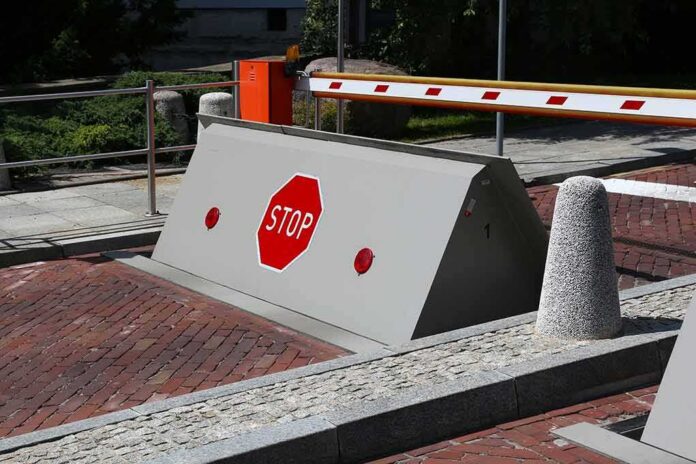
Across UK cities, the quiet spread of portable anti-ram barriers is a clear sign that protecting crowded public spaces from vehicle attacks has moved from exceptional measure to routine civic engineering.
At a Glance
- Hostile vehicle mitigation has become standard practice in UK guidance for protecting crowded urban spaces.
- Events like Nottingham’s city-centre beach now sit behind purpose-built anti-ram barriers, justified as extra safety precautions against vehicle-as-a-weapon threats.
- Modern portable barriers are engineered systems: crash-tested, impact-rated, and designed to stop multi-tonne vehicles at urban traffic speeds.
- The expansion of these barriers reflects a chronic background risk, not a one-off panic, and raises wider questions about how cities manage security in open, diverse societies.
From Exceptional Threat to Routine Design Problem
Over the past decade, vehicle-ramming has shifted in UK security thinking from a rare tactic to a standing design problem: how to keep large numbers of people safe in open, accessible places without turning city centres into fortified compounds. National guidance now treats hostile vehicle mitigation — the systematic use of barriers, bollards, and distance to prevent vehicles being used as weapons — as a core component of protecting crowded places. This is not framed as an emergency add-on but as standard practice, embedded in official documents that describe crash-rated bollards, vehicle barriers and stand‑off distances as basic tools for public realm safety.
That change of status matters. Once a risk becomes chronic rather than exceptional, the question stops being whether to respond and becomes how to respond proportionately, intelligently and in a way that can be sustained year after year. In the UK, that “how” increasingly includes portable, impact‑tested barrier systems designed specifically for temporary events and high‑footfall spaces.
Nottingham Beach: A Case Study in Hostile Vehicle Mitigation
The annual Nottingham Beach event in the city’s Old Market Square offers a concrete illustration of this shift. What was once simply an artificial beach and fairground attraction now operates behind a line of bright red Husson H‑Stop units — modular steel barriers deployed across the main approaches. Around fifteen barriers block the four principal entrances, creating a controlled interface between city traffic and dense pedestrian crowds.
These barriers are not generic crowd-control kit; they are engineered specifically to counter “vehicle-as-a-weapon attacks.” Reporting on the installation notes that the Husson units are designed to tip upwards when struck, altering a vehicle’s trajectory and generating sufficient friction to halt a three-and-a-half-tonne truck travelling at roughly 30 mph — essentially the mass and speed of a typical urban delivery vehicle. The design premise is simple physics: change the angle of impact, bleed off kinetic energy, and prevent the vehicle from reaching the crowd with lethal momentum.
Local decision-makers have been explicit about why they are there. Neghat Khan, leader of Nottingham City Council, described the barriers as an “additional safety measure” implemented “following advice from the multi-agency events safety advisory group, which includes counter-terrorism colleagues.” Event organiser James Mellors was equally direct: aesthetics are secondary; the Market Square is a very high footfall area, and keeping people safe is the primary design constraint.
How Portable Anti-Ram Barriers Work
To understand why these systems are proliferating, it helps to look at their mechanics. Anti-ram vehicle barriers — whether portable units like Husson H‑Stop or permanent installations — are designed around a single purpose: stopping or deflecting a vehicle so that it cannot enter a protected area with dangerous speed. They do this through a combination of structural strength, controlled deformation, and the manipulation of vehicle dynamics.
Portable barriers used at events are typically modular steel assemblies that sit on the road surface rather than being deeply anchored in foundations. On impact, they are engineered to tilt or lift, forcing the front of the vehicle upward and off its normal trajectory. This tilt increases friction, destabilises steering, and rapidly dissipates energy. Some systems use interlocking units to spread impact forces across multiple modules, reducing the chance of a single-point failure. Manufacturers stress two key performance metrics: what mass and speed of vehicle the barrier can absorb, and whether that performance has been independently verified in full-scale crash tests.
Because these installations are not purely theoretical, standards have evolved to codify performance. In the UK, earlier Publicly Available Specifications such as PAS 68 and PAS 69 set out impact test criteria and guidance for vehicle security barrier systems, establishing a common language for “crash-rated” products. Internationally, standards such as ASTM F2656 define specific test vehicles, speeds and acceptable penetration distances. The practical effect is that when a council buys a barrier advertised to stop, say, a 3.5‑tonne truck at 30 mph, there is a test regime behind that claim rather than mere marketing.
Temporary Barriers and UK Security Guidance
The Nottingham deployment sits within a broader framework articulated by Protect UK, the national platform for protective security advice. Guidance on temporary vehicle security barriers is explicit: only barriers that pass appropriate testing should be used as part of a hostile vehicle mitigation scheme, and temporary barriers in particular should be subjected to both a high‑speed impact test and a repetitive ramming test to reduce risk to “as low as reasonably practicable.”
The emphasis on both single, high‑energy impacts and repeated lower-speed strikes reflects real-world scenarios. A determined attacker may attempt multiple blows, or a vehicle might strike, reverse and strike again. Barriers must withstand not just one textbook collision but a messy sequence of events amid crowds and confusion. Protect UK’s documents also stress the importance of matching barrier ratings to the expected threat — considering vehicle types, approach speeds, street geometry and event design. In practice, this means that councils and security advisers are not simply dropping barriers wherever they fit; they are designing schemes tuned to the specific urban environment and event profile.
From Fixed Fortifications to Flexible Urban Safety
Permanent or semi-permanent barriers have long been visible outside embassies, courts and financial centres, where stand‑off distances and hardened perimeters are part of everyday architecture. What is new is their migration into civic spaces: markets, festivals, high streets and public squares now routinely incorporate hostile vehicle mitigation elements built into street furniture, landscaping and event infrastructure.
The design trend is toward flexibility. Older solutions relied on massive fixed installations — deep-set bollards and heavy planters — that reshaped streets for decades. Modern approaches use lighter, modular systems that can be deployed for specific events and removed afterwards, allowing cities to retain openness while still meeting security obligations. This portability comes with its own demands: logistics for installation and removal, training for staff, and careful integration with emergency access routes so that protective measures do not impede response.
The practical driver for this evolution is the recognition that many of the highest-risk scenarios involve temporary concentrations of people: summer events, Christmas markets, parades, and demonstrations. If public authorities accept that the risk of vehicle-ramming at such gatherings is now part of the baseline, then temporary mitigation becomes as routine as crowd stewards, medical tents and CCTV.
Safety, Urban Life, and the Question of “Normalisation”
Describing vehicle-ramming threat as “the norm” is not a claim that such attacks occur daily; rather, it reflects their incorporation into standard risk assessments for crowded urban spaces. The experience of recent years — from deliberate ramming incidents to catastrophic accidents involving heavy vehicles — has reinforced the idea that any large, accessible gathering adjacent to traffic carries a non-trivial vulnerability. Security professionals no longer treat such scenarios as edge cases, and the presence of counter-terrorism officers on multi‑agency event safety groups, as in Nottingham, has become typical.
Critics sometimes point to visible barriers as emblematic of a creeping security state or as symbolic commentary on social change. Supporters counter that the barriers are simply the physical expression of due diligence in the face of known tactics: a relatively low-intrusion measure that absorbs risk without markedly restricting movement. From an engineering and governance perspective, the core justification is straightforward. When a known mode of attack can be mitigated by tested, relatively unobtrusive infrastructure, failing to use it at high‑risk events becomes difficult to defend.
The broader urban reality is that UK cities have grown more ethnically diverse and more densely mixed over the past three decades. Census data show steady increases in minority populations alongside declining residential segregation, leading to what researchers describe as “rainbow” towns and cities where people of different backgrounds share neighbourhoods in large numbers. That demographic context and the security context are often discussed together in public debate, but they are analytically distinct: one concerns who lives in and uses the city; the other concerns how to protect any large gathering, regardless of its composition, from the specific threat of a vehicle used as a weapon.
Where the Operational Questions Now Lie
With the conceptual case for barriers largely settled in UK guidance, the operational questions have shifted. First, performance and procurement: are the barriers being bought and deployed truly impact‑tested to recognised standards, or are cheaper, untested products finding their way into use? Protect UK’s insistence on tested barriers is meant to prevent a false sense of security.
Second, integration: how do these systems mesh with emergency services’ needs, traffic management, accessibility for disabled users, and the aesthetic and commercial demands of city-centre life? Event organisers like Nottingham’s Mellors acknowledge that barriers “don’t look very pretty,” but argue that safety trumps appearance. Urban designers are increasingly challenged to hide or soften hostile vehicle mitigation within benches, planters, art installations and subtle street layout changes.
Third, communication: councils must explain to residents and visitors why barriers are present without either minimising the risk or promoting anxiety. The Nottingham approach — describing them as “additional safety measures” introduced on police advice — is characteristic of a matter-of-fact, precautionary framing rather than a crisis narrative.
For now, the trajectory is clear. As long as crowded public events coexist with open vehicle access in dense city centres, portable anti-ram barriers will remain part of the normal toolkit of local government. Their presence at places like Nottingham Beach does not signal the end of open urban life; it signals a recalibration of what it takes to keep that openness safe.
Looking Ahead: Security as a Layer of Civic Design
In mature urban systems, security becomes a layer of design rather than an interruption. Hostile vehicle mitigation in UK cities is moving in that direction: codified in guidance, tested in laboratories, deployed routinely by councils and event organisers, and increasingly embedded in the fabric of the streetscape. The barriers at Nottingham Beach are part of that evolution — visible for now, but conceptually aligned with a future in which safety measures are structurally present, technically robust, and socially accepted as one more condition of city life.
Sources:
zerohedge.com, bandlshutters.co.uk, bbc.co.uk, riskstop.co.uk, youtube.com, tymetal.com, bbc.com, protectuk.police.uk, blacksp.com, deltascientific.com