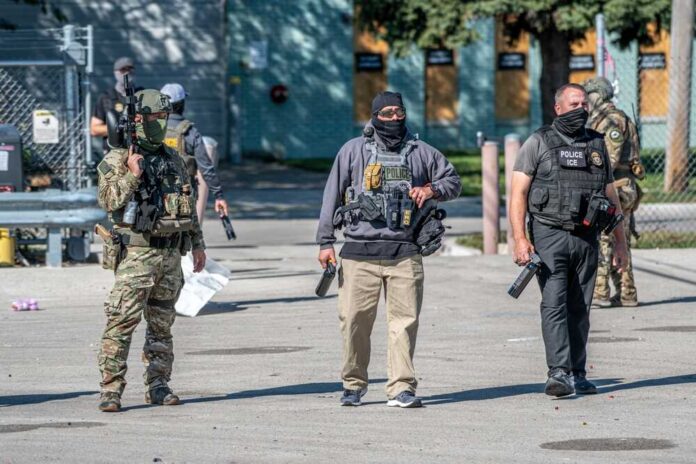
A local prosecutor’s felony case against a federal immigration agent now pits city hall, Washington, and public trust against each other—raising the question of who polices the police when stories and video do not match.
Story Snapshot
- Hennepin County charged Immigration and Customs Enforcement agent Christian Castro with four counts of second-degree assault and one count of falsely reporting a crime [1][2]
- Prosecutors say Castro shot Julio Cesar Sosa-Celis through a Minneapolis home’s front door, injuring his leg, and endangered others inside [1][3]
- Reporting says video evidence contradicts initial claims that Castro was attacked before firing [3]
- The case underscores a recurring clash between federal enforcement narratives and local accountability demands [1][3]
What Prosecutors Allege Happened in Minneapolis
Hennepin County prosecutors charged Immigration and Customs Enforcement agent Christian Castro with four counts of second-degree assault and one count of falsely reporting a crime after a January shooting in north Minneapolis that wounded Julio Cesar Sosa-Celis in the leg [1][2]. Prosecutors say the shot came through a home’s front door while people were inside, creating risk beyond the person struck [1][3]. The charging announcement emphasized the seriousness of firing into a residence and the accuracy of post-incident reporting [1][2].
Local reporting states that video evidence collected in the investigation did not align with initial accounts that the agent was attacked with household objects before firing [3]. That discrepancy sits at the center of the case because the justification for force turns on what the agent reasonably perceived and whether the threat matched the response [3]. Prosecutors argue the facts indicate criminal assault and a false report, framing the incident as endangering multiple people inside the home [1][3].
What the Defense and Federal Authorities Can Argue
The available material reflects charges and allegations, not a conviction or judicial finding, leaving room for a defense that the shooting was justified and the report accurate [1][2][3]. Because the public summaries do not include the full complaint, affidavit, or complete set of exhibits, the prosecution’s narrative remains filtered through secondary coverage at this stage [1][3]. Castro’s defense can contest the interpretation of video, argue split-second decision making, and challenge whether his perception of threat met legal standards for use of force [1][3].
Federal-state friction often intensifies in cases involving immigration enforcement. Local officials emphasize community safety and transparent accountability when force is used in neighborhoods; federal agencies stress operational risks during arrests and the need to protect agents in uncertain environments. The dispute here mirrors that tension: local prosecutors assert excessive and dangerous conduct, while the defense is expected to frame the encounter as a lawful response under pressure, pending full evidentiary review in court [1][3].
Why This Case Resonates Beyond Minneapolis
This case lands in a climate where many Americans believe competing institutions protect their own rather than the public. Conservatives who worry about rising disorder and weak enforcement want accurate reporting and justified force, not legal overreach that erodes confidence. Liberals who fear abusive policing want proof that no one is above the law. Both sides share a core demand: when official stories and video clash, an impartial process must separate fact from spin [1][3].
An ICE agent facing charges related to an incident during Operation Metro Surge in Minneapolis was located and arrested in Texas Friday. Christian Castro was charged in Hennepin County earlier this month after shooting through a door during a foot chase.https://t.co/29rwnujm7h
— News Talk 830 WCCO (@wccoradio) May 29, 2026
Public trust hinges on concrete answers: what the footage shows frame by frame, where people stood behind the door, what the agent perceived, and how quickly events unfolded. The law will turn on whether a reasonable officer would have fired and whether the subsequent report matched the facts. Until a court weighs admissible evidence, claims remain allegations. The integrity test is simple and universal: follow the facts, disclose the record, and let accountability track the truth—no matter who wears the badge [1][3].
Sources:
[1] Web – BREAKING: ICE Agent Charged by Soros Prosecutor in Nonfatal Shooting …
[2] Web – ICE agent accused of shooting man in north Minneapolis arrested in …
[3] YouTube – ICE agent charged for January shooting