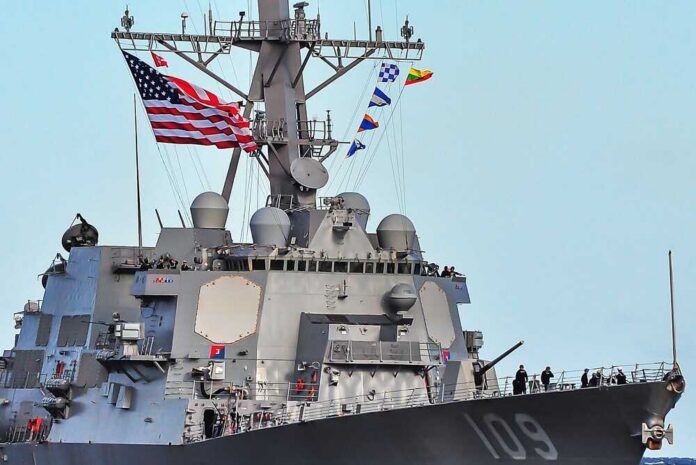
American destroyers shot down fresh waves of Iranian attack drones in the Strait of Hormuz, underscoring a high-stakes test of U.S. resolve and maritime freedom under relentless Tehran pressure.
Story Highlights
- U.S. Central Command described recent strikes as self-defense after Iranian missiles, drones, and small boats targeted U.S. warships [1].
- Iranian officials accused the United States of violating a ceasefire and claimed additional strikes near Qeshm Island, a charge Washington disputes [2][3].
- Analysts identify the Strait of Hormuz as a recurring flashpoint where rapid U.S. responses deter threats to global shipping [4][6].
- The clash arrives as Iran signals it sees control of the chokepoint as strategic leverage over world markets [2].
CENTCOM Details Defensive Action Against Iranian Threats
U.S. Central Command said the U.S. military executed self-defense strikes after Iranian forces launched missiles, drones, and small boats against U.S. Navy destroyers transiting the Strait of Hormuz, a vital trade corridor that carries a significant share of the world’s energy shipments [1]. Reporting identified swift U.S. fighter aircraft responses that eliminated Iranian air defenses, a ground control station, and one-way attack drones that posed imminent danger to American vessels and crews operating lawful maritime transits [4]. The stated objective remained force protection and secure passage.
The incident followed earlier exchanges that already strained a tenuous ceasefire framework, with Central Command characterizing recent interceptions and strikes as calibrated actions to neutralize immediate threats rather than broaden the conflict [1][4]. The Council on Foreign Relations noted that fighting around the Strait of Hormuz has slowed shipping and amplified risk premiums worldwide, reflecting Iran’s strategy of brinkmanship and harassment alongside America’s deterrent patrols and quick-response posture to keep the sea-lane open [6]. The events reinforced the long-recognized volatility of the chokepoint.
Tehran’s Claims and the Ceasefire Dispute
Iranian officials alleged new American strikes near Qeshm Island and accused the United States of violating a ceasefire, asserting that U.S. and allied actions escalated tensions rather than curbed them [2][3]. Those claims directly conflict with Central Command’s framing of limited, defensive engagement aimed at neutralizing drones and hostile platforms targeting U.S. ships [1][4]. The CBS report also quoted an adviser to Iran’s supreme leader likening control over the Strait to having an “atomic bomb,” a statement that reveals Tehran’s view of the waterway as powerful leverage over global markets [2].
Public analysis indicates Iran often pursues coercive maritime tactics—drones, small-boat swarms, and air defenses—intended to raise costs without matching U.S. naval strength, while Washington sets tripwires to respond rapidly and proportionally to direct threats [6]. The International Crisis Group described fast U.S. strikes that dismantled immediate danger to American forces in this latest flare-up, consistent with that established pattern [4]. This dynamic sustains a cycle where each side’s narrative competes for legitimacy amid real risks to crews, cargoes, and insurers.
Why the Strait of Hormuz Still Matters for American Families
The Strait of Hormuz remains the world’s most sensitive oil chokepoint, so disruptions there drive up shipping insurance rates, squeeze supply, and raise prices at the pump—costs that land on American consumers and small businesses already battling inflationary pressure [6]. When Iranian forces threaten U.S. ships, they threaten energy security and the wallets of families back home. Maintaining freedom of navigation deters hostile actors who would treat global commerce as a bargaining chip against the United States and its allies.
Conservatives understand that peace through strength deters aggression. The recent shootdowns and targeted defensive strikes align with that principle, focusing on precision and immediacy to protect American sailors while avoiding unnecessary escalation [1][4]. Clear red lines, credible capability, and the resolve to act quickly are essential to keep trade moving and to prevent adversaries from turning a vital waterway into a geopolitical tollbooth. Upholding maritime law protects both national security and family budgets.
Assessing the Competing Claims and Strategic Outlook
Competing U.S. and Iranian accounts reflect a long-running information battle layered atop kinetic risks. On the facts available, Central Command says Iranian platforms directly threatened U.S. warships and were destroyed in time-sensitive engagements [1][4]. Iran says the United States struck beyond self-defense and breached a ceasefire [2][3]. Independent analysts consistently classify the area as a recurring flashpoint where American forces act quickly to preempt imminent threats, often preventing wider damage to commercial traffic [4][6]. That pattern appears intact.
Policy implications are clear. First, the United States must sustain persistent presence and early-warning integration to blunt swarms and drones before they close distance. Second, targeted defensive rules of engagement should remain tight, transparent, and repeatable to reduce ambiguity Tehran exploits. Third, allied coordination and public communication should emphasize the narrow, defensive nature of U.S. actions, shrinking space for propaganda that undermines deterrence. These steps help secure the strait and stabilize costs for American families.
Sources:
[1] Web – U.S. CENTCOM Shoots Down More Iranian Attack Drones
[2] YouTube – US and Iran trade fire in Strait of Hormuz, threatening ceasefire
[3] Web – Trump says Iran’s response to peace proposal “totally unacceptable”
[4] YouTube – Iran accuses U.S. of violating ceasefire after fresh strikes near …
[6] YouTube – Trump Uutimatums, Iran response & rising war fears explained