
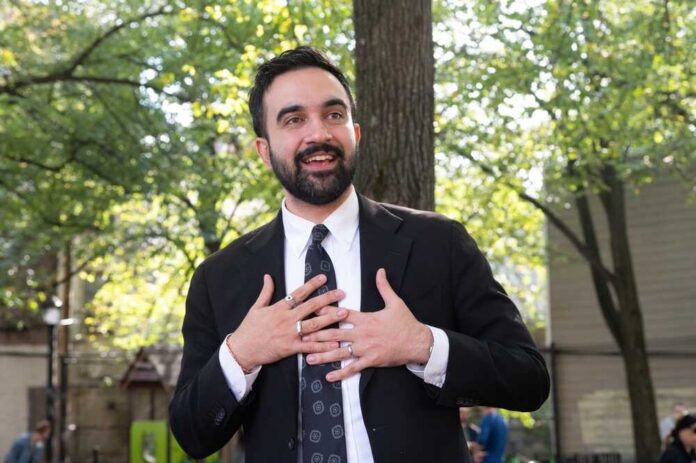
The Mamdani–Netanyahu controversy is not, at bottom, about a mayor’s “epic fail,” but about the collision between moral insistence on war-crimes accountability and the hard limits of American constitutional and international law.
Key Points
- Zohran Mamdani has repeatedly said he believes Benjamin Netanyahu is a war criminal who “belongs in The Hague” and that the ICC warrant against him should be taken seriously.
- He initially vowed to have New York authorities arrest Netanyahu if the Israeli leader visited the city, then publicly acknowledged that New York lacks independent legal authority to enforce an ICC warrant.
- The United States is not a party to the ICC; federal statutes and diplomatic immunity doctrines make it effectively impossible for a municipal government to execute an ICC arrest warrant against a foreign head of government.
- Mamdani’s stance exemplifies a broader enforcement gap: international courts can issue warrants, but they depend on states—and, in the U.S., the federal government—to act, leaving local officials’ promises largely symbolic.
From arrest pledge to legal admission: what Mamdani actually said
Zohran Mamdani’s position on Benjamin Netanyahu has been consistent on one axis and evolving on another. On substance, he has repeatedly described Netanyahu as a war criminal and has stated plainly, “I agree with the ICC that Benjamin Netanyahu should be arrested and tried for his crimes” and “I believe that Prime Minister Netanyahu belongs in The Hague.” Those statements do not waver: Mamdani accepts the legitimacy of the ICC’s arrest warrant and wants it enforced. The evolution lies in his claims about what New York City itself can do. During his mayoral campaign and early months in office, he pledged that, if Netanyahu came to New York—most notably for the UN General Assembly—he would instruct the NYPD to arrest him pursuant to the ICC warrant. That vow generated immediate national and international attention because no U.S. city has ever detained a visiting foreign leader on the basis of an international criminal court warrant.
As scrutiny mounted, Mamdani emphasized that he was not claiming unconstrained personal power. In interviews and video statements, he underscored that his administration was “reviewing every avenue available under applicable law to determine whether New York City could execute the International Criminal Court’s arrest warrant if Benjamin Netanyahu came here” and that he would “exhaust every legal option in front of me, not to make new laws to do so.” His message was that the city would push the limits of existing law, but would not attempt to invent new executive authority or disregard established legal constraints. Ultimately, after consultation with city lawyers, he issued a clear public acknowledgment: “It is clear that we do not have the independent legal authority to enforce this warrant.” That admission did not retract his characterization of Netanyahu or his support for the ICC; it conceded that New York cannot lawfully act as the ICC’s enforcement arm.
Why New York cannot enforce an ICC warrant against Netanyahu
To understand why Mamdani ended at that point, you have to look at how ICC warrants work and how U.S. law treats them. The ICC has no police force of its own; it issues warrants and then relies on states that have ratified the Rome Statute to make arrests and surrender suspects. The court itself is explicit: “States alone have the powers to execute arrest warrants,” and cooperation depends on domestic procedures in those states. The United States, however, is not a party to the ICC and has long rejected its jurisdiction. The American Servicemembers’ Protection Act of 2002 goes further, barring state and local entities from cooperating with the ICC in most circumstances. Legal analyses of Mamdani’s proposal treat that statute as a structural barrier: a municipal government cannot convert a non-self-executing international demand into local arrest power when the U.S. has not undertaken the treaty obligations that would make ICC warrants domestically enforceable.
This is compounded by foreign-affairs and immunity doctrines. Foreign policy is constitutionally a federal prerogative, and courts have consistently treated the president’s control over recognition and diplomacy as exclusive. Heads of government attending UN proceedings also benefit from protections tied to the UN Headquarters Agreement and customary diplomatic immunity. Legal experts quoted in multiple outlets—ranging from Vanderbilt’s Michael Newton to Indiana University’s David Bosco—conclude that any attempt by a city mayor to have police arrest Netanyahu on an ICC warrant would collide with both federal statutes and immunity rules. In practice, if the U.S. were ever to enforce such a warrant, it would be through federal channels—Justice Department, U.S. Marshals, extradition proceedings—not a unilateral order from a mayor.
Campaign rhetoric, legal review, and the “humiliation” narrative
Against that legal backdrop, the sequence of Mamdani’s statements has been reframed in some partisan media as an “epic fail” or humiliation: a young progressive mayor “threatens” to arrest a world leader, then discovers he cannot. The evidence paints a more prosaic picture. Mamdani’s initial pledge—“As mayor, New York City would arrest Benjamin Netanyahu”—was made in the heat of an electoral campaign where alignment with international accountability resonated strongly with his base. It was always, in the words of one expert, an “unenforceable campaign promise” under existing U.S. law. Once in office, facing concrete questions about implementation, he did what officeholders are supposed to do: sent the question to the Law Department and publicly reported back that New York lacks independent authority to enforce the ICC warrant.
Politically adversarial coverage has understandably seized on the contrast between the maximalist pledge and the minimalist legal reality. Critics, from Governor Kathy Hochul to members of Congress, have used the legal constraints to argue that Mamdani was overreaching or engaging in mere performative politics. Some have gone further, suggesting that even threatening such an arrest might itself violate New York law on directing law enforcement against specific individuals. But the record does not show a secret legal power dramatically withdrawn; it shows a rhetorical commitment forced through an established filter of federal supremacy, treaty non-participation, and diplomatic immunity, emerging stripped of operational teeth.
The enforcement gap: why international justice often stops at the border
The Mamdani–Netanyahu episode is a local theater of a broader structural drama: international criminal tribunals can issue warrants, but they depend entirely on states’ willingness to act. Empirical work on international warrant enforcement has documented a persistent “enforcement gap”—many high-profile suspects remain at large for years because courts lack their own coercive capacity and must rely on domestic authorities with jurisdiction over the territory where the suspect is located. That is true for the ICC generally and has been particularly visible in cases involving powerful heads of state, from Sudan’s Omar al-Bashir to Russia’s Vladimir Putin.
In the U.S. context, the gap is institutionalized. Federal hostility to the ICC—reinforced by statutory limits on cooperation and, in some periods, sanctions against ICC personnel—means that even sympathetic officials at the state or city level have no clear legal channel to convert an ICC warrant into an arrest. Analyses of Mamdani’s proposal call this the “first structural defect”: unless Congress alters the legal framework or the executive branch formally embraces cooperation, local actors cannot lawfully act on ICC demands. As a result, declarations of support for ICC warrants by governors or mayors tend to function as signaling devices—expressions of moral or political alignment—rather than concrete operational plans.
Symbols, law, and the politics of accountability
That does not mean the controversy is meaningless. Mamdani’s insistence that “our city should be in compliance with international law” speaks to a tension many democracies face: constituents increasingly expect their governments to respond to alleged atrocities abroad, but the machinery of accountability remains fragmented and state-centric. By publicly endorsing the ICC’s view of Netanyahu and calling on the federal government to “join the ICC and execute this warrant,” Mamdani is pressing on that tension from below. He is saying, in effect, that if national leaders will not act, local leaders will at least refuse to pretend the warrant does not exist, even if their hands are tied by higher law.
For opponents, that posture is easy to recast as reckless or illegitimate. Netanyahu and his allies have described the ICC as a “kangaroo court” and portrayed Mamdani as siding with “terror actors” or harboring animus toward Jews and Israel. Federal politicians have introduced or touted legislation explicitly aimed at preventing any ICC-based arrest attempt in New York. In that framing, the legal constraints are not a neutral backdrop; they are part of an active defense of a close ally and a repudiation of the ICC’s claim to jurisdiction. Mamdani’s admission that he cannot arrest Netanyahu under existing law therefore becomes, in partisan hands, not a sober legal conclusion but a punch line.
What this episode tells us going forward
For a reader trying to make sense of the incident beyond the headlines, three lessons stand out. First, international criminal law is structurally dependent on state cooperation; when a powerful state chooses non-participation, courts’ most dramatic tools—arrest warrants against sitting leaders—are reduced to travel advisories for those leaders in member states, not global restraints. Second, in the U.S. legal architecture, foreign policy and the enforcement (or rejection) of international warrants are federal questions. Mayors can speak, signal, and explore, but they cannot unilaterally transform New York City into an enforcement arm of a court the U.S. has chosen not to join.
Third, and more politically, episodes like Mamdani’s pledge and subsequent admission illustrate how accountability debates now permeate local politics. City leaders campaigning on values-based platforms are increasingly willing to tie municipal identity—“this is a city whose values are in line with international law”—to positions on foreign leaders’ alleged crimes. The law, at least for now, keeps those positions from becoming operational arrests. But the public argument over whether they should become operational, and whether the federal government should change course on institutions like the ICC, is likely to intensify, not fade.
Sources:
redstate.com, aljazeera.com, politico.com, youtube.com, foxnews.com, nytimes.com, instagram.com, newarab.com, stefanik.house.gov, huffpost.com, moneycontrol.com, international-and-comparative-law-review.law.miami.edu, facebook.com, reddit.com, populardemocracy.org, legalaiinsights.com, wp.peio.me, ibanet.org