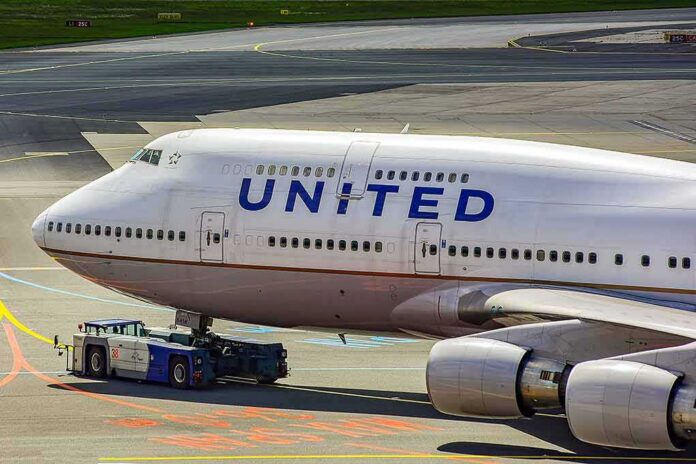
Commercial passenger aviation and military logistics are not separate worlds; they interlock by design, and in periods of high demand or constrained lift, airlines routinely become extensions of state supply chains—sometimes visibly, often not.
At a Glance
- Passenger airlines can, and sometimes do, carry declared military cargo in belly holds under civil aviation rules.
- Israel has systematically equipped its commercial fleet with defensive countermeasure pods—militarizing the platform’s protection, not just its paint scheme.
- Investigations have alleged that El Al and United moved military materiel to Israel on scheduled passenger services, including shipments transiting Irish airspace.
- The practice sits within a broader, longstanding pattern of dual-use air logistics, where commercial capacity backstops state priorities during crises.
What “using commercial airliners for military hardware” actually means
In civil aviation, “commercial passenger flight” describes the service model, not an embargo on what goes below the floorboards. International and domestic regulations allow the carriage of specific categories of weapons, components, and ammunition in checked or cargo holds, provided they are declared, packaged, and manifested in line with hazardous materials and security rules. In the United States, for example, statute and implementing regulations carve out conditions under which weapons can be transported as inaccessible checked baggage or as cargo, distinct from the absolute ban on accessible weapons in the cabin. That legal architecture exists precisely because airlines are expected to move controlled goods in a regulated way—military consignments included—especially when demand spikes and dedicated freighter capacity is insufficient.
Operationally, belly cargo on a widebody—containers, pallets, or loose-load—uses the same airport security perimeters, screening regimes, and chain-of-custody processes as any other special cargo. The distinction that matters to safety is packaging class and segregation; the distinction that matters to politics is destination and end-use. When a scheduled passenger flight also carries a crated electro-optical turret, an ammunition handling subsystem, or communications racks, the airplane is not transformed into a gunship. It is doing what civil fleets have done for decades: monetizing volumetric capacity while satisfying shipper and government demand.
Israel’s deliberate defensive militarization of civil fleets
Israel has gone further than most states by systematically fitting its commercial airliners with counter–man-portable air-defense (MANPADS) systems—podded DIRCM (directed infrared countermeasures) that detect and jam heat-seeking missiles. Elbit’s C-MUSIC and related systems combine missile warning sensors with a fiber-laser turret in a transferable under-fuselage pod, certified on common Boeing and Airbus types. The Israeli government selected these systems for all Israeli commercial carriers as a state protection measure; the program dates back more than a decade and reflects a sober threat assessment of shoulder-fired missiles near air corridors. This is defensive militarization of the aircraft’s survivability, not a statement about what cargo it carries.
That context matters for two reasons. First, it shows that Israel treats its commercial fleet as strategic infrastructure worth hardening—an unsurprising choice for a country that relies on air bridges during conflict. Second, the presence of DIRCM pods can confuse outside observers, who may conflate visible defensive kits with covert offensive use. The pods signal state involvement in airline operations, but they do not answer the separate question of what is in the belly hold on any given day.
Allegations of military cargo on passenger services: what the record shows
Several investigations have asserted that munitions or military components moved to Israel aboard scheduled passenger flights. One line of reporting examined El Al freight records and described six shipments consigned by Elbit Systems of America, labeled under U.S. Foreign Military Financing, traveling from Newark to Tel Aviv and transiting Irish sovereign airspace—shipments the outlet characterized as “munitions of war.” The claim is specific in routing and consignee and is presented as document-based.
A separate body of work focused on United Airlines, asserting that the carrier used civilian passenger flights to move military hardware at scale, with researchers tracking roughly 2,761 shipments to weapons manufacturers aboard 160 passenger flights over a seven‑month window. The framing emphasizes a return to established practice rather than a novel wartime improvisation. These are consequential numbers if accurate and, critically, fit the structural reality that passenger belly space is a routine pressure valve for defense logistics when freighter lift is tight.
What is uncontested, what is contested
On the uncontested side: Israel’s commercial airlines are equipped with state‑selected DIRCM pods; Israeli authorities and suppliers have said so for years. That is a public, defensive adaptation of civil airframes to a credible threat environment. Also uncontested: airlines, including Israel’s flag carrier, have surged cargo capacity—using passenger aircraft when necessary—during conflict, moving thousands of tonnes to maintain national supply lines. The numbers reported for El Al’s wartime cargo uplift illustrate scale rather than secrecy.
On the contested side: whether, and how often, those passenger services carried specific classes of “munitions of war” as defined by national transit rules, as opposed to dual‑use components or benign military supplies. The cited records and counts from investigative outlets are detailed and align with standard logistics patterns; they are, however, external to official Israeli confirmation. Absent an authoritative manifest released by a regulator or the carriers, the allegations remain well‑specified claims supported by shipping data rather than denials or admissions from state sources. In evaluating credibility, the mechanism fits what airlines can lawfully do; the volume alleged by United’s trackers, if borne out, suggests policy, not exception.
Why commercial lift gets tapped for military supply
Three forces drive the choice. First, capacity: the global freighter fleet is finite, and chartering widebody passenger aircraft for cargo—“preighters” or simply using the belly—can be faster than sourcing dedicated lift. Israel has its own strategic airlift, including multi-mission tankers that can mix cargo and passengers, but national requirements routinely exceed organic capacity in surges. Second, network: scheduled passenger services offer dependable frequencies, gates, and ground handling at hubs where defense suppliers already export. Third, law and policy: most jurisdictions allow properly manifested military cargo to move on passenger flights under hazardous materials and security rules, with additional state approvals as required. The system anticipates this use case; it is not a legal gray zone.
Ireland’s airspace controversy underscores the policy dimension: transit permissions and national definitions of “munitions of war” can create friction when overflight intersects with domestic law or political commitments. That is a regulatory and diplomatic question layered atop a logistics reality, not proof for or against any single shipment’s manifest.
Breaking: Israel Is Using COMMERCIAL AIRLINERS to Move Military Hardwarehttps://t.co/PLPj9vtEbZ
— Dr. Vinnie Boombatz (@Tango711th) September 13, 2026
Implications for risk, transparency, and public consent
Mixing passengers and military cargo within one fuselage raises three categories of concern—safety, security, and societal license. From a safety standpoint, the dangerous goods code already addresses compatibility, packaging, and segregation; airlines accept or reject consignments accordingly. From a security standpoint, properly declared military cargo does not make an aircraft a more attractive target than it already is as a national symbol—indeed, the Israeli decision to fit DIRCM across the civil fleet acknowledges baseline threat rather than cargo‑specific risk. From a societal standpoint, however, public consent depends on transparency to regulators and accountability to law, even if individual manifests remain proprietary. Investigations that surface shipment counts and routings nudge that accountability process forward; governments and carriers, in turn, weigh operational security against disclosure.
Bottom line
The claim that Israel is “using commercial airliners to move military hardware” is best understood not as a shocking breach of aviation norms but as an instance of those norms at work under stress. Israel has openly militarized the protection of its civil fleet; allegations that passenger services have ferried military cargo are detailed, data‑driven, and consistent with how dual‑use logistics function, even if not officially corroborated shipment‑by‑shipment. For readers, the prudent test is simple: can the mechanism carry the weight of the claim? Here, it can. The remaining debate is not about possibility, but about policy—what a given nation permits through its airspace, what a carrier accepts into its holds, and how much the public should be told when commercial and military imperatives share the same airplane.
Sources:
youtube.com, theintercept.com, en.wikipedia.org, zona-militar.com, israeldefense.co.il, jpost.com, aerospaceglobalnews.com, en.globes.co.il