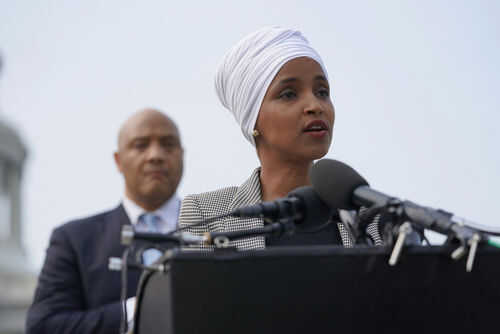
A routine ethics filing turned into a political firestorm after Rep. Ilhan Omar’s reported wealth appeared to jump into the tens of millions—then evaporated to under $100,000 with an “accounting error” explanation that even TMZ mocked.
Quick Take
- Rep. Ilhan Omar’s 2024 financial disclosure initially listed assets between $6 million and $30 million, triggering scrutiny online and from an ethics watchdog.
- Omar’s office blamed an accounting mistake involving how her husband’s business interests were reported, saying liabilities weren’t netted out.
- An amended filing later showed a net worth range of roughly $18,004 to $95,000, with liabilities including student loans and credit card debt.
- The Office of Congressional Conduct sought answers, while outlets from TMZ to Fox News highlighted the scale—and implausibility, critics argue—of the swing.
What Omar’s disclosure reported—and why the swing raised alarms
Rep. Ilhan Omar, a Democratic lawmaker from Minnesota, drew fresh attention after reporting assets in her 2024 financial disclosure that suggested a net worth far higher than prior years. The filing listed combined assets for Omar and her husband, Tim Mynett, in a range reported as $6 million to $30 million. That kind of jump matters because disclosures exist to flag conflicts of interest, not to create mystery math for the public.
Omar’s team later said the figures were inflated because Mynett’s business interests were listed in a way that failed to subtract liabilities, making gross assets look like personal wealth. In plain terms, critics saw a congresswoman who appeared suddenly rich; her office argued it was a paperwork presentation problem, not real money in the bank. The political punchline wrote itself, and the story spread quickly beyond partisan media.
The amended filing shows a far smaller net worth, but questions persist
An amended filing submitted later changed the overall picture dramatically, reporting a net worth range of about $18,004 to $95,000. The revision reflected liabilities and debts that, in the amended accounting, effectively erased the earlier multi-million-dollar appearance. Omar’s office maintained she is “not a millionaire” and said the disclosure was corrected once the issue was identified, while her attorney argued there was “nothing untoward and nothing illegal.”
The mechanics of the dispute center on spousal business interests. Mynett reportedly has partial ownership stakes in a venture capital firm and a winery, with valuations cited in reporting that fed the original “millionaire” narrative when presented without offsetting liabilities. The amended disclosure reportedly listed the businesses with no net value after liabilities were considered. That explains the numerical swing, but it also underscores why ethics filings must be easy to read and hard to game.
Why the Office of Congressional Conduct letter matters in a trust crisis
The Office of Congressional Conduct, a nonpartisan watchdog, sought answers about the discrepancy, adding institutional weight to what might otherwise be dismissed as internet outrage. That step is significant in 2026, when many voters across the right and left increasingly believe Washington’s rules protect insiders while ordinary Americans get stuck with rising costs and uneven enforcement. Even when no illegality is proven, sloppy or confusing disclosures feed the perception of a political class operating by different standards.
TMZ’s mockery and conservative skepticism reflect a broader accountability demand
TMZ’s coverage stood out because it mocked the explanation with sarcasm rather than treating the amended filing as the end of the story. Right-leaning outlets amplified the same point: a “massive accounting error” large enough to swing reported wealth by tens of millions strains credulity for many voters. Critics such as Judicial Watch’s Tom Fitton questioned how “previously unreported liabilities” could wipe out such a large figure, while Omar’s camp insisted the correction resolves the matter.
WHOA: TMZ Actually MOCKS Ilhan Omar's Claim That OOPSIE Her Accountant Made Her Rich by Accident and LOLhttps://t.co/HbZlVv6PyV pic.twitter.com/UnNNSIjMMt
— Twitchy Team (@TwitchyTeam) April 19, 2026
The most defensible conclusion from the available record is narrow: the filing was amended, the office denies wrongdoing, and no definitive public finding of fraud is established in the provided reporting. But politically, the damage can linger because the episode lands on an already raw nerve—voters who think “the system” is built for well-connected elites. If Congress wants to restore trust, it should tighten disclosure clarity, improve auditing, and ensure that “errors” don’t become a permanent escape hatch for the powerful.
Sources:
Ilhan Omar Claims Accounting Error Made Net Worth Look Higher
Ilhan Omar’s office says she’s not a millionaire after $30M filing revised to under $100K: report