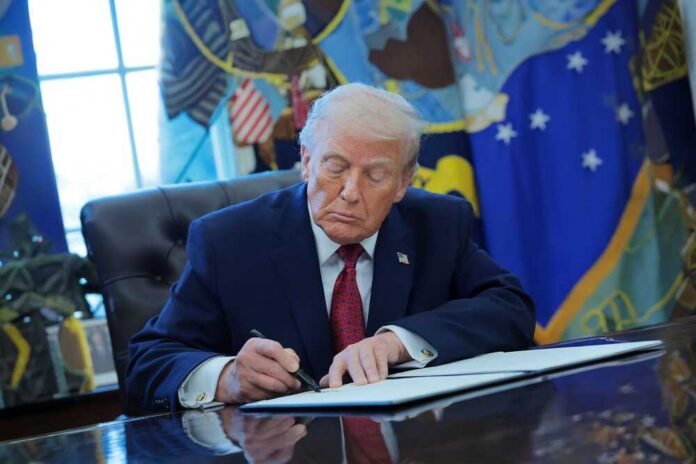
Trump is telling Americans Iran is asking for a ceasefire—while Iran’s own officials are publicly calling that claim “false,” leaving voters to wonder who’s steering the war narrative and why.
Story Snapshot
- Iranian state media and Foreign Ministry spokesperson Esmail Baghaei rejected President Trump’s claim that Iran requested a ceasefire, calling it “false and baseless.”
- Trump suggested the U.S. could end its offensive in roughly 2–3 weeks, while also floating expanded targets and issuing deadlines tied to the Strait of Hormuz.
- Iranian Foreign Minister Abbas Araghchi acknowledged messages from U.S. envoy Steve Witkoff but denied negotiations or any ceasefire request, saying trust is “at zero.”
- The Strait of Hormuz remains a central pressure point, with disruptions threatening energy prices and exposing U.S. households to higher costs.
Iran Publicly Denies Trump’s Ceasefire Claim
Iranian state TV and Foreign Ministry spokesperson Esmail Baghaei rejected President Trump’s statement that Iran’s “new regime president” asked for a ceasefire, describing the claim as “false and baseless.” Multiple reports also note that no independent confirmation has been presented publicly for Trump’s assertion beyond his own remarks. The immediate contradiction matters because it signals that the war’s diplomatic messaging may be as contested as the battlefield itself.
Iran’s denial is reinforced by comments from Foreign Minister Abbas Araghchi in an Al Jazeera interview, where he acknowledged receiving messages via U.S. Middle East envoy Steve Witkoff but said Iran was not negotiating and had not requested a ceasefire. Araghchi’s posture suggests Tehran wants to project firmness and independence, even while indirect contact channels remain open through intermediaries such as Pakistan, Egypt, and Turkey.
Trump Signals a Fast Timeline—And a Wider Target Set
President Trump has suggested the U.S. military campaign could conclude in two to three weeks, pairing that expectation with warnings that the U.S. could escalate. Reports describe Trump shifting between claims of diplomatic progress and threats of expanded military action, including strikes tied to critical infrastructure. That combination—promising a near-term endpoint while keeping the option of deeper blows—creates uncertainty for Americans trying to measure whether the administration is moving toward de-escalation or widening war aims.
Trump also tied the conflict to the Strait of Hormuz, signaling that the United States would not keep playing hall monitor for a waterway that other nations rely on heavily for energy shipments. Reports describe an April 6 deadline associated with reopening the strait and Trump’s frustration with allies. For a conservative audience already burned out on open-ended commitments, the burden-sharing message lands, but it also raises the obvious question: if the Strait remains closed, how will Washington avoid being dragged into enforcing outcomes anyway?
Congressional Authority Questions Shadow the Offensive
Another major fault line is process: reporting indicates the U.S. offensive has proceeded without full congressional approval. That fact will matter to constitutional conservatives who view war powers as a core guardrail against executive overreach, regardless of which party controls the White House. If the administration is asking Americans to accept higher risk, higher costs, and potential blowback, many voters will demand clarity on objectives, legal authority, and what “victory” realistically means.
Energy Shock Risk Hits Families First
The Strait of Hormuz is not an abstract geopolitical headline; it is a chokepoint through which roughly a fifth of global oil flows, and disruptions can ripple fast into fuel and shipping costs. Reports describe attacks and instability affecting Gulf infrastructure and supply chains, with downstream impacts on global consumers. For middle-class households, higher energy costs function like a tax—raising prices across the board and punishing commuters, small businesses, and retirees living on fixed incomes.
MAGA Frustration Grows as War Messaging Collides With “No New Wars”
Within the pro-Trump coalition, the split is increasingly visible: some voters emphasize standing with Israel and confronting Iran, while others are openly skeptical of another Middle East conflict and question the blank-check instincts that defined earlier eras. The available reporting underscores a basic problem for the White House: the ceasefire claim is disputed, the end-state remains unclear, and the messaging swings between “wrapping up soon” and threatening bigger strikes. That combination is a recipe for distrust.
What’s missing in the public record is hard verification—either proof of the alleged ceasefire request or clear terms for what a negotiated off-ramp would look like. Until the administration provides more detail, conservatives focused on limited government and national interest will keep pressing for answers: Who authorized what, what’s the concrete objective, what’s the exit ramp, and how does this avoid sliding into the kind of long war that drains American power while Washington claims it is “almost over”?
Sources:
Trump claim that Iran asked for ceasefire ‘false’: state TV
The Latest: Trump says Iran wants a ceasefire, Iran says remarks are false and baseless
Iran-US war live: Trump oil Israel Strait of Hormuz