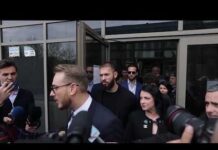
A would-be attacker targeted “administration officials,” yet the media moment that dominated the next day was a national TV interview that amplified the gunman’s vile manifesto back at the president.
Story Snapshot
- Gunman Cole Allen breached the White House Correspondents’ Association (WHCA) Dinner security perimeter at the Washington Hilton on April 25, forcing an evacuation of Trump, the First Lady, the vice president, and more than 2,500 attendees.
- During a CBS “60 Minutes” interview aired April 26, Norah O’Donnell read excerpts of Allen’s alleged manifesto, including a line warning that “Administration officials” were “targets.”
- President Trump cut in, angrily denounced CBS, and denied the manifesto’s explicit accusations, calling O’Donnell “a disgrace” for reading the words on air.
- The clash sharpened an ongoing national argument: how to inform the public about political violence without rewarding it with mass attention.
Security Failure at a Symbolic Target: The WHCA Dinner
Authorities identified the suspect as Cole Allen after he breached the WHCA Dinner security perimeter at the Washington Hilton on April 25, with shots fired and a rapid evacuation that included President Trump, the First Lady, the vice president, Cabinet officials, members of the press, and thousands of guests. The WHCA Dinner is built around the idea of press freedom; the breach underscored how exposed high-profile civic rituals can become in an era of radicalized grievance.
Coverage of the incident described the president as calm during the evacuation, with Trump later praising Melania Trump’s composure and saying he had “been through this before.” That detail matters because it frames the White House’s immediate posture as continuity of government, not panic. The larger unresolved question is practical, not partisan: how did an armed suspect get close enough to trigger a mass evacuation at one of Washington’s most predictable annual events?
“60 Minutes” Confrontation Centers on the Manifesto, Not the Breach
On April 26, CBS aired an extended “60 Minutes” interview in which anchor Norah O’Donnell asked Trump about a manifesto tied to Allen. O’Donnell read a passage alleging that “Administration officials” were “targets” and included inflammatory accusations against an unnamed figure. O’Donnell also clarified that she was quoting the gunman’s words. Trump interrupted, insisted the allegations were false, and accused CBS of misconduct for putting them on air.
Trump’s response was blunt and personal: he told O’Donnell and CBS they were “horrible people” and called her “a disgrace” for reading the accusations aloud, while explicitly denying the claims (“I’m not a rapist… I’m not a pedophile”). The exchange is already being interpreted through familiar partisan lenses, but the mechanics are straightforward: a journalist pressed for motive and context after an attack, and a president treated the on-air repetition of a shooter’s screed as an unacceptable platform.
The First Amendment vs. the Incentive to Broadcast Hate
The debate isn’t whether the press can report on a manifesto; it can. The harder question is how much detail is necessary to inform the public without inadvertently marketing a killer’s narrative. Conservatives have long argued that legacy outlets sometimes launder partisan smears by repeating them with a disclaimer, then letting the allegation linger in the public mind. Liberals counter that transparency about motive helps society understand radicalization. In this case, both sides are reacting to the same tension.
The available reporting indicates only excerpts of the alleged manifesto were made public, not a complete text, and that Allen’s social media included anti-Trump and anti-Christian rhetoric. That combination—ideological hostility plus a high-visibility soft target—fits a pattern Americans have watched repeatedly: political violence searching for maximum attention. Even when a network flags the words as the gunman’s, repetition can still grant the attacker what he wanted most: a broadcast megaphone.
What This Means Politically in 2026: Trust, Institutions, and “Elites”
Trump’s clash with CBS also lands in a broader crisis of trust. Many voters on the right see major networks as part of a protected political class that rarely faces consequences for errors, bias, or selective framing. Many voters on the left see Trump’s media attacks as pressure on independent journalism. The shared overlap is bigger than either camp admits: a growing number of Americans believe institutions serve insiders first—whether those insiders sit in corporate boardrooms, newsrooms, or government agencies.
For Republicans controlling Congress and the White House, the next chapter will likely focus less on the TV argument and more on security accountability: who failed, what protocols didn’t work, and how future events will be hardened without turning public life into a fortress. For the press, the episode raises an uncomfortable professional test: coverage that prioritizes facts about threat prevention and motive can inform citizens, but turning a manifesto into prime-time content risks deepening polarization while feeding the very attention economy that political violence exploits.
Sources:
Suspect Detained in Shooting at White House …
Running Gunman Was Tackled by Law Enforcement Near …
What we know about the suspect in shooting at White …
President safely evacuated from correspondents’ dinner …