
When a child is killed in a marked crosswalk by a driver who accelerates through a stop sign, the law’s core question is not abstract: it is whether that death was the preventable product of criminally reckless driving while impaired — and in Queens, prosecutors say they can show exactly that.
The Short Version
- Prosecutors charged a Queens motorist with second-degree manslaughter and related offenses after a crash that killed a one-year-old in a stroller and injured his nanny.
- Authorities say the driver failed a field-sobriety test at the scene and tested positive for cocaine and THC; he allegedly ran a stop sign and accelerated into a marked crosswalk with pedestrians lawfully crossing.
- The driver had a suspended license tied to a pending April 2026 DWI case in the Bronx, according to multiple reports.
- The case sits within a broader urban-safety effort: pedestrian fatalities in New York City have declined in recent years, but crashes in crosswalks remain a stubborn, preventable source of tragedy.
What prosecutors say happened on Murray Street
The charging narrative is direct and, taken at face value, damning. At approximately 8:35 a.m. on October 11, 2026, a white 2016 Chevrolet Silverado traveling north on Murray Street in Flushing allegedly rolled a stop sign at 32nd Avenue, then accelerated into the intersection and struck a stroller in a marked crosswalk. The pedestrians — a nanny and a one-year-old child, identified as Justin Hu — had the right of way. The child was rushed to a hospital and died; the nanny suffered an injury to her right arm. The driver, identified in reports as Rivera, remained at the scene and was arrested. He was later arraigned in Queens Criminal Court on charges including second-degree manslaughter, second-degree vehicular manslaughter, assault, operating a motor vehicle under the influence of drugs or a combination of substances, reckless driving, and driving while unlicensed.
The impairment case, as presented publicly, rests on two pillars: observed performance on field-sobriety tasks and a positive on-scene drug test for cocaine and THC. Multiple outlets cite authorities stating Rivera failed a field-sobriety test; a screening test administered at the scene reportedly detected both cocaine and THC. Those facts, paired with the stop-sign violation and acceleration into a pedestrian crosswalk, supply the prosecution’s theory of criminal recklessness and drug-impaired driving in the moments before impact.
The defendant’s licensing history and prior DWI case
Context matters when the state charges manslaughter rooted in unlawful driving. Reports describe Rivera’s license as suspended in connection with a pending April 2026 DWI case out of the Bronx. Accounts indicate he pleaded not guilty in that earlier matter; nonetheless, the administrative consequence — a suspension — was in effect at the time of the Queens crash, which is why driving while unlicensed appears among the charges. The Queens case thus places alleged drug impairment and reckless movement through a crosswalk atop an already unlawful decision to drive while suspended, a combination prosecutors routinely frame as compounding culpability when deaths result.
The law does draw a line between prior allegations and current proof: an open DWI case does not establish what happened in April, nor does it by itself prove causation in October. But as a licensing matter, a suspension is a concrete status. That is why, in addition to the manslaughter counts, the accusatory instrument includes the unlicensed-operation charge, which carries its own exposure and, practically, signals to the court that the defendant was not authorized to be behind the wheel that morning.
How prosecutors typically build a drug-impaired driving case
Unlike alcohol, for which blood alcohol concentration provides a well-correlated proxy for impairment, drug-impaired driving cases are inherently more complex. A positive screen for a substance such as cocaine or THC can indicate recent use, but without a validated, laboratory-confirmed toxicology panel and expert interpretation, a screening result does not by itself quantify impairment at the precise time of driving. National research has underscored that there is no universally accepted per se threshold for many drugs equivalent to the 0.08% BAC standard for alcohol; proving impairment turns on a mosaic of observations, testing, timing, and driving behavior.
New York prosecutors, aware of that evidentiary landscape, typically tie three strands together: eyewitness and officer observations (demeanor, coordination, eye movements, speech), standardized field-sobriety test performance, and toxicology. In a fatal crash, they often add reconstruction evidence — vehicle event data recorder downloads if available, skid and yaw marks, impact geometry, and visibility. The reported allegations here already include the driving sequence (rolling a stop, accelerating into the crosswalk) and field-sobriety failure, plus a reported positive for cocaine and THC at the scene. That structure is recognizable: behavior consistent with recklessness, signs of impairment, and chemical evidence pointing to substances known to degrade judgment, reaction time, and risk perception.
Urban safety backdrop: crosswalks, right-of-way, and preventable deaths
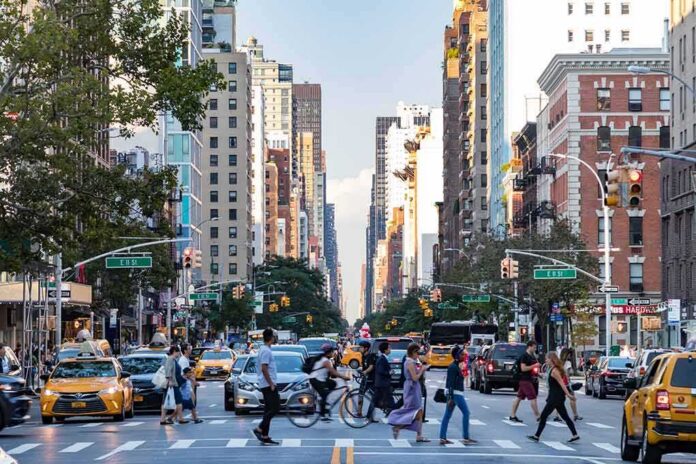
Even as New York City has made measurable progress on traffic safety, pedestrians remain the most vulnerable road users and continue to bear a disproportionate share of fatalities. City reporting shows pedestrian deaths declining over recent cycles — from 111 to 105 year over year in one series — and DOT has highlighted that the first half of 2025 recorded the lowest traffic deaths in the modern dataset, with pedestrian fatalities down from 63 to 51 year over year. That trend matters, but it is precisely crashes like this one — a driver entering a crosswalk against a stop sign while pedestrians have the right of way — that keep the numbers from falling further. In the Vision Zero framework, intersections are high-consequence environments; compliance with controls is non-negotiable if the system is to deliver its promise.
When prosecutors charge manslaughter following a crosswalk strike, they are not criminalizing misfortune; they are alleging a breach of a clear duty that urban driving imposes. Stop means stop. A marked crosswalk with pedestrians present requires yielding. The claimed acceleration into that conflict zone transforms a low-speed, zero-harm scenario — a complete stop with a two-second look — into a lethal event. That’s why the driving sequence sits at the heart of the case: it is the mechanism by which risk became death.
What to watch as the case proceeds
The early public record lays out a coherent prosecution theory: unlawful operation by a suspended driver, alleged drug impairment evidenced by a failed field-sobriety test and positive screen, a stark traffic-control violation, and a fatal result. As the case moves beyond arraignment, the technical spine will be the full toxicology — specimen type, confirmatory methods, timing relative to the crash — and any reconstruction or vehicle data that corroborate acceleration and failure to stop. While the defense has not publicly detailed an alternative account, the courtroom will be where causation and impairment are tested against evidentiary standards.
One brief caveat on stage-setting: at arraignment, allegations remain unproven, and the defendant has pleaded not guilty. The legal process is designed to convert allegations into findings through evidence, not headlines. But the public-safety lesson does not need to await a verdict. A crosswalk, a stroller, a stop sign — these are not ambiguous features of city life. They are guardrails of predictability on streets dense with human beings. When drivers honor them, tragedies like this are extraordinarily rare. When they do not, no one else on that corner has a margin for error.
Sources:
nypost.com, nydailynews.com, qns.com, abc7ny.com, cbsnews.com