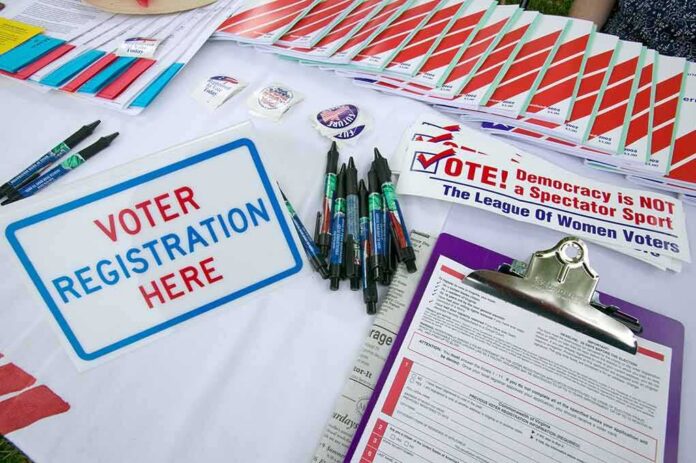
When a large, credible local poll shows a 24-point swing within a pivotal electorate days before a major face-off, that’s not color for a horse-race column; it’s a concrete signal about coalition math. In Los Angeles, the latest Berkeley IGS/Los Angeles Times survey found Councilmember Nithya Raman leading Mayor Karen Bass among likely Latino voters, 45% to 21%, with a striking share still undecided. That single cross-tab reframes the endgame of a citywide contest where Latino voters routinely constitute roughly a quarter of turnout and can decide margins in a close race.
At a Glance
- Berkeley IGS/L.A. Times polling shows Raman leading Bass 45%–21% among likely Latino voters; about a third remain undecided.
- The survey is large for a municipal race (2,150 likely voters, ~±3% overall MOE), lending procedural heft to subgroup reads.
- Raman also leads citywide in the same polling series, so the Latino finding tracks with the broader topline, not against it.
- Age splits inside the Latino electorate are divergent: younger Latinos tilt hard to Raman, older Latinos lean to Bass, a dynamic campaigns can target.
The finding: a decisive Latino lead inside a broader Raman advantage
The core empirical claim is simple and consequential: in a UC Berkeley Institute of Governmental Studies/Los Angeles Times poll fielded September 15–20, likely Latino voters favored Raman over Bass by 45% to 21%, with 34% undecided. Multiple outlets reported the same split, minimizing the chance of a transmission error between poll and press. The Latino cross-tab sits inside a larger picture: across the series, Raman held a citywide lead as well — a double-digit edge in late September reporting — which means the subgroup read complements, rather than contradicts, the topline trajectory. For a demographic that often accounts for about a quarter of actual ballots cast in recent L.A. mayoral elections, that alignment matters to outcomes.
Scale and timing matter too. With 2,150 likely city voters, the overall survey is robust for a municipal race and reported about a three-point citywide margin of error — not a cure-all for subgroup noise, but a professional baseline that elevates the Latino estimate above anecdote. Within that subsample, subsequent reporting pegged Latino respondents at 427, with an estimated six-point margin of error, and described a pronounced age gradient: Raman 60% to 9% among Latinos 18–49, Bass 36% to 26% among Latinos 50+. Those patterns are analytically coherent and electorally actionable.
Mechanism: why subgroup polling can both illuminate and mislead
Subgroup estimates are where polling does its most valuable and most fragile work. Valuable, because winning coalitions are built in segments — age, language, neighborhood, turnout propensity — and a persuasive cross-tab can reveal real movement. Fragile, because when you slice any survey, the effective sample shrinks and the error bands widen. Methodologists have been blunt: national or citywide polls frequently have ample overall N but insufficient Latino Ns to support fine-grained inference; margins of error balloon as sample sizes drop, and weighting assumptions pull more weight than readers often realize. None of that negates the Berkeley/L.A. Times read; it clarifies how to treat it — as a strong snapshot within a competent instrument, not a proclamation of permanence.
Language access, likely-voter screens, and age composition further shape Latino reads. Younger Latinos are overrepresented among first-time or intermittent voters and are more reachable via online modes; older Latinos often have higher vote regularity and distinct media diets. A bilingual, bicultural approach generally improves coverage of the electorate’s diversity; without it, you risk skewing toward higher-propensity, English-dominant respondents and mistaking mode effects for persuasion. The reported 427-person Latino subsample and notable age split are consistent with a poll that captured both ends of this spectrum — younger, more Raman-leaning respondents and older, more Bass-leaning voters — producing a net Raman advantage.
How we got here: a moving target over the cycle
Elections are narratives punctuated by data points. Earlier in the cycle, public polling showed Bass ahead among Latino voters; a May snapshot had Bass at 29% and Raman at 9% among Latinos — a very different picture from October. Between those bookends, the Berkeley/L.A. Times series moved citywide toward Raman, with late-September reporting describing an 11-point lead and a large undecided bloc. In that context, the Latino cross-tab does not stand alone; it sits atop a trendline where undecided voters — including many Latinos — were still evaluating, and where issue salience around homelessness, wildfire recovery, and public safety shaped perceptions debate by debate.
A large undecided share softens any pundit’s impulse to declare a realignment. But campaigns cannot wait for textbook certainty; they allocate resources based on the best evidence available. If you are Bass, the older-Latino edge signaled by the age split offers a defend-and-expand path with senior-focused field, neighborhood Spanish-language radio, and institutionally rooted validators. If you are Raman, a 60–9 youth margin among Latinos suggests maximizing registration, vote-by-mail chase, and turnout operations tuned to renters and service workers — the electorate that tends to appear last and swing late.
What the divergence inside “Latino voters” actually means
“Latino voters” is an analytical convenience that conceals a complex electorate spanning nativity, language, generation, class, region, and issue priorities. In Los Angeles, turnout history shows Latinos often constitute about a quarter of ballots even though their share of the population is far higher — a gap driven by age structure and participation rates that campaigns must bridge with persuasion and mobilization. The Berkeley age split maps onto that reality: younger Latinos, who are more progressive on housing and immigration and often more digitally reachable, tilt to Raman; older Latinos, more anchored in neighborhood institutions and attentive to public safety and cost-of-living stability, lean Bass.
Operationally, that means two different playbooks. Appeals to renters’ rights, production incentives to protect Hollywood jobs, and accountability on homelessness programming resonate differently by age and neighborhood. Debate-stage contrasts on emergency management and policing — including arguments about wildfire preparedness and officer staffing — are filtered through these lived experiences. The cross-tab doesn’t dictate outcomes; it identifies the hinge points where campaigns either match message to segment or miss them.
There's a real decision brewing in Los Angeles. Nithya Raman, currently polling at 39%, is challenging incumbent Mayor Karen Bass. The election is November 3rd.
Bass's campaign highlights accelerating nearly 47,000 affordable housing units. That sounds like a lot, but look at…
— Bottom Line Bella 📊 (@veeranhq) October 4, 2026
Reading the poll responsibly: what endures beyond the headline
Three conclusions travel well beyond this news cycle. First, the Latino 45–21 split is a credible, consequential data point because it is housed in a reputable local series, replicated across major outlets, and consistent with the same poll’s citywide direction. Second, subgroup results are inherently more variable than toplines; analysts should weigh the larger undecided share and the age cleavage when projecting durability. Third, the strategic lesson is clear: Latino voters are not a monolith but a coalition within the coalition — and the path to 50% plus one in Los Angeles runs through the specifics of who turns out, in which neighborhoods, with what concerns.
Sources:
nypost.com, latimes.com, abc7.com, yahoo.com, newsroom.ucla.edu