
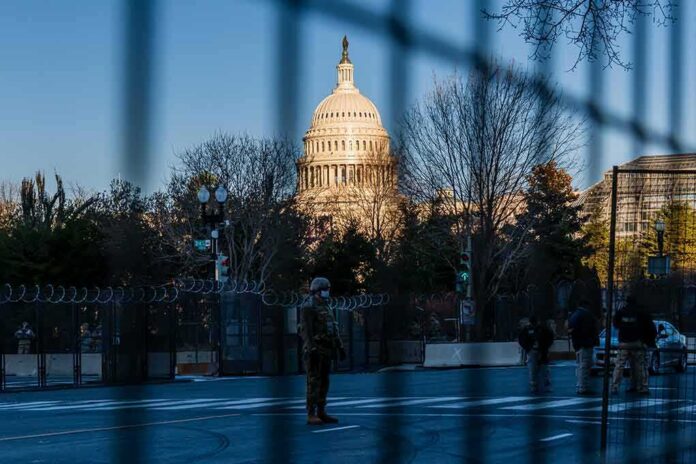
Authorizing the District of Columbia National Guard to field marked patrol cars, military tactical vehicles, and patrol boats is not a drift into domestic soldiering; it is a defined expansion of logistics and presence in support of civilian law enforcement, bounded by longstanding legal constraints and executed under clear visibility rules.
At a Glance
- Two memoranda signed October 29 authorized up to 60 marked patrol cars, military tactical vehicles, maritime assets, and up to 20 light towers and generators for D.C. Guard support missions.
- The authorization explicitly includes two patrol boats for operational maritime support, with requirements that vehicles be visibly marked “National Guard” and troops operate in uniform.
- Multiple independent outlets reported the same authorization, scope, and date, indicating broad alignment on core facts.
- The policy sits within the well-defined legal line between military “support” and direct law enforcement “execution,” shaped by the Posse Comitatus Act and National Guard status rules.
What Hegseth Authorized and Why the Details Matter
According to contemporaneous reporting, Defense officials issued two memoranda on October 29, signed by Defense Secretary Pete Hegseth, authorizing the D.C. National Guard to employ a suite of assets in support of federal and local law enforcement operations. The package included up to 60 marked patrol cars, unspecified military tactical vehicles, maritime patrol boats, and as many as 20 light towers and generators. Critically, the guidance required National Guard marking on vehicles and uniforms for personnel—signaling an overt, accountable presence rather than covert policing. The maritime component was explicit: two patrol boats would provide operational support on District waterways, augmenting perimeter and pursuit options coordinated with civilian authorities.
The scale and specificity distinguish this action from routine Guard assistance. The ceiling—60 patrol cars and up to 20 light towers—creates predictable capacity for visible patrol surges, traffic control support, event security backstopping, and nighttime operations where lighting can be decisive. While outlets described “military tactical vehicles” in general terms, examples such as Humvees are consistent with prior Guard urban-support roles, where durability and mobility are the draw, not firepower. The authorization itself does not convert Guard members into police; it equips them to support police with transport, scene security, maritime mobility, and logistics.
How This Fits Within U.S. Law: Support vs. Execution
American law draws a bright line between supporting civilian law enforcement and executing civilian law. The Posse Comitatus Act (PCA) generally forbids the use of the federal military to perform domestic law enforcement functions—arrest, search, seizure—unless Congress authorizes it. The National Guard’s status is pivotal: Guardsmen operating under state authority (Title 32 or state active duty) are not considered “federal troops” for PCA purposes, but when the Guard is federalized (Title 10), the PCA limits attach. Congress’s nonpartisan research arm has summarized these distinctions for decades, emphasizing that domestic missions must be structured to avoid military execution of the laws, even when the military provides substantial equipment and manpower in a support posture.
Support typically includes transportation, communications, perimeter security, traffic management, search and rescue, disaster response, and specialized capabilities like aviation or maritime assets—roles that assist civilian agencies but do not substitute for them. The October 29 authorization lands squarely in that domain: marked vehicles and uniformed troops performing visible, coordinated tasks that extend police reach and endurance without supplanting police authority. That is why the memoranda’s identification and uniform rules matter; they reinforce the chain of accountability and the “support not supplant” principle embedded in the PCA framework.
Operational Mechanics: What These Assets Actually Enable
Marked patrol cars and tactical vehicles are force multipliers. They move personnel quickly to where police need perimeter control, free sworn officers from static posts, and sustain presence in neighborhoods or around events without draining local police overtime budgets. Light towers and generators expand safe operating hours, improve scene management after dusk, and increase deterrence where visibility reduces opportunistic crime. Maritime assets extend that support to the Potomac and Anacostia—deterring flight by water, improving interagency coordination during special events near waterfronts, and giving incident commanders options when suspects exploit river boundaries. Reports indicate that Guard boats were specifically tasked to provide “operational maritime support,” a clear, bounded role.
None of this suggests Guard personnel are empowered to execute arrests as a primary function. Where jurisdictions have previously extended limited authority—such as detentions under the supervision of deputized federal officers—those arrangements have been formal, temporary, and circumscribed, often under U.S. Marshals Service oversight and with explicit constraints. The October 29 permissions, as reported, are focused on vehicles, boats, and support equipment—capabilities that are valuable precisely because they scale police capacity without crossing into police prerogatives.
Public Perception and the “Militarization” Critique
Critics often argue that armored trucks and Humvee silhouettes blur the line between police and soldiers. That concern is not frivolous; visible military hardware can alter how communities experience everyday security. At the same time, presence is a policy lever. The requirement that cars be clearly marked “National Guard,” that personnel remain in uniform, and that support be coordinated with civilian agencies helps maintain transparency about who is doing what—and under whose authority. Framing the deployment around patrol cars, light towers, and maritime platforms, rather than weapons or arrest powers, also reflects an intent to add mobility and logistics rather than coercive authority.
Several outlets reported the same core facts about the authorization, the date, and the categories of equipment, including the ceiling on vehicles and light towers, and the maritime role. That alignment across Associated Press, The Hill, Politico, Stars and Stripes, and others signals a broadly uncontested factual baseline about what was approved and how it was to be presented in public spaces. The question that remains policy-relevant is not whether the authorization occurred—it did—but how commanders and civilian partners implement it on the street to preserve the support-execution boundary the law demands.
United States Expanded National Guard patrols in Washington DC have been approved. New equipment includes light towers, dozens of vehicles, patrol boats, and the arming of some soldiers with rifles. Currently they are mostly military police, specially trained on and carrying… https://t.co/86aiw0sThl
— AVSEC Pro (@avsec_pro) November 7, 2026
Historical Pattern: Not New, But Always Contested
Domestic use of the National Guard is older than the modern city; what changes is the mission mix. The Guard has secured desegregation orders, stabilized riot-torn neighborhoods, and managed hurricanes, pandemics, and mass gatherings. Each episode revives the same legal and civic questions: when does prudent support turn into impermissible policing, and how does the government demonstrate fidelity to the PCA’s limits? The Congressional Research Service’s analysis underscores the durable logic here: transparency, civilian command, and a mission design that keeps Guardsmen as supporters, not substitutes, are the safeguards that keep domestic assistance lawful and legitimate.
Applied to D.C., the October 29 authorization fits the historic pattern of using Guard mobility, logistics, and visibility to buttress civilian agencies during periods of elevated operational demand. The policy’s marking and uniform provisions are not cosmetic; they are the rule-of-law guardrails that have allowed similar deployments to function without collapsing the distinction between soldier and cop. Multiple outlets have documented the memos’ content and limits; one brief caveat is that reporting focused on authorization rather than full deployment records, which is typical in early operational phases.
What to Watch: Implementation Discipline and Measurable Effects
The value of this authorization will be measured in execution: interagency coordination, adherence to visibility requirements, disciplined mission creep avoidance, and whether the presence helps police reallocate sworn officers to tasks that require arrest authority. If commanders stick to mobility, perimeter, and maritime support—and if the “National Guard” markings and uniforms are consistently maintained—the operation remains on well-traveled legal ground. Over time, the proof will be administrative, not rhetorical: deployment logs, after-action reviews, response-time deltas, and incident trends that show whether the extra wheels, boats, and lights improved public safety without eroding the civilian character of law enforcement.
Sources:
zerohedge.com, apnews.com, stripes.com, clickondetroit.com, inquirer.com, washingtonexaminer.com, congress.gov, bpr.org