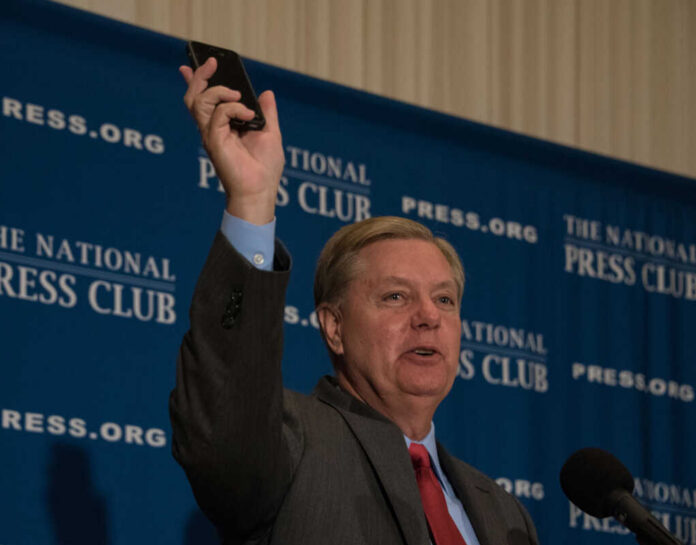
Senator Lindsey Graham visibly lost patience with NBC’s Kristen Welker when she repeatedly questioned whether President Trump has a concrete plan to deal with Iran, sparking a heated on-air confrontation that exposed the ongoing disconnect between conservative policy approaches and mainstream media expectations.
Story Snapshot
- Graham sharply rebuked NBC host for questioning Trump’s Iran strategy after explaining it multiple times
- Trump’s approach uses tariffs on countries purchasing Iranian oil to financially strangle the terrorist regime
- Exchange highlights media’s persistent skepticism toward practical conservative foreign policy solutions
- Graham’s frustration reflects broader GOP irritation with journalists demanding detailed “plans” while ignoring proven results
Media Confrontation Exposes Policy Communication Gap
Senator Lindsey Graham confronted NBC’s Kristen Welker on Meet the Press after she repeatedly pressed whether Trump possesses a specific Iran strategy. Graham had already outlined Trump’s approach multiple times during the interview, explaining how tariffs targeting countries that purchase Iranian oil would cut funding to the terrorism-sponsoring regime. The senator’s exasperation culminated in his pointed question: “How many times do I have to tell you?!” This exchange occurred during broader discussions about Middle East policy, including Gaza ceasefire negotiations and Saudi-Israel normalization efforts that could reshape regional stability.
Tariffs as Economic Leverage Against Terrorism
Graham defended Trump’s strategy of imposing reciprocal tariffs on nations like Russia and China that purchase Iranian oil, thereby funding proxy terrorist organizations like Hezbollah. This approach mirrors Trump’s first-term success using tariffs to change behavior in China and Mexico, demonstrating that economic pressure works when applied consistently. Unlike the Obama-Biden JCPOA nuclear deal that Trump abandoned in 2018, this “maximum pressure” strategy directly targets Iran’s revenue streams without conceding sanctions relief. Graham emphasized that countries aiding Iran through oil purchases would face immediate economic consequences, forcing behavioral change without military escalation.
Conservative Strategy Versus Media Skepticism
The confrontation reflects a persistent pattern where mainstream media questions conservative solutions despite their proven effectiveness. Graham’s frustration stems from explaining a straightforward economic deterrence strategy multiple times while Welker continued demanding what she characterized as a detailed “plan.” This disconnect reveals how journalists often dismiss practical conservative approaches that prioritize American interests and leverage economic strength over diplomatic concessions. Trump’s reciprocal tariff framework represents limited government action with maximum impact, precisely the type of approach conservatives favor over expensive interventionist policies that defined previous administrations.
Graham positioned tariffs as tools for forcing adversaries to cease enabling Iran’s terrorism sponsorship while maintaining domestic energy independence. His comments came after a Ukraine trip where he observed firsthand how Russia-Iran oil relationships fund regional destabilization. The senator also offered bipartisan support for Saudi-Israel normalization if it genuinely advances Middle East peace, demonstrating conservative willingness to support practical solutions regardless of which administration pursues them. However, Graham stressed that lasting Gaza stability requires Arab leadership replacing Hamas governance, rejecting Biden’s temporary ceasefire optimism without addressing underlying terrorist infrastructure.
'How Many Times Do I Have to Tell You?!' Lindsey Graham Snaps at NBC's Kristen Welker Asking if Trump Has 'A Plan' On Iran https://t.co/wrK47PKclI
— Mediaite (@Mediaite) March 1, 2026
Graham’s defense of Trump’s Iran approach underscores a fundamental conservative principle: economic strength properly deployed achieves national security goals without entangling America in endless foreign conflicts. This confrontation with NBC exemplifies the frustration many Americans share when media figures refuse to acknowledge straightforward policy explanations. As Trump returns to office in 2026, this tariff-based deterrence model may well define a new era of American foreign policy that prioritizes results over diplomatic theater, protecting national interests while avoiding the globalist compromises that weakened America’s position during previous administrations.
Sources:
Trump says he signed a 10% global tariff after Supreme …
Congressional Research Service Report on Iran