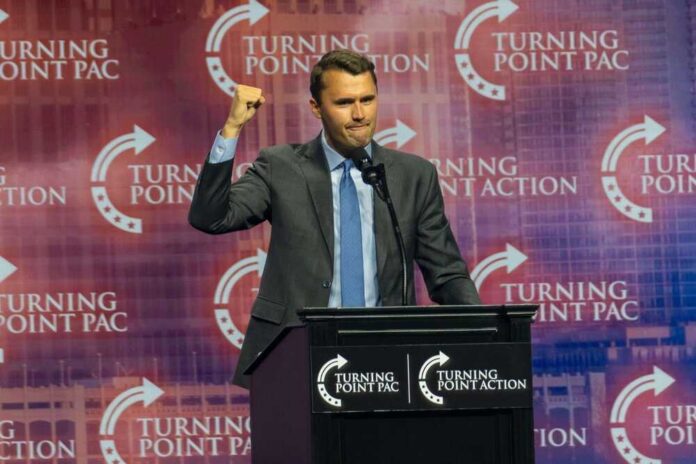
A “hate map” meant to warn the public has become a political weapon that critics say can put everyday Americans—especially campus conservatives—directly in harm’s way.
Story Snapshot
- In 2023, Turning Point USA founder Charlie Kirk warned that the Southern Poverty Law Center’s “hate map” blurred the line between violent extremism and mainstream political advocacy.
- Conservative sources later tied that warning to Kirk’s assassination at a TPUSA event at Utah Valley University, arguing the labeling climate “puts people in the crosshairs.”
- As of 2025, the SPLC listed Turning Point USA as an “antigovernment extremist,” intensifying GOP calls for oversight of how the nonprofit influences government and media.
- Supporters of SPLC argue it tracks extremism; critics counter that broad labels chill speech and can fuel real-world threats.
Why a “Flashback” Story Is Resurfacing Now
Turning Point USA allies are circulating a “flashback” to 2023 comments in which Charlie Kirk criticized the Southern Poverty Law Center’s practice of labeling conservative organizations, arguing it unfairly equated mainstream campus activism with violent groups. The available reporting does not clearly show Kirk using the exact phrase “hate group” to describe SPLC in 2023, but it does document his warning that SPLC’s hate-map style designations could put people at risk.
The renewed attention comes from how the warning is now framed after Kirk’s death. According to the research provided, the “flashback” is being used to argue that public “extremist” lists can create a permission structure for harassment—especially in high-tension environments like universities. The key factual limitation is that most of the material circulating today is retrospective; it leans heavily on interpretation of motive and effect rather than a single definitive 2023 soundbite.
What the SPLC Labeling Dispute Is Really About
The core dispute is definitional power: who gets to decide what counts as “hate” or “extremism,” and what happens when those labels are applied beyond clearly violent actors. SPLC, founded in 1971, built its brand tracking hate groups through its “Hate Map,” but critics argue it later expanded into branding mainstream conservative organizations as extremist. In the research, TPUSA is portrayed as pro-Constitution, pro-life, and pro-family—yet allegedly treated as comparable to groups like the KKK.
That is not just a public-relations fight. The research points to a precedent conservatives frequently cite: the 2012 Family Research Council shooting, where the gunman reportedly cited the SPLC map. Even without claiming direct legal responsibility, that episode functions as a warning for many Americans: when major institutions label ideological opponents as dangerous, unstable individuals may treat the label as justification. From a limited-government perspective, this is also a caution about private “watchdogs” gaining quasi-official authority.
How Kirk’s Warning Collided With a Violent Reality
The timeline described in the provided sources is what gives the story emotional force. In 2023, Kirk warned that SPLC-style mapping put activists “in the crosshairs.” Later, SPLC “Hatewatch” content reportedly mentioned Kirk shortly before his death, and Kirk was then assassinated during a TPUSA event at Utah Valley University. SPLC condemned the shooting afterward, but critics point to the sequence as evidence that stigmatizing lists can escalate tensions beyond political argument.
Based on the research, Andrew Sypher of TPUSA has argued the labeling regime “villainizes open dialogue,” and he treats Kirk’s earlier warning as prophetic. The strongest verifiable point here is not a claim of direct incitement—something the provided reporting does not conclusively prove—but the broader risk: when civic disagreement is reframed as “extremism,” people can become targets. That concern resonates across ideological lines in an era of rising political violence.
The Political Stakes: Oversight, Influence, and Credibility
The dispute also sits inside a larger Washington story about influence networks and accountability. House Republicans previously probed SPLC’s access to the Biden White House, including reported meetings, and conservatives have continued questioning whether the nonprofit’s work is treated as authoritative by federal agencies and legacy media. In a second Trump term with GOP control of Congress, that oversight instinct is only stronger—especially when “disinformation” and “extremism” frameworks increasingly shape policy debates.
FLASHBACK: Charlie Kirk Called Out the Southern Poverty Law Center as a 'Hate Group' Back in 2023 https://t.co/8a2oXqWix1 #gatewaypundit via @gatewaypundit
— Debbie (@LottaCats454) April 23, 2026
Meanwhile, SPLC’s credibility is being fought over in the open. The Washington Times report cited in the research describes ongoing conservative pushback as SPLC lists TPUSA as an “antigovernment extremist,” and it notes similar disputes involving organizations like PragerU. The limited data in the provided material includes few full-throated SPLC defenses beyond its general anti-extremism posture, so readers should recognize the source set is unbalanced. Still, the underlying issue—who controls the label-maker—has become a defining flashpoint of modern politics.
Sources:
Charlie Kirk dismisses SPLC as ‘laughingstock’ after listing Turning Point as ‘hate’