

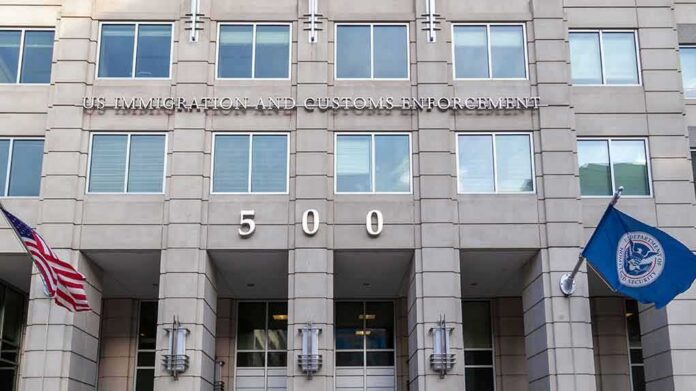
The meaningful line in a high-profile federal search is not the headline-grabbing address but the legal threshold it crosses: a judge found probable cause that evidence of specific immigration-related offenses could be found, and Homeland Security Investigations executed that warrant with the Justice Department’s authorization. That is the concrete development. Everything else—speculation, slogans, and decade-old rumor—sits downstream of that fact.
At a Glance
- Justice Department officials confirmed that HSI executed a judicially authorized search warrant tied to an ongoing federal criminal investigation involving Rep. Ilhan Omar.
- Multiple outlets reported the probe centers on immigration paperwork, with potential offenses including false statements and fraud in immigration documents.
- Reporting indicates investigators are examining whether Omar derived citizenship through a parent whose own naturalization eligibility may be in question.
- Senior administration officials publicly acknowledged an active investigation; no charges have been filed as of the confirmed search.
What Happened: A Judicially Authorized Search In An Active Federal Case
The Department of Justice stated that Homeland Security Investigations executed a search warrant “secured by the Department of Justice” at or near Rep. Ilhan Omar’s Washington-area residence. The department characterized the operation as part of an “ongoing federal investigation,” confirming both judicial approval and an active criminal inquiry—not a preliminary inquiry, not a mere request for records, but a warrant-based search that requires probable cause under the Fourth Amendment.
According to reporting that cited sources familiar with the matter, the warrant and investigative focus relate to immigration paperwork and potential immigration-fraud offenses—specifically, alleged false statements in immigration documents and related conspiracies. ABC News linked the search to Omar’s immigration paperwork, while other coverage summarized potential statutory theories as including false statements and fraud in immigration filings. Those are weight-bearing assertions because they define the legal frame of the inquiry and explain why HSI, the investigative arm of DHS with primary authority over document and immigration fraud, is leading execution of the warrant.
The Legal Frame: What Immigration-Fraud Investigations Actually Test
Immigration-fraud cases turn on precision. For a naturalization-related criminal charge under 18 U.S.C. § 1425(a), prosecutors must prove the defendant knowingly misrepresented or concealed a material fact and that the misrepresentation caused the grant of the immigration benefit—an exacting causation element reinforced by Supreme Court precedent and DOJ charging guidance. Civil denaturalization actions under the Immigration and Nationality Act require a similar showing: illegal procurement or procurement by willful misrepresentation of a material fact. In both tracks, “material” means the fact had a natural tendency to influence the decision; “caused” means the misrepresentation played a role in the conferral of status. Sloppy insinuations do not meet this bar; documentary contradictions often do.
Reason’s summary of New York Times reporting points to a specific investigative question: whether Omar derived citizenship through a father who may have been ineligible to naturalize—a theory that, if substantiated, would test derivation rules and the materiality of any misstatement connected to that parent’s eligibility. That line of inquiry fits the mandate HSI routinely executes in document-fraud and status-fraud cases, and it aligns with the kind of evidence warrants are designed to seize: original identity documents, application packets, correspondence with preparers or interpreters, and digital communications that speak to knowledge and intent.
What Is Known Versus What Is Often Repeated
Two categories of claims have circulated for years around Omar’s biography: disputes over family relationships and allegations tied to her marriages. The warrant-confirmed development here is narrower and more concrete: federal investigators are testing immigration paperwork and potential false statements. Reports that the brother-marriage allegation has been made “without evidence” remain relevant context; they are not the engine of the current legal action as described in the strongest sourcing. Public officials, including the DHS Secretary and the Vice President, have acknowledged an ongoing investigation and pledged prosecution if crimes are found—statements that affirm the posture of the case without proving its elements. One sentence of caveat matters for scope: no criminal charge, indictment, or released affidavit establishing Omar’s personal commission of immigration fraud has been identified in the public record as of the search.
Parallel coverage has also touched on Omar’s amended financial disclosures. The correction moved an initially reported asset range in the millions down to tens of thousands, with the explanation that liabilities had not been deducted by an accountant. A House ethics review reportedly voted to clear her of wrongdoing, which weakens any direct inference that the filing error itself indicates intentional financial deceit. Whatever its political resonance, that ethics disposition is analytically distinct from the immigration-paperwork probe.
How Federal Agents Build (or Dismiss) an Immigration-Fraud Case
Experienced document-fraud investigators proceed in layers. First, they consolidate every identity-linked artifact across agencies: refugee intake forms, I-130s and I-485s, naturalization applications, passports, school and civil records—then reconcile names, dates, and biographical kernels for internal consistency. Second, they source-test the documents: who prepared them, who translated, who witnessed signatures, and what contemporaneous communications exist around the filing. Third, they overlay legal thresholds: was any misstatement knowing, was it material, and did it cause the benefit to be granted. Case law and DOJ practice emphasize the causal link; immaterial inaccuracies and innocent mistakes do not support the charge.
When a derivation theory is in play—whether a child’s status flowed from a parent’s naturalization—the parent’s eligibility becomes a hinge issue. Investigators may scrutinize the parent’s own entry pathway, identity attestations, and any disqualifying conduct that was concealed. If a parent’s naturalization is deemed illegally procured, the legal consequences fork: civil denaturalization cases against the parent, potential criminal exposure if willful fraud is proved, and complex downstream questions about the durability of a derivative grant. DOJ has periodically launched waves of denaturalization and related actions when patterns of concealment surface, underscoring the institutional familiarity with these mechanics.
Politics, Process, and Why Probable Cause Is Not Proof
Searches involving sitting members of Congress are rare and inherently political in their public effects. That is precisely why the lodestar for analysis should be the legal process rather than the decibel level of commentary. A federal magistrate judge’s probable-cause finding authorizes a search; it does not establish guilt. DOJ’s confirmation that it secured the warrant and that the case is active is dispositive of what stage we are in. From here, the investigative arc is procedural: execution and inventory of seized items, forensic review, potential witness interviews or grand jury testimony, charging decisions—or declination—based on the interplay of evidence and statutory elements.
The appropriate standard for public judgment mirrors the prosecutorial one: match claims to documents, timelines, and statutes. If the government ultimately alleges that a misstatement was knowing and material and that it caused the conferral of status, the proof will look like discrepancies across sworn forms, corroborated by contemporaneous communications or testimony from preparers. If, instead, the evidentiary record shows clerical error, mistaken translation, or immaterial inconsistencies, the criminal theory collapses on causation and intent. That is not spin; it is the law that governs how these cases are won or lost.
Homeland Security Investigations executed a court-approved search warrant at the Minnesota Democrat's Washington-area home on Monday; no charges have been filed, and the timing has set off a sharp partisan fight. https://t.co/Pw63mvp6YE
— AmericanDailyPress (@USDailyPress) October 13, 2026
What To Watch Next
Three developments would meaningfully advance public understanding: unsealing of the warrant affidavit and inventory, which would specify the alleged offenses and the evidentiary spine; any civil or criminal action targeting a parent’s eligibility if a derivation theory is central; and charging decisions—or a formal declination—from DOJ. Until then, the confirmed facts are clear: HSI executed a DOJ-approved, judge-authorized search as part of an immigration-paperwork probe that senior officials acknowledge is ongoing. In the American system, that is serious. It is not, by itself, the end of the story.
Sources:
facebook.com, abcnews.com, kpbs.org, denverpost.com, axios.com, reason.com, france24.com, detroitnews.com, dailycaller.com, usatoday.com