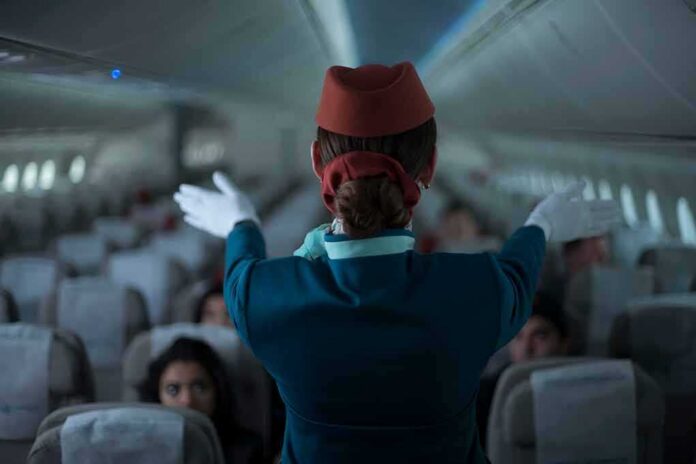
When a modern airliner silently dials 7500 into its transponder and diverts under armed escort, you are watching a mature safety system doing exactly what it was built to do—translate chaos on the flight deck into clear signals on the ground, trigger practiced countermeasures, and give crews precious space to resolve a life-threatening problem.
At a Glance
- Flydubai confirms an in-cockpit altercation on FZ1073 bound for Tel Aviv; the 737 MAX diverted safely to Tabuk with all aboard accounted for.
- The aircraft first broadcast squawk 7700 (general emergency) then 7500 (unlawful interference/hijack), prompting a robust regional response.
- Reporting identifies the co-pilot, Hamam al-Hammami, and surfaces a pattern of violent, misogynistic social media posts during remote study at a UK university.
- Squawk 7500 is an alert, not a diagnosis; aviation security treats it as real until proven otherwise because the downside of delay is catastrophic.
What We Know About Flight FZ1073: The Safety System in Motion
Flydubai has stated that “an altercation occurred in the flight deck of flight FZ 1073” and that the crew diverted to Prince Sultan bin Abdulaziz Airport in Tabuk, Saudi Arabia, where the aircraft landed safely and all passengers and crew were accounted for. That single paragraph—spare, procedural—is how professional airlines speak under crisis: confirm the operational facts, defer speculation to investigators, and signal control of the situation. Publicly available flight-tracking data and subsequent reporting align: the Boeing 737 MAX transmitted squawk 7700, the standard general emergency code, and then 7500, the internationally recognized code indicating unlawful interference, commonly referred to as the hijack code.
Those codes matter because they anchor decision-making across the system. Air traffic control treats 7500 as a real hijacking until proven otherwise; air defenses posture; destination airports prepare. This is not theater. It is a risk calculus honed by decades of painful lessons: a false positive can be unwound, a slow response to a real cockpit takeover cannot.
Squawk 7700 and 7500: What They Signal, How Crews Use Them
Transponder “squawk” codes are a pilot’s silent alarm panel. Three are universally reserved: 7700 flags a general emergency (from medical crises to rapid decompression), 7600 signals radio failure, and 7500 declares unlawful interference. In practice, a crew may start with 7700 to get immediate priority handling and then, as facts clarify, set 7500 to cue the hijack protocol—an escalation path consistent with the FZ1073 sequence reported by multiple outlets.
Why not just transmit 7500 outright? Because in a dynamic cockpit emergency, a captain is managing aviate-navigate-communicate in that order. If an assault or struggle is unfolding, 7700 buys airspace priority and assistance without verbally tipping off an aggressor; 7500 then aligns responders on the specific threat. The important distinction for lay readers: 7500 does not prove a hijacking in a legal sense—only that the crew signaled one. But operationally, that difference is immaterial in the moment; the system must assume the worst until it can safely assume less.
The Suspect and His Digital Footprint
Named reporting has identified the co-pilot as Hamam al-Hammami, now in custody, and has surfaced a corpus of online posts attributed to him during a period when he was studying remotely at Buckinghamshire New University in the UK. The Telegraph and other outlets describe misogynistic and violent rhetoric, including statements that women should be “stomped on,” endorsements of harsh punishments in the name of religious law, and praise for violence—all compiled from an X account linked to his name and persona. Universities and employers will ask two questions after an episode like this: did vetting miss an already-visible pattern, and are social media audits a reliable proxy for risk? The first is empirical and typically addressed by internal reviews. The second is more complicated: online speech can be probative when identity linkage is strong and the pattern is consistent over time, but investigators still have to tie authorship and intent to behavior in the cockpit, which is the province of criminal inquiry, not content analysis.
For the traveling public, the significance of those posts—if the linkage holds—is that they may help explain motive and inform future screening. For the safety case, their existence did not determine the outcome. What determined the outcome was a resilient crew, additional trained personnel among passengers, and a set of procedures that move an aircraft and its souls on board from unstable to safe as quickly as the physics of jet transport allow.
False Alarms Exist; The Protocol Still Stands
Aviation history contains false or ambiguous 7500 episodes. Mis-set transponders have scrambled fighters; garbled radio exchanges have led to inadvertent hijack codes, later resolved as misunderstandings. A LOT Polish Airlines flight in 2026 triggered three nations’ alerts after a hijack code that authorities later attributed to malfunction or error; Korean Air Flight 085 on 9/11 complied with an ATC instruction to squawk 7500 amid miscommunication, generating a now-famous false alarm. These cases form the backdrop to why professionals emphasize that 7500 is an alert, not a diagnosis. But they also reinforce why the posture is “treat as real.” The cost of mobilizing and then standing down is measured in fuel and overtime. The cost of waiting is measured in lives.
That principle is codified in controller rulebooks and airline checklists: if you see 7500, you assume unlawful interference and respond accordingly. FZ1073’s diversion to Tabuk fits that template exactly. The code’s use here is therefore a feature, not a flaw, of the system’s design.
Why Incidents Like FZ1073 Become Narratives Battlegrounds
Within an hour of the emergency signal from FZ1073, conspiracy content was circulating online attributing the event to shadowy plots or political manipulation—an unfortunately common pattern after high-salience security incidents. Monitoring groups documented thousands of posts within the first half-day pushing false-flag claims and alternate culprits. The tactic is familiar: fill the vacuum before verified details settle, muddy causal interpretations, and make later corrections feel like partisan rewrites rather than simple facts asserting themselves.
Countering that dynamic requires two disciplines. First, operational institutions must publish verified kernels fast—what the airline confirmed, what the codes were, where the airplane landed. Flydubai did so. Second, readers need a mental model robust enough to resist ambient speculation. Understanding that 7700 and 7500 are professional signals with defined meanings—and that their sequence tells you something about cockpit triage—helps. Skepticism is healthy; cynicism is corrosive. The former waits for the record; the latter invents one.
Security Lessons: Vetting, Redundancy, and Human Factors
Aviation security is not a single gate; it is layered defense. Pilot vetting and recurrent evaluation are the first layers, but they are not foolproof—people change between checks, and ideology can radicalize quickly. That is why aircraft are engineered with reinforced cockpit doors, why crash axes are secured yet accessible, why airlines roster augmenting crew on certain routes, and why procedures quietly ask: what if the threat comes from inside the flight deck? The answer is redundancy—of personnel, of training, of routes to a safe diversion—and a culture that empowers decisive action when a scenario deviates from script.
FZ1073 is, in that sense, a success story nested inside a serious breach. A failure somewhere allowed an in-cockpit altercation to occur; multiple other systems then performed as designed to prevent catastrophe. Investigations will apportion the former. The latter is already visible in the data: a coded alert, a controlled diversion, and 182 people who stepped off a jet in Saudi Arabia instead of into a disaster.
Sources:
feedpress.me, telegraph.co.uk, lbc.co.uk, nypost.com, indianexpress.com, thesun.co.uk, bbc.com, aa.com.tr, en.wikipedia.org, upday.com, mirror.co.uk, ynetnews.com, ndtv.com, express.co.uk, newsminimalist.com