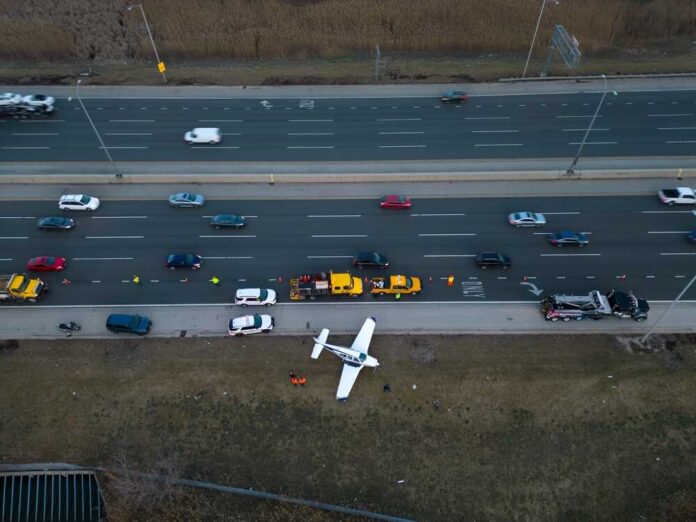
A twin‑engine training plane falling onto a Florida freeway without killing anyone is dramatic enough—but the early clues about fuel starvation raise deeper questions about safety, judgment, and who is really watching the skies over America’s highways.
Story Highlights
- A Beechcraft Baron training flight lost power and crash‑landed on I‑95 near Merritt Island, striking a Toyota sedan.
- All aboard the aircraft walked away; the 57‑year‑old driver in the car suffered minor injuries in what many call a miracle escape.
- Early federal data points to fuel starvation, renewing concerns about training standards and basic airmanship.
- Dashcam and 911 audio show stunned motorists and a dispatcher struggling to process a “plane out of the sky” over a busy interstate.
Training Flight Turns Florida Freeway Into Runway
A routine training flight over Florida turned into a terrifying highway scene when a Beechcraft 95‑B55 Baron lost power returning to Merritt Island Airport and came down on Interstate 95 near the King Street interchange. Investigators say the twin‑engine aircraft, on a local training profile of more than an hour, suddenly suffered power loss on final approach at roughly 1,500 feet, leaving the crew with barely a minute to pick a landing spot and attempt to save lives on board and on the ground.
Dashcam and traffic camera video show the Baron descending with landing gear and flaps extended, both propellers windmilling, before it settles directly onto the rear of a southbound Toyota Camry. The impact crushed the trunk but narrowly missed the driver compartment, sparing the 57‑year‑old woman behind the wheel from anything worse than minor injuries. Two 27‑year‑old men in the cockpit, likely pilot and instructor on a training sortie, escaped the mangled airplane without serious harm.
Stunned 911 Dispatcher Captures Public Shock
Immediately after the impact, stunned motorists flooded 911 with reports that a plane had just landed on top of a car on the interstate. Recordings later released by news outlets capture a dispatcher repeating back, almost in disbelief, that a “plane… out of the sky” had come down onto I‑95. That human reaction—mirroring what any driver might feel hearing such a claim—became a central focus of media coverage and reminded many viewers how quickly everyday life can be disrupted by events far beyond their control.
For conservative Americans already wary of chaos on the roads, from crime to distracted driving, the idea that a twin‑engine airplane can suddenly drop into freeway traffic adds yet another layer of unease. While pilots are trained to choose the “least bad” option in an emergency, highway landings shift the risk from those who chose to fly to families simply commuting to work or church. That tension between aviation necessity and public safety is driving renewed questions about how training operations are managed near major transportation corridors.
Fuel Starvation Concerns and Training Culture
Federal databases now list the defining event in this accident as fuel starvation, meaning fuel was present but not reaching the engines—a failure that often points back to human factors rather than sudden catastrophic hardware failure. Aviation records also indicate this particular Baron had experienced previous engine issues before the day of the crash, raising fair questions about oversight, maintenance decisions, and whether a twin with that history belonged on a prolonged instructional flight over busy highways and neighborhoods.
Pilot‑analyst channels dissecting the ADS‑B track and video have zeroed in on the combination of a long training sortie, low‑altitude power loss, and a rapid forced landing decision. They are using the case to highlight basic but too often neglected disciplines: conservative fuel planning, strict adherence to checklists, and deep familiarity with fuel‑system quirks in older twins. For readers who value personal responsibility, the early fuel‑starvation classification underscores how critical individual judgment remains, even in a heavily regulated industry.
Balancing Emergency Decisions With Public Safety
The geography around Merritt Island complicates any emergency: swamp and wetland flank the interstate, and there are few flat, obstruction‑free fields within gliding distance when engines quit at 1,500 feet. Faced with swamp, trees, or a straight stretch of I‑95, the pilots chose the pavement. From an airmanship standpoint, the outcome—no fatalities and only minor injuries—will be cited as evidence that their decision avoided a much uglier crash into terrain or structures. For the woman in the Camry, however, there was no say in becoming part of that calculation.
Stunned 911 dispatcher reacts to plane crash-landing on Florida freeway: 'A plane … out of the sky?' https://t.co/WzYZcKRBTf
— Fox News (@FoxNews) December 12, 2025
Investigators from the FAA and NTSB are now working through the standard process: examining wreckage, reviewing maintenance logs, and interviewing those involved before issuing a formal probable‑cause finding. For now, I‑95 is open again and life has moved on for most commuters. Yet the dashcam footage and incredulous 911 audio will continue circulating online, reminding Americans how thin the margin can be between routine travel and catastrophe—and why serious, disciplined safety culture matters more than any talking‑point about regulation or bureaucracy.
Sources:
911 audio released after plane crashes on Florida highway – Fox News video segment