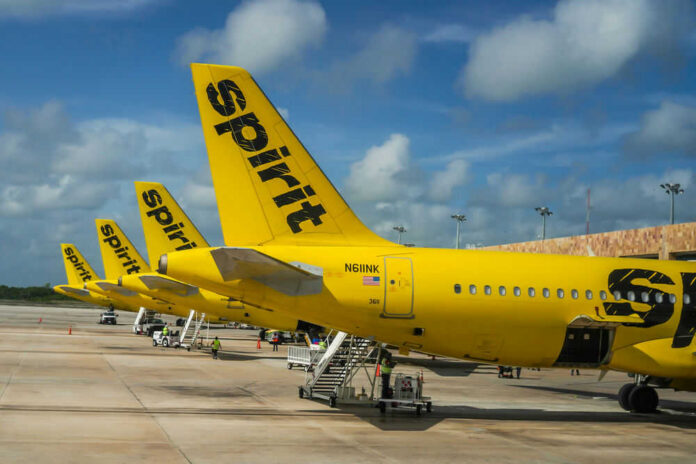
President Trump’s openness to a taxpayer-backed takeover of Spirit Airlines is reviving a hard question for conservatives: when does saving jobs become corporate welfare?
Quick Take
- Trump said he would consider a taxpayer-funded takeover of bankrupt Spirit Airlines “for the right price,” with a goal of protecting jobs and later selling the company for a profit.
- Bankruptcy-court discussions indicate the administration and Spirit are in advanced talks on government financing that could help Spirit exit Chapter 11.
- Reported terms include roughly a $500 million loan paired with warrants that could give taxpayers a meaningful ownership stake.
- Transportation Secretary Sean Duffy has publicly questioned whether aid would simply delay an inevitable liquidation.
Trump’s “Right Price” Pitch: Jobs Now, Profit Later
President Trump told reporters Thursday that he is weighing a taxpayer takeover of Spirit Airlines if the government can get it “for the right price.” Trump framed the idea as a two-part plan: stabilize the carrier, preserve jobs, and then sell the company when conditions improve—specifically after oil prices fall. That argument aims to distinguish the concept from a no-strings bailout, but it still puts taxpayer capital at risk.
Spirit’s situation gives the White House a narrow window to act. The airline employs about 14,000 workers, and its bankruptcy has become a public test of whether the administration prefers market outcomes or targeted intervention. Trump had recently encouraged private buyers to step in, but he also signaled federal help could be on the table. With Republicans controlling Congress, the political barrier is lower than in past divided-government showdowns, though public scrutiny remains intense.
What Bankruptcy Court Revealed About the Deal Mechanics
The most concrete details have emerged from Chapter 11 proceedings rather than press releases. During a U.S. Bankruptcy Court hearing in New York, Spirit’s attorney indicated the airline is in advanced talks with the U.S. government about financing that could enable Spirit to emerge from Chapter 11. Reports describe a potential structure involving roughly a $500 million loan along with warrants—an equity-like instrument that could translate into substantial government ownership if exercised.
That structure matters because it changes how taxpayers participate in the upside and downside. A plain loan positions the public as a lender, first in line to be repaid only if the reorganized company can generate cash. Warrants, by contrast, tie taxpayers to the company’s future valuation and can resemble partial nationalization in everything but name. Supporters argue it aligns incentives and could recoup costs; critics counter that government ownership tends to politicize business decisions.
Viability Questions: Duffy’s Warning and the Liquidation Risk
Transportation Secretary Sean Duffy has acknowledged the pressure point that often gets buried in bailout debates: whether new money actually fixes the business or just delays failure. Duffy publicly questioned whether the government would be “putting good money into a company that inevitably is gonna be liquidated.” That concern reflects a conservative instinct for fiscal restraint—especially after years of voter anger over inflation and the sense that Washington backstops well-connected institutions.
Spirit’s headwinds are not theoretical. The carrier has struggled with sustained losses, operational challenges, and a harsh competitive environment for ultra-low-cost airlines. Elevated fuel prices have been a major strain, and Trump’s profit thesis hinges partly on the assumption that oil will drop enough to make Spirit more valuable later. The administration has not publicly released a full cost-benefit analysis, so outsiders cannot yet evaluate whether the “sell for a profit” scenario is realistic or optimistic.
Why This Fight Lands in the “Elites vs. Everyone Else” Crosshairs
Politically, a Spirit rescue sits at the intersection of two voter frustrations that now overlap on the right and left: skepticism toward “big corporate” privilege and distrust of federal decision-making. Many Americans believe government intervention frequently rewards insiders while ordinary families face higher prices, tighter budgets, and fewer second chances. In that environment, even a jobs-first rationale can read as selective compassion—especially if layoffs in other industries get no comparable federal backstop.
At the same time, bankruptcy outcomes can ripple beyond one company. Spirit’s disappearance could reduce low-fare competition on key routes, which can raise prices for working families who depend on budget travel. The administration has also signaled resistance to major airline consolidation, including opposition to certain merger scenarios. From an America First perspective, keeping competition alive and protecting U.S. jobs can be legitimate priorities; the unresolved question is whether Washington can do it without normalizing permanent rescue culture.
For now, the public facts point to a deal that is close enough to be discussed in court but not final enough to judge on outcomes. The key tests will be transparency on terms, protections for taxpayers, and a clear exit plan that doesn’t turn a “temporary” rescue into long-term government management. If the administration can show strict safeguards, the move may look like hard-nosed bargaining. If not, critics will call it another chapter in bailout politics.
Sources:
Trump weighing taxpayer takeover of Spirit Airlines, CBS News
Spirit Airlines bailout talks with Trump administration, CBS News
Trump says he wants somebody to buy Spirit Airlines, opposes United-American merger, Fox Business