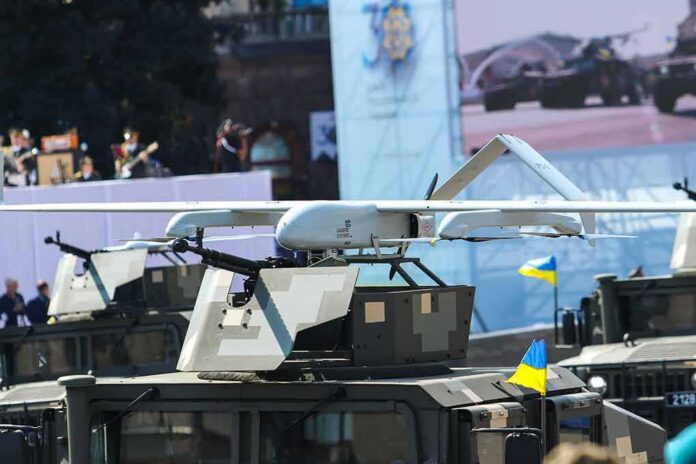
The most consequential change in Ukraine’s war with Russia is no longer happening along the trenches, but across the dozens of kilometers behind them, where midrange drones are systematically turning Russian rear areas from safe havens into contested battlespace.
Key Points
- Verified Ukrainian midrange drone strikes have severely degraded Russian ground-based air defense and rear-area logistics, creating exploitable gaps in coverage.
- These drones—especially FPV and systems like the Hornet—are used in coordinated campaigns against radars, bridges, depots, and fuel infrastructure, not just frontline trenches.
- Russia intercepts large numbers of drones and retains substantial air-defense and electronic warfare capacity, but cannot achieve comprehensive denial; saturation and attrition favor Ukraine’s low-cost systems.
- The strategic effect lies less in headline-grabbing single strikes and more in the cumulative erosion of Russia’s ability to move, mass, and resupply forces in occupied Ukraine.
From Tactical Gadgets to an Operational Strike System
When Russia’s full-scale invasion began, Ukrainian drones were largely improvisations: commercial quadcopters jury-rigged to drop small munitions or spot artillery. Within a few years, that improvisation hardened into an integrated, multi-layered “drone wall” in which unmanned systems now provide the vast majority of targets for Ukrainian fires and account for a large share of Russian casualties. At the front, tens of thousands of first-person-view (FPV) drones function as miniature precision-guided weapons, making it prohibitively dangerous for Russia to mass armor or infantry in the open.
Midrange drones extend this logic into the enemy’s rear. Instead of merely killing soldiers in trenches or disabling individual vehicles, Ukrainian units use medium-range strike UAVs to attack air defenses, logistics hubs, railways, and bridges tens of kilometers behind the line. The Institute for the Study of War has visually documented more than one hundred successful strikes on Russian ground-based air defense systems and radars since late 2025, a pattern that points to a deliberate campaign rather than opportunistic harassment. Ukraine’s own arms analysts report more than 300 verified drone strikes against Russian air-defense assets and rear infrastructure over roughly the same period. The shift is clear: drones are now tools of operational interdiction.
This is not purely Ukrainian innovation; Russia also fields large numbers of midrange drones and glide bombs, striking Ukrainian rear areas and logistics hubs as well. But the evidence indicates that Ukraine has achieved particular success in using intermediate-range drones to erode Russia’s traditional advantages in layered air defense and concentrated artillery, especially in sectors where Ukrainian forces can mass unmanned systems.
How Midrange Drones Attack Air Defense and Logistics
Midrange drones operate in a band between cheap frontline FPV systems and expensive, long-range strategic strike drones. In Ukrainian hands, that band is being used to dismantle the connective tissue of Russia’s occupation force: the radars, missile batteries, fuel trains, depots, and bridges that allow a large army to function as a coherent system.
The method is cumulative. Instead of seeking a single decisive blow, Ukraine conducts thousands of individual strikes distributed across rear-area targets. ISW’s battlefield data show peaks of more than 2,000 unique hits per day in May 2026—an intensity that would be impossible to sustain with traditional manned aviation or cruise missiles. Swarms of low-cost drones probe for gaps, exhaust missile stocks, and exploit weaknesses in Russian electronic warfare coverage.
One element of this campaign is the systematic targeting of Russian air defenses. By repeatedly striking radars and launchers, Ukrainian drones create temporary “corridors” in coverage through which longer-range systems can penetrate deeper into Russian territory. This is not unusual: modern air campaigns often begin with suppression of enemy air defenses. What is novel is that Ukraine is achieving SEAD-like effects primarily with unmanned, relatively inexpensive platforms, rather than manned strike aircraft.
The second element is logistics interdiction. Ukrainian midrange drones have struck ammunition depots, fuel storage sites, and rail infrastructure in occupied territories and in Russia proper, with particular emphasis on Crimea and the land bridge through southern Ukraine. These strikes rarely annihilate an entire theater-level supply system, but they impose steady friction—forcing Russia to reroute trains, disperse storage, and accept longer, more vulnerable supply lines. Recent analysis suggests that overland routes feeding Russian forces in Zaporizhzhia, Kherson, and Crimea are increasingly under midrange drone threat, raising the cost and risk of resupplying the southern grouping of forces.
The Chonhar Bridge, linking northern Kherson to Crimea, illustrates the logic. Ukrainian drones reportedly inflicted enough damage to force a complete closure and halt traffic, at least temporarily. Satellite imagery and ground reports are still being refined, but the operational point is not whether a single bridge is permanently disabled; it is that midrange drones now routinely reach and disrupt such critical chokepoints, compelling Russia to spread its logistics across more—and more vulnerable—routes.
The Hornet and the Rise of AI-Enabled Strike Systems
Beyond classical FPV systems, Ukraine has begun fielding more sophisticated midrange platforms such as the US-made Hornet UAV. These drones reportedly incorporate AI-assisted navigation and target recognition, allowing them to function effectively even in contested electromagnetic environments where radio links are degraded by Russian jamming. Ukrainian sources describe instances in late 2025 and early 2026 in which Hornet-equipped units achieved local “drone overmatch” after suppressing Russian unmanned capabilities—essentially flipping sectors of the front from being dominated by Russian drones to being dominated by Ukrainian ones.
The broader trend is toward autonomy. Both Ukrainian and Russian militaries have moved beyond purely human-in-the-loop control, experimenting with drones that can follow pre-programmed routes, choose among designated target types, or adjust to jamming without direct operator input. In some cases, this produces what Russian commentators describe as “autonomous flying robots” capable of independent target engagement. For midrange strike campaigns, this matters because it reduces vulnerability to electronic warfare. A drone whose guidance and warhead employment are increasingly self-contained is harder to disrupt.
At the same time, claims that Russia has “no effective countermeasures” against specific systems like Hornet are overstated. Russia invests heavily in electronic warfare, decoys, layered air defenses, and physical hardening of key sites. Battlefield evidence shows that EW remains essential but cannot guarantee persistent denial; it produces localized, temporary effects that force both sides to adapt but does not restore the kind of clean sanctuary rear areas once enjoyed. The realistic picture is not unilateral Ukrainian invulnerability, but a dynamic contest in which midrange drones have shifted the advantage toward the attacker’s ability to generate cheap, flexible strike capacity faster than the defender can patch every hole.
Russian Interceptions, Attrition, and the Limits of Counter-Claims
Russian officials regularly emphasize impressive interception numbers, sometimes claiming to have shot down more than two hundred Ukrainian drones in a single night. Crimean authorities have reported relatively low casualty figures from specific attacks, and Russian-appointed governors often attribute fuel shortages or local disruptions to “logistical delays” rather than catastrophic destruction. These statements are part of Moscow’s effort to frame Ukrainian drone campaigns as costly but ultimately contained—dramatic footage, limited effect.
Some of these claims are plausible; high interception rates are consistent with dense air-defense networks and extensive use of electronic warfare. Others are clearly political messaging. What is missing, on the Russian side, is specific, independently corroborated forensic data that directly refute the more detailed Ukrainian accounts of successful strikes on particular depots, fuel trains, or air-defense batteries. General assertions about interceptions do not negate the growing corpus of geolocated imagery and open-source analysis showing repeated Ukrainian hits on rear-area targets.
The evidentiary asymmetry is typical of drone wars. Analysts of previous campaigns—from Pakistan to Yemen—have noted that strike severity and effect tend to follow lognormal distributions, with few spectacular events and many moderate ones that are harder to assess from outside. In Ukraine, this translates into a gap between claimed effects and verified effects on both sides. Ukraine sometimes overstates casualty or destruction figures; Russia understates them. Independent organizations such as ISW, the BBC’s verification unit, and specialized open-source teams therefore anchor their assessments in visual confirmation: satellite imagery, geolocated videos, and repeat documentation over time.
Within that verified evidence base, the pattern is clear enough to draw firm conclusions. Ukrainian midrange drones are hitting Russian air defenses and logistics at scale, and Russia’s countermeasures, while substantial, are insufficient to prevent meaningful degradation of rear-area security. Interceptions limit damage; they do not prevent drones from reshaping the risk calculus behind the front.
Operational Impact: Turning Rear Areas into Contested Space
What has this actually done to the battlefield? The most immediate effect is on mobility. Tanks, self-propelled guns, and logistics convoys that once moved relatively freely in rear zones now face continuous risk of detection and attack by drones roaming tens of kilometers beyond the line of contact. Western military analyses note that in some sectors, armored vehicles have ceased maneuvering altogether during daylight, relying on concealment and limited night movements to avoid becoming easy drone targets.
Another effect is on tempo. Sustaining offensive operations requires reliable flows of ammunition, fuel, and reinforcements to staging areas. As midrange drones strike depots and choke points, Russia must either accept disruptions or invest heavily in dispersal and redundancy—both of which slow decision cycles and complicate planning. Ukrainian and allied analysts argue that this erosion of logistical coherence is one reason Russian large-scale ground offensives have become rarer, shorter, and more costly.
Strategically, midrange drone campaigns have helped Ukraine offset deficits in traditional airpower. Lacking fleets of strike aircraft capable of deep interdiction, Ukraine has built an unmanned strike network that can target Russian refineries, ports, and industrial facilities hundreds of kilometers away, while midrange systems gnaw at the operational seams closer to the front. Reuters reporting cited by the Irregular Warfare Center, for example, attributes a significant temporary reduction in Russia’s oil export capacity in part to concerted Ukrainian drone attacks on refineries in early 2026. This kind of economic interdiction compounds the battlefield impact by shrinking Russia’s resource base for sustaining the war.
Yet the war has not become a clean exercise in “drone-enabled maneuver” leading to sudden collapses of major formations. Serious military scholars stress that while drones have drastically increased attrition and constrained movement, they have not—so far—produced the operational shock necessary to turn local disruptions into sweeping encirclements or theater-level routs. The front remains largely static; drones are accelerating grinding attrition rather than unlocking rapid maneuver. Midrange systems are reshaping the character of the fight behind the front, but within a broader context of positional warfare.
Putin Pressure Watch, 6 July
The real story today is the space behind the front.
For years, Russia could still move men, fuel and ammunition through rear areas that were dangerous, but not constantly hunted. That space is now disappearing. AP reports that Ukrainian midrange…
— NazeINhaze (@NhazeINhaze) July 6, 2026
What This Means for Future Wars
Ukraine’s midrange drone campaign against Russian rear areas is a preview, not an anomaly. Across conflicts from the Caucasus to the Middle East, drones have already eroded the distinction between front line and rear, making long-range interdiction accessible to actors without large air forces or expensive missile arsenals. The Ukraine case pushes that trend further, demonstrating that a state under attack can, within a few years, build layered unmanned strike capabilities that rival or partly offset an adversary’s traditional advantages.
Several lessons stand out. First, rear-area sanctuary can no longer be assumed. Any force operating within range of cheap midrange drones must treat logistics hubs, air-defense batteries, and bridges as exposed assets requiring continuous dispersion, camouflage, and rapid repair capacity. Second, electronic warfare and air defenses, while vital, are insufficient on their own. They must be integrated into adaptive operational concepts that assume leakage and plan around it, rather than promising absolute protection that reality cannot deliver.
Third, the side that can combine mass-production of drones with intelligent employment—selective targeting of high-value nodes, coordinated campaigns against air defenses and logistics, and creative use of autonomy to defeat jamming—can impose disproportionate costs on a stronger opponent. Ukraine has not won the war through drones, but it has fundamentally altered the cost-benefit calculus for Russia’s occupation of its territory.
For militaries watching from afar, the real stakes lie not in any single dramatic strike, but in the emerging doctrine. Ukraine’s midrange drones are showing how to turn what once looked like tactical gadgets into an operational system of rear-area interdiction. Future wars will be fought in that space behind the front as much as on the front itself—and the side that prepares for that reality now will be far better positioned than the one that assumes its logistics are safely out of reach.
Sources:
military.com, understandingwar.org, ukrainesarmsmonitor.substack.com, en.wikipedia.org, bbc.com, youtube.com, facebook.com, hisutton.com, researchcentre.army.gov.au, kyivpost.com, aljazeera.com