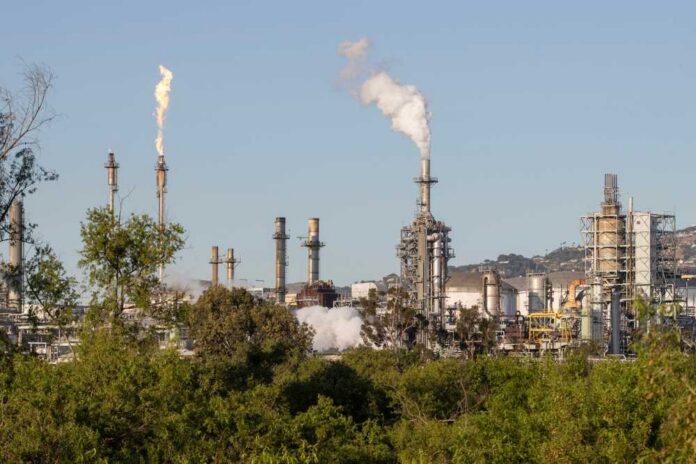
China’s “independent” oil refiners are being forced to bleed cash, and the ripple effect should worry every American who cares about energy security and honest markets.
Story Snapshot
- China’s private “teapot” refiners have slashed operations to their lowest level since 2017 as losses explode.
- Beijing is ordering refiners to keep fuel flowing “at any cost,” even while they lose over $100 per ton of crude processed.
- Tighter Chinese runs and slower Asian buying are pressuring Middle East oil and reshaping global crude prices.
- The crisis exposes the danger of command-and-control energy policy and why America must stay energy independent.
China’s Refiners Hit a Wall as Losses Pile Up
China’s independent refiners in Shandong province, called “teapots,” have cut their operating rates to about fifty percent of capacity, the weakest level since 2017 and even below pandemic lows.[7] These small refiners are a major part of China’s import machine and act as a real-time signal of demand for physical crude. High crude costs, weak fuel demand at home, and tight limits on fuel exports have turned refining into a money-losing business, so many plants are dialing back runs.[7]
Trade and consulting data show just how bad the math has become. In late April, independent refiners were losing an estimated five hundred to six hundred yuan, or roughly seventy-four to eighty-eight dollars, on every metric ton of crude they processed.[19] One commodities provider reported that in April 2026 alone, Chinese refiners lost about six hundred forty-nine yuan per ton, after showing a profit of two hundred sixty-nine yuan per ton just one year earlier.[19] By June, average losses had grown further, hitting about seven hundred fifty-two yuan per ton.[3]
Beijing’s Command Economy Meets Energy Reality
Even as losses mounted, China’s powerful state planner ordered private refiners in early April not to cut their operating rates below the average of the last two years, warning that crude import quotas could be reduced for anyone who did not comply.[19] Reports from April said officials told refiners to keep output at 2025 levels “at all costs,” placing national fuel supply above company profits or balance sheets.[12] In June, planners slightly eased the rules, letting some teapots trim runs, but only down to at least eighty percent of last year’s levels, which still forces many plants to operate in the red.[3]
New tax rules have added more pressure. Earlier policy changes cut feedstock tax rebates to about fifty to eighty percent of a key fuel consumption tax, raising costs by roughly thirty-three to eighty-three dollars per ton and adding losses of three hundred to six hundred yuan per ton for smaller refiners.[5] At least four plants with a combined annual capacity of about eighteen million metric tons have shut or entered open-ended “maintenance” because they cannot survive under the new tax and tariff burden.[5] For many of these operators, state demands for more fuel and higher taxes land at the same time.
Global Oil Markets Feel the Strain
The cutbacks are not only a Chinese problem. Independent refiners in Shandong usually act as “marginal buyers” for Middle East crude, stepping in when others will not. Now their utilization has dropped to just over fifty percent, the lowest in nine years, and Asian refiners more broadly have slowed purchases of Middle Eastern oil after a recent buying wave.[1] Analysts note that, unless refining profits improve or demand suddenly jumps, Middle Eastern producers may have to cut prices to move barrels in a world where Chinese buyers are stepping back.[2]
@ChinaSelect https://t.co/FDVzkJB4HB
"Pillar 2—The Buyer of Last Resort.
Finding 3: China exploited Western sanctions to become the buyer of last resort for discounted crude. Western sanctions on Russian, Iranian, and Venezuelan crude were designed to reduce the revenue… pic.twitter.com/GcxwXcAxv1
— Alberto (@jedoradodebeza) June 22, 2026
Broader Asian refining tells a similar story. As the war in Iran and the closure of the Strait of Hormuz disrupted crude flows from the Middle East, several refineries across Asia cut runs and even shut units because they could not secure enough feedstock.[10] In China, one major refinery supported by a Saudi company shut a two hundred thousand barrel per day unit, while another cut an eighty thousand barrel per day train for an unknown period.[10] Global markets are feeling both a physical squeeze on supply routes and a demand shock from refiners that simply cannot profit at today’s costs.
Why This Matters for American Patriots
For American readers, this crisis is a warning about what happens when politicians, not markets, control energy. Beijing is forcing private companies to buy expensive crude, then sell fuel at controlled prices to avoid unrest, treating their losses as the cost of “national stability.”[8] State planners decide how much plants must run and even block exports of diesel and gasoline to keep domestic supplies high.[15] This is command-and-control energy, and it is crushing private industry while hiding the true cost from everyday citizens.
China’s troubles also show why American energy independence and free-market pricing matter. When one-fifth of China’s refining capacity can be pushed into deep losses by political orders and tax games,[13] the ripple effects reach global crude prices, shipping routes, and even what we pay at the pump here at home. If Washington copied Beijing’s model—tight export controls, price caps, and central planners picking winners—our refineries, our workers, and our families would pay the price. The answer is the opposite: more domestic production, fewer mandates, and policies that let American energy compete and win on a level field.
Sources:
[1] Web – China’s Refiners Slash Runs To Lowest Since 2017, As Asia Refiners …
[2] Web – China’s independent refiners cut output in May as losses … – Reuters
[3] Web – Sources say that China’s independent refining companies cut …
[5] Web – China’s Independent Oil Refiners Slash Runs to Nine-Year Low
[7] Web – Iran War: China orders private refineries to maintain output “at all …
[8] YouTube – Private Refineries Crushed for National Stability
[10] Web – China has reportedly ordered its major state-owned and private …
[12] Web – China orders independent refineries to maintain fuel production
[13] Web – China Tells Private Refiners to Keep Up Fuel Output at All Costs
[15] Web – CHINA INDEPENDENT OIL REFINERIES: Refiners succumb to …
[19] Web – China’s Independent Refiners: A New Force Shaping Global Oil …