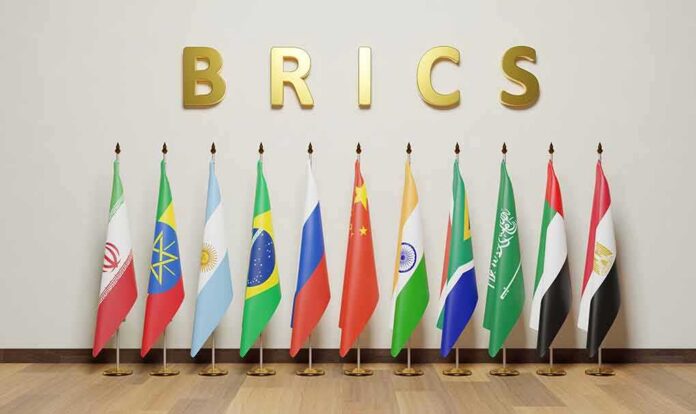
BRICS is not trying to replace the dollar with a grand new currency; it is building the plumbing that lets members settle more trade and finance more projects in their own money—an incremental, technical strategy that matters precisely because it is operational, not theatrical.
At a Glance
- BRICS leaders endorsed expanding local-currency trade settlements and investments while rejecting a common BRICS currency.
- The bloc’s Payment Task Force is focused on cross-border payment interoperability—fast, low-cost, and safe rails over headline symbolism.
- The New Development Bank was tasked to increase local-currency financing and diversify its funding mix.
- The approach is voluntary, country-led, and cumulative—consistent with a decade of BRICS communiqués backing local-currency use.
What BRICS actually decided: optionality over orthodoxy
The New Delhi Declaration anchors a clear policy direction: members will “discuss trade settlements and investments using BRICS local currencies,” pursue practical fixes to cross-border payments, and lean on the New Development Bank (NDB) to expand local-currency lending. Officials were explicit about what this is not: there is no proposal for a common BRICS currency, no mandatory settlement scheme, and no attempt to supplant the global dollar system in one stroke. The language is careful—“respecting national priorities,” “no one-size-fits-all”—because the mechanism here is choice architecture, not fiat decree. Countries keep the dollar when it serves them, and use domestic units when the economics or politics make that better.
That preference for optionality reflects where the most stubborn frictions actually live. Cross-border payments are still too slow, too costly, and too fragmented for small and mid-size firms in emerging markets. The summit therefore highlighted the BRICS Payment Task Force’s technical work: interoperability among payment and messaging systems and solutions that are faster, cheaper, and safer across borders. In payments, “interoperability” means different domestic systems—real-time gross settlement, fast retail rails, and message standards—can talk to one another without bespoke one-off bridges. It’s unglamorous engineering, but it’s what moves volume in the real world.
How the mechanics work: rails, settlement, and development finance
Local-currency settlement is straightforward in concept. Two firms agree to invoice and pay in their own currencies; their banks clear through central bank accounts or correspondent relationships; any residual exchange-rate risk is hedged with swaps or forward contracts. What limits uptake is not theory but plumbing: messaging standards that don’t align, compliance checks that don’t port across systems, liquidity and hedging tools that are shallow or expensive, and settlement windows that miss business hours across time zones. Hence the BRICS emphasis on linking payment systems and standardizing messages before leaping to a new unit of account.
The NDB mandate matters for a different reason. Project finance sets currency habits because contractors, suppliers, and lenders match the currency of loans with the currency of receipts. When the NDB lends in reais, rand, rupees, or yuan—rather than defaulting to dollars—it seeds local-currency ecosystems: swap demand, bond benchmarks, and bank balance-sheet capacity in those units. The declaration’s call for the NDB to expand local-currency financing and diversify funding is therefore a concrete lever for durable change, even if the bank remains modest in scale relative to members’ infrastructure needs.
Why “no common currency” is a feature, not a bug
Calls for a single BRICS currency reliably generate headlines, but they founder on the hard prerequisites of a shared unit of account: common monetary policy, fiscal backstops, and willingness to mutualize risk. BRICS is a coalition, not a treaty-based monetary union; its comparative advantage is coordination, not consolidation. By rejecting a premature currency project and concentrating on standards, pipes, and institutional habits, the bloc aligns with the pattern scholars describe as partial de-dollarization: gradual increases in local-currency use in trade and finance alongside payment-network upgrades, without a structural break in the dollar’s international role.
This agenda is also continuous, not episodic. Earlier BRICS communiqués welcomed the use of local currencies and urged stronger financial cooperation; the New Delhi text extends the same line with more detailed marching orders on payments and the NDB. Reuters’ factbox on the 2024 Kazan declaration captured the throughline succinctly: “We welcome the use of local currencies in financial transactions between BRICS countries and their trading partners”. The current decisions slot directly into that longer arc.
Iran’s push and sanctions as a forcing function
Within this shared agenda, members’ motivations differ. Iran has pressed the case most forcefully, arguing that concentration of trade and finance in “a limited number of currencies” makes the system vulnerable to political shocks. Tehran’s position is rooted in experience: under extensive sanctions pressure, it must either find alternative rails and currencies or face chronic payment disruptions. That logic is not uniquely Iranian; Russia’s trade realignment since 2022 has produced similar behavior, with national-currency settlement proliferating where sanctions and banking restrictions bite hardest. The summit’s emphasis on reciprocal settlement tools, risk-management instruments, and NDB local-currency credit lines mirrors those operational needs.
The consequence is not an anti-dollar manifesto but a portfolio strategy. For sanctioned economies, local currencies are survival tools; for non-sanctioned members, they are bargaining chips and cost reducers. The New Delhi package accommodates both use cases without committing the group to a uniform model—again, a deliberate design choice rather than a lack of ambition.
Exactly—“gold-backed BRICS currency” gets the headlines, but payment infrastructure and local-currency settlement are the real story. The de-dollarization shift looks gradual, not overnight. 🌍💰
— ❤️ CryptoConnect 🔗Hub 🚀 (@CrytoconnectHub) September 14, 2026
Where the genuine limits lie
Three constraints will govern how far this goes. First, liquidity and hedging depth: a currency’s usefulness in trade scales with the ability to hedge exposures cheaply at tenors that match real contracts. Building forward and swap markets takes time and credible policy frameworks. Second, network effects: the more counterparties accept and price in a currency, the more attractive it becomes to the marginal user. Interoperable rails help, but usage begets usage. Third, institutional scale: the NDB can catalyze, yet its balance sheet is small against members’ infrastructure pipelines; multiplying local-currency issuance across development banks and private markets will be necessary to anchor the shift.
None of these limits negate the project. They simply explain its pacing. BRICS is pursuing the amendable parts of the system first—standards, connections, and financing precedents—while leaving the intractable ones, like forging a single currency or replacing the dollar’s deep capital markets, off the table. That is strategy, not retreat.
How to read the road ahead
Expect more of the same, measured in operational milestones rather than grand pronouncements: additional central bank and payment-operator linkages; messaging-standard convergence; pilot corridors that move from trial to production; NDB and national development banks raising and lending more in local currencies; ministries reporting rising shares of bilateral trade settled outside the dollar where it makes economic sense. This is the “quiet compounding” phase of financial infrastructure building. If it succeeds, the outcome will not be a dethroned dollar but a more plural settlement landscape, with the dollar still central yet less singular—a configuration academic and policy literature now treats as the most realistic end state.
Sources:
zerohedge.com, linkedin.com, ground.news, timesofindia.indiatimes.com, cnbctv18.com, edgeconsultancykw.com, hindustantimes.com, bricsthinktankscouncil.org