
When a U.S. carrier strike group pulls into a foreign port after months at sea, it is not a war move; it is logistics, diplomacy, and human recovery rolled into one—and Thailand’s reception of the USS Abraham Lincoln is a textbook case of all three.
The Short Version
- Thailand hosted the USS Abraham Lincoln and its escorts September 2–6 as a routine port call for rest, resupply, and shore leave—no joint drills were scheduled.
- The U.S. Embassy in Bangkok detailed the strike group’s distribution across eastern Thai ports, underscoring a planned, orderly visit tied to the ship’s return leg.
- Local authorities prepared for an influx of roughly 5,000 U.S. personnel, calibrating immigration processing and city policing for a controlled, short-duration stop.
- The visit capped an extended deployment widely reported as 200-plus days at sea, a factor shaping both crew welfare needs and the public framing of the stop.
What Happened: A Carrier Port Call Designed for Recovery and Logistics
Thai defense officials announced in advance that the USS Abraham Lincoln (CVN-72) would visit Thailand from September 2–6 for rest and recuperation. The message was unambiguous: routine port call, no joint operations or exercises. That clarity matters; port visits carry political freight, and host governments often signal intent by the language they use. Here, the language was practical, not martial, and it set expectations for a low-drama logistics stop before the strike group’s return to the United States.
Contemporaneous reporting placed the carrier’s arrival in Thailand on a Wednesday and framed the stop as the ship’s first regular port call in more than eight months—an end-of-deployment breather rather than a staging action. The timing and tone were consistent across major outlets tracking the ship’s movements and mission arc.
How It Was Structured: Ships, Ports, and People
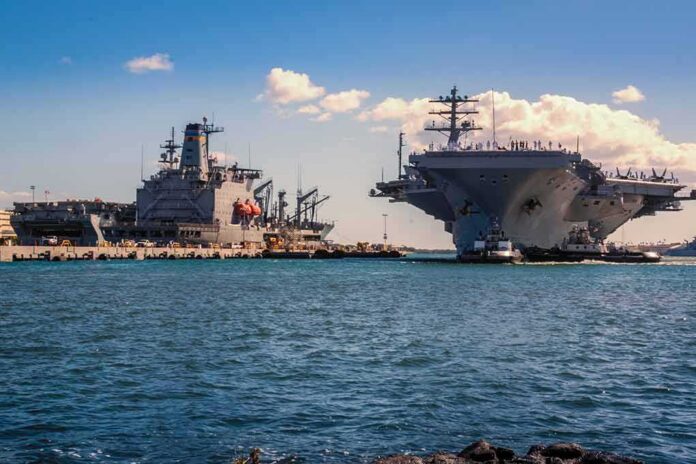
Carrier strike groups do not tie up as a single block; they disperse to available berths and anchorages based on port capacity, mission support needs, and force protection. The U.S. Embassy in Bangkok described precisely that pattern: the Lincoln at Laem Chabang, the destroyer USS Frank E. Petersen Jr. alongside in Sriracha, and the guided-missile cruiser USS Robert Smalls in Map Ta Phut. That distribution is standard practice and optimizes both logistics and traffic management in a commercial port complex that services container lines, bulk carriers, and energy shipments alongside episodic naval visits.
Thailand’s Immigration Division anticipated “more than 5,000” U.S. personnel ashore during the window—a reasonable estimate for a Nimitz-class carrier’s crew and air wing plus elements of the escorts and staff. Such advance coordination is not window dressing; it underwrites the entire liberty plan and ensures that shore leave, medical support, and security can scale without disrupting local commerce or public services.
Why This Stop, and Why Thailand: The Operational Rhythm and the Alliance
Carrier deployments have a cadence: sustained operations, transits, maintenance windows, and carefully chosen port calls that balance crew recovery with diplomatic signaling. By every account, the Lincoln’s Thailand visit landed in the recovery lane—after 200-plus days at sea across a demanding theater set, with the group steaming homeward. That context explains the absence of scheduled bilateral drills and the emphasis on rest and resupply. It also explains the concentration of sailors in well-serviced, accustomed liberty ports where host-nation agencies know the rhythm and risks of a large-scale visit.
Thailand occupies a pragmatic niche in U.S. maritime operations: a treaty ally with deep experience hosting large U.S. contingents, a port infrastructure capable of handling a capital ship’s support demands, and a local economy that can absorb—and benefit from—a short surge of visitors. Prior carrier stops by other U.S. flattops have followed the same pattern: pull in, resupply, shore leave, cultural exchanges, pull out. In other words, alliance maintenance through the quiet competence of logistics and hospitality rather than displays of force.
The Two Frames of a Carrier Visit—and Why Both Are True
Coverage of carrier port calls reliably splits into two narratives. The first is operational: routine visit, rest and recuperation, no exercises, back underway soon. That was the line from Thai defense officials and was borne out by the scheduling and distribution of ships. The second is socio-economic: an influx of thousands of sailors into a resort-adjacent region, with an attendant boost to hotels, restaurants, and retail—and the predictable concerns about policing, pricing, and public order. Thai officials publicly warned against overcharging visitors and surged police presence in nightlife corridors, a recurrent theme when Pattaya and Laem Chabang host large military contingents.
Both frames can be true without contradiction. A port call can be routine in military terms while being economically significant and socially visible for a host city. The job of officials—Thai and American—is to keep the first frame dominant (safe, uneventful logistics) while managing the second (crowd control and commerce) so it does not overwhelm the visit’s purpose.
USS Abraham Lincoln arrives in Laem Chabang, Thailand. pic.twitter.com/wokCWvq9Pk
— Mike (@BKKMikeF) September 2, 2026
Deployment Strain and Crew Welfare: Context, Not the Mission of the Stop
Many reports linked the Lincoln’s visit to the cumulative burden of a long deployment—variously characterized as 200 to 250-plus days at sea—which naturally elevated interest in shore leave, medical access, and simple decompression. While detailed welfare assessments are separate from the fact of the port call, the length of time underway is not a mere sidebar; it is why crews need ports that are predictable, well-organized, and close to airlift and medical networks if required. In that context, Thailand’s efficient immigration posture and the U.S. Embassy’s transparent port distribution signaled a plan tailored to recovery rather than operations.
The operational security caveat also fits the pattern. U.S. Navy public messaging rarely confirms future ship movements; host-nation officials and post-arrival embassy statements often carry the public factual load for port calls. That is not secrecy; it is standard practice designed to balance transparency with force protection. The Thai-side specificity and on-the-ground reporting supplied what readers genuinely needed to know: who came, where they berthed, and why they were there.
What It Means Going Forward
Three takeaways endure beyond this single stop. First, routine port calls are the circulatory system of naval power: they keep ships supplied and crews healthy, and they do so without the political heat of exercises or freedom-of-navigation operations. Thailand is a reliable node in that system. Second, messaging discipline matters. When defense ministries frame visits as rest-and-recuperation events and stick to that script—and when embassies clarify ship dispositions—the public temperature stays low and the visit stays on schedule. Third, alliance maintenance is often measured in eventless days. A carrier arrives, thousands of Americans enjoy a few days ashore, local businesses get a lift, and the strike group departs without incident; that quiet success is the point.
Sources:
youtube.com, cnn.com, militarytimes.com, english.elpais.com, ktvb.com, stripes.com, nationthailand.com, asianews.network, abcnews.com, forbes.com, thethaiger.com