When high-profile arrests happen at a protest, the core question is not celebrity or spectacle but calibration: where the line sits between protected dissent and police management of space, and whether officials drew that line with restraint or excess. The detentions of Hannah Einbinder and Susan Sarandon outside the United Nations during Benjamin Netanyahu’s address became a laboratory for that question—one that turns on how civil disobedience operates in practice and how New York police chose to enforce the rules of the street.
At a Glance
- Einbinder and Sarandon were detained during a protest near the UN timed to Netanyahu’s General Assembly speech; images and reporting confirm NYPD custody.
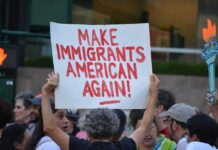
- The protest’s message targeted U.S. support for Israel’s military campaign; organizers used sit-ins and roadway blockades—classic civil disobedience tactics.
- NYPD says arrests followed clear warnings to vacate the roadway; most detainees received summonses and were released without incident.
- This pattern—symbolic disruption met by targeted, low-level enforcement—reflects the enduring friction between speech and space in American protest policing.
What Happened and Why It Matters
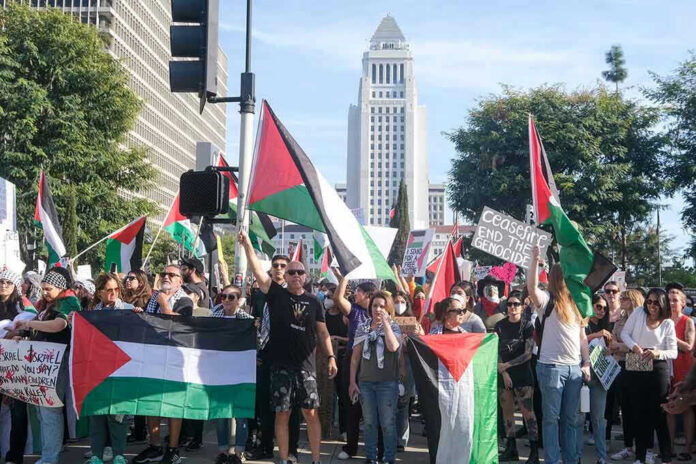
As delegates assembled for Netanyahu’s speech, demonstrators massed outside the UN, pressing a simple demand: stop U.S. arms to Israel. Among them were veteran actor Susan Sarandon and comedian Hannah Einbinder, both publicly visible and both ultimately detained by the NYPD. Wire photos and contemporaneous coverage document Sarandon in police custody and Einbinder among those removed from the roadway; agencies tallied dozens to roughly a hundred arrests across clustered actions that day, a scale consistent with a planned sit-in aimed at maximum visibility rather than confrontation.
Police provided a straightforward account of their enforcement threshold. According to NYPD statements reported by multiple outlets, officers issued warnings that remaining in the roadway would trigger arrests for disorderly conduct, then proceeded person by person after noncompliance. The department framed the operation as peaceful, with detainees generally receiving summonses and release rather than custodial bookings—an approach tailored to restore traffic flow without escalating force. Video from the scene captured an officer’s formula: refusal to clear the roadway equals arrest on disorderly conduct grounds, with resisting raising the stakes. That is the standard choreography of civil disobedience—and the crux of the debate over necessity and proportionality.
How Civil Disobedience Meets the First Amendment
In American doctrine, content-based suppression of speech is anathema; management of time, place, and manner is allowed if it is content-neutral, narrowly tailored, and leaves open ample alternative channels. Street blockades—deliberate disruptions of traffic—fall squarely into the category police can regulate. That is why protest movements so often adopt the tactic intentionally: forcing a public-order response to dramatize their claim. The legal system, in turn, routes most such cases to low-grade charges like disorderly conduct, treated as symbolic citations more than criminal sanctions.
The gray area—the space in which constitutional protection rubs against logistical control—lies in police discretion. Officers decide when a crowd becomes an obstruction, how much time to negotiate, whether sidewalks suffice for expression, and when to turn to arrests. Scholarship on protest policing emphasizes that discretion, dispersal orders, and spatial controls largely determine whether expressive conduct becomes a criminal event; arrest patterns also shift with counter-protest presence and political salience of the issue. In this case, the NYPD’s own description suggests a textbook, low-temperature enforcement arc: warn, confirm intent, arrest peacefully, issue summonses, release.
Competing Frames: Suppression or Routine Crowd Control?
Protesters and allied public figures framed the detentions as a free-speech affront tied to an unpopular war policy. The timing—minutes before a highly scrutinized address—was deliberate. Visuals of Sarandon zip-tied on a police bus and Einbinder in custody potentiate that narrative, which is precisely why movements recruit visible participants to sit down in traffic: it converts a minor charge into a media vehicle for the cause. Movement logic is not coy about this; civil disobedience presumes arrest as the cost of moral witness.
Police counter-framed with operational necessity: the roadway was blocked, warnings were issued, the arrests were peaceful, and summonses followed. Independent footage and reporting corroborate at least that much of the sequence; officers are heard informing demonstrators they would be arrested if they remained in the street, a predicate that satisfies the content-neutral “time, place, manner” script in most jurisdictions. To the extent there is a dispute, it is not factual—whether detentions happened, whether warnings were given—but normative: whether, given the moment and the method, arrests were the least restrictive means of restoring order or an avoidable flex of authority.
What the Evidence Supports
The record bears out several points. First, these were not random roundups; they were targeted detentions triggered by a sit-in that intentionally blocked First Avenue near the UN complex, timed to create friction during a high-security event. Second, the NYPD’s pathway—warnings, confirmation, arrests, summonses—tracks with standard practice in managing civil disobedience without force. Third, celebrity status did not confer immunity; if anything, it amplified the protest’s communications strategy as organizers likely intended. None of this diminishes the protest’s expressive value; it clarifies its method and predictable consequence in a city conditioned by years of UN-week logistics.
In other words, these arrests are better understood as the currency of civil disobedience than as an aberrant clampdown. They are the foreseeable trade-off of choosing the street over the sidewalk to force an issue into the frame of world media. The legal system, for its part, processed the event as low-level disruption—summonses rather than heavy charges—signaling an institutional willingness to acknowledge the speech interest while defending the state’s claim to keep a critical artery passable.
The Durable Pattern—and How to Judge It
Zoom out, and the Einbinder–Sarandon episode fits a durable American pattern. Arrest risks are higher when protests collide with state power, identity conflict, or counter-protest—and when tactics use spatial disruption as leverage. Policing strategies that minimize force and emphasize targeted, negotiated arrests tend to reduce injuries and litigation exposure; mass arrests and rapid escalations do the opposite. Research on protest events and policing approaches underscores that balanced, sparing enforcement preserves both order and legitimacy, whereas heavy-handedness can chill speech and backfire politically.
Judging necessity turns on practical alternatives. Could officials have held traffic, rerouted vehicles, and let the sit-in burn itself out quickly without arrests? Sometimes yes—particularly when numbers are small and security stakes modest. During UN week, with hardened perimeters and motorcades threading Manhattan, tolerance for sustained blockades typically narrows. The evidence here points to a managed, low-level enforcement sequence rather than punitive overreach. That conclusion neither vindicates nor condemns the cause; it describes how the state and dissenting citizens negotiated space under pressure, with each side behaving in character.
Susan Sarandon, Hannah Einbinder Detained at United Nations Netanyahu Protest https://t.co/3zd6UM5k8F via @thr
— Terrie Lake (@terrielake) September 25, 2026
Practical Takeaways for the Next Demonstration
For organizers, the lesson is operational clarity. If the tactic is civil disobedience, plan for arrests: train marshals, brief participants on charges and rights, coordinate legal support, and use the moment of custody to carry the message. For police, the durable best practice remains constant: communicate clearly, create off-ramps, avoid force, and treat citations as a last step after genuine alternatives. That equilibrium—order maintained, dissent expressed—does not resolve the underlying policy fight, but it keeps the street a plausible forum for politics rather than a battleground.
Sources:
youtube.com, reuters.com, rmb.reuters.com, cbc.ca, yahoo.com, ew.com