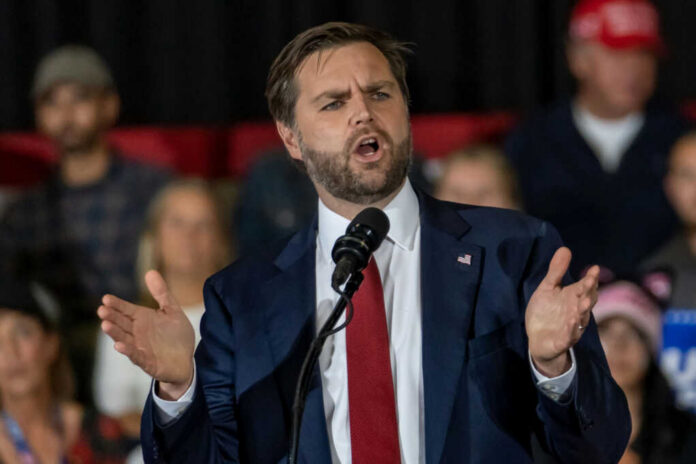
When campaigns trade jabs about facial hair and gym numbers, they are not just being petty; they are weaponizing “authenticity” as a political asset, converting appearance and masculinity cues into claims the audience can judge instantly—and share even faster.
At a Glance
- Abdul El-Sayed publicly alleged that Vice President JD Vance is “juiced up on TRT” and sporting a “fake” beard, then challenged him to a weightlifting duel, escalating a running beard-related feud.
- The exchange began after Vance mocked El-Sayed’s “patchy beard” on social media, with El-Sayed responding via TMZ and other outlets, repeating the TRT and fake-beard points and naming lifts for a head-to-head contest.
- The claims were framed as on-the-record media remarks and spectacle-ready taunts; outlets captured multiple formulations of the allegation and the specific gym challenge.
- The episode exemplifies a modern campaign dynamic: appearance-based ridicule recast as quasi-factual assertion, amplified by attention markets that reward virality over verification.
What Happened: From Beard Taunts to a Gym Challenge
In mid-September, a simmering feud between Abdul El-Sayed and Vice President JD Vance turned concrete and theatrical. After Vance needled El-Sayed’s “patchy beard” in earlier posts and riffs, El-Sayed answered on camera with two sharp thrusts: that Vance’s beard might be fake and that Vance is “amped up” or “juiced up” on testosterone replacement therapy (TRT). He invited Vance to settle the matter in the weight room—bench press, squats, take your pick—painting the challenge as a test of “real” strength and, by implication, “real” masculinity. The remarks appeared in a TMZ DC interview and were picked up by political and media outlets that quoted similar formulations across pieces, including “fake beard, fake strength, fake period.”
Specificity made the spectacle portable. This was not vague posturing; El-Sayed named lifts, dared “any gym,” and even joked about “paste” on Vance’s face, turning an insult into a quasi-factual claim that audiences could replay and evaluate in slow-motion close-ups. The coverage documented the progression from Vance’s initial facial-hair mockery to El-Sayed’s counterpunch and the measurable invitation to test strength publicly.
How These Claims Travel: From Insult to “Fact-ish” Assertion
Modern political communication compresses insult and allegation into the same frame. A jab about grooming (funny, fast, and legible) becomes an assertion about authenticity or enhancement (seemingly testable, newsworthy), then gets remixed by outlets built to maximize shareable moments. In that cycle, “fake beard” functions like a prop: it implies deception you can see; “TRT” adds a biomedical gloss that sounds concrete even when no records are in evidence, making the taunt feel like a claim. As this exchange shows, once a campaign surrogate supplies the line on record, the media economy will do the rest—clip it, headline it, and distribute it across platforms where humor, humiliation, and pseudo-forensics intermingle.
There is a legal and cultural undertone here. In American defamation doctrine, public figures face a high bar; parody and satire are strongly protected, and even “outrageous” speech can be shielded when a reasonable audience would recognize it as such. Yet statements that a listener could plausibly treat as literal, reputationally harmful facts occupy a more dangerous zone. The line between protected mockery and actionable factual assertion runs through how an ordinary audience would interpret the words in context—an increasingly difficult inquiry when political theater is staged for virality and remixed without tone, winks, or the original setup.
Mechanics of the Spectacle: Why the Gym Duel Works
The invitation to a bench-off or squat-off is not a throwaway bit; it operationalizes a vibe war. Gym numbers translate masculinity cues into a scoreboard and allow a candidate or surrogate to telegraph vigor, discipline, and competitiveness. The tactic has antecedents in politics and sports culture—the weigh-in, the staredown, the “pick your event.” By naming lifts and daring a venue, El-Sayed made the taunt scannable: is the beard real, are the lifts real, is the man real? In performance politics, that clarity is the point. Media coverage reflected this: the quotes were crisp, the verbs active, and the premise portable enough for splashy headlines and talk segments.
Vance’s initial beard mockery set the stage, creating a reciprocal frame in which both sides could escalate without changing genres. Once a public figure’s team embraces the aesthetics of ridicule—short clips, visual cues, memeable lines—the other side will answer in kind, often with an additive claim that nudges from appearance to biology. That is precisely what unfolded here: facial-hair banter upgraded into “is it natural?” and “are you enhanced?” challenges, culminating in the weight room proposition.
Where Substance Ends and Stakes Begin
Within the four corners of the coverage, the on-record elements are straightforward. El-Sayed said Vance may be on TRT; he questioned the beard; he threw down a lifting challenge; he repeated the beats across outlets; and the whole exchange grew from Vance’s earlier mockery of El-Sayed’s beard. Those facts are consistent across the clips and write-ups. What they mean politically is less about pharmacology or follicle science and more about the contest for perceived authenticity. In campaigns, voters routinely use low-information cues—voice timbre, posture, grooming, gym fluency—as proxies for leadership style and trust. The beard becomes a referendum on “realness,” the gym a proxy for stamina, and the callout a test of swagger under pressure.
The media incentives are obvious. Stories with a built-in visual hook—close-ups of beards, b-roll of barbells—outperform policy paragraphs. A single provocative line can outcompete a detailed position paper, particularly on platforms where the watchword is shareability, not durability. That does not make the moment trivial. It makes it telling. Campaigns that win the nonverbal frame early often shape how their policy messages are received later, because audiences have already decided which messenger feels “authentic.”
JD Vance Turns Abdul El-Sayed Feud Into A ‘Beard Arrest’
JD Vance’s latest jab at Abdul El-Sayed starts with a “patchy beard” joke — but the vice president’s message to House Republicans goes much further. pic.twitter.com/oaF5Ts2TdD
— MEAWW News (@meawwcom) September 16, 2026
The Broader Pattern: Ridicule, Allegation, and the Law’s Outer Boundaries
This episode sits within a well-documented pattern: attention markets favor the humorous, the humiliating, and the instantly legible; campaigns adapt by packaging identity and authenticity as performance; and the line between satire and assertion blurs. Courts have long protected parody of public figures—even when crude or “outrageous”—yet the same jurisprudence distinguishes obvious lampooning from specific statements that a reasonable audience could treat as factual and reputationally damaging. The dance between those categories is precisely where modern campaign jabs try to live: bold enough to land, elastic enough to claim humor, and calibrated to travel.
Why It Matters
Strip away the gym talk and what remains is an object lesson in how twenty-first-century campaigns operationalize authenticity. If you can make voters “see” a candidate as real or fake in a five-second clip, you have framed the policy hearing that follows. That is why a beard can carry more communicative heft than a white paper and why a bench press challenge can feel, to some audiences, like a referendum on vigor. You do not have to like the incentives to recognize their power—and if you’re analyzing modern campaigns, you ignore these theater mechanics at your peril.
Sources:
twitchy.com, tmz.com, rawstory.com, realitytea.com, washingtonexaminer.com, ua.news, huffpost.com