
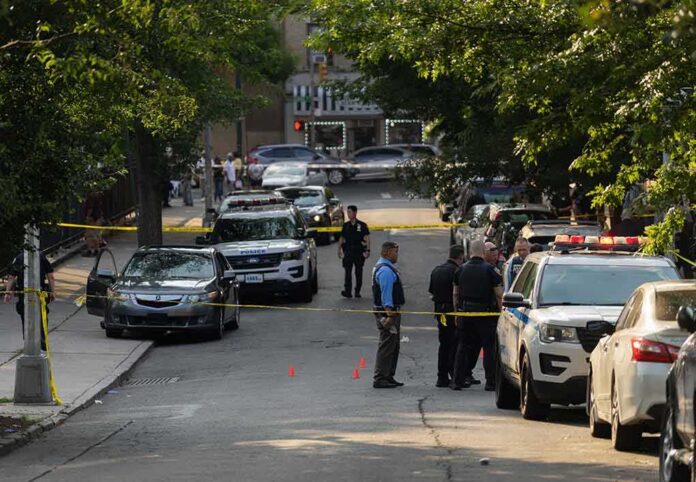
When gunfire erupts at a high school homecoming game, the criminal case that follows turns on evidence gathered in days, not months—video, geolocation trails, and physical corroboration that either survive scrutiny or do not. In Eden Prairie, Minnesota, prosecutors built such a case and a judge set bond; the defendant posted it and was released. That sequence—investigate, charge, release under conditions—illustrates how modern felony charging and pretrial rules work after high-profile violence, not an exception to them.
At a Glance
- Prosecutors charged an 18-year-old with two counts of second-degree assault and one count of second-degree riot after two teens were shot outside Eden Prairie High School’s homecoming game.
- The charging theory relies on surveillance video, cellphone-location data, and a vehicle link; a home search produced clothing matching the shooter’s attire in video.
- Hennepin County jail records show the defendant posted a $100,000 bond (or $10,000 cash option) and was released ahead of a court appearance.
- The incident fits a broader, uncommon-but-real pattern of gunfire at youth football events and raises familiar questions about evidence, pretrial release, and community safety.
What the charging documents and parallel reporting establish
Prosecutors in Hennepin County filed three felonies in the Eden Prairie case: two counts of second-degree assault with a dangerous weapon and one count of second-degree riot while armed. Those charges track the conduct described in the criminal complaint summaries: a driver arrived at the high school parking lot amid a fight, exited a Hyundai Sonata, and fired, striking two teens—one in the leg, one in the foot—before fleeing. Multiple outlets report the victims’ ages (17 and 18) and nonfatal injuries, and that the shooting occurred outside the Oct. 2 homecoming game, which was halted and later rescheduled.
The identification theory is prosecutorially conventional: triangulate a suspect using independent strands of evidence. Investigators linked the shooter to a Sonata registered to the defendant’s brother, then used cellphone-location data to place the defendant with that vehicle before, during, and after the shooting. Surveillance footage captured the shooter’s movements in and out of the car; a subsequent search at the defendant’s residence yielded clothing consistent with what appears on the video. That matrix—vehicle association, geolocation, and corroborative clothing—can meet probable cause even without a recovered firearm, which reporting to date does not indicate the police have found.
Pretrial release is a legal decision, not a referendum on outrage
After booking, the court set bond at $100,000 with a $10,000 cash option. Hennepin County jail records show the defendant posted bond and was released in the days following the arrest, ahead of the next scheduled appearance. For readers accustomed to equating bond size with offense gravity, the key is purpose: pretrial release serves to assure appearance and manage risk through financial sureties and conditions, not to punish. Minnesota law requires judges to calibrate bail to the individual—criminal history, community ties, and the particular allegations—often layering geographic restrictions, no-contact orders, and monitoring. The news digests do not publish every condition or the court’s full rationale, but the documented release itself is uncontested.
A short caveat belongs here and nowhere else: summaries paraphrase the complaint; they are not the complaint’s full text. That is normal in the first week of a case and does not change what is already clear from the record—what was charged, on what backbone of evidence, and that a bond was posted.
How the investigative pieces fit together
Surveillance video supplies temporal sequencing and descriptive identifiers—vehicle arrival and departure, shooter emergence, gait, build, clothing—while narrowing the window for any claimed alibi. Cellphone-location records, obtained by warrant, add positional data points that place a specific device in proximity to the vehicle and scene; when prosecutors later argue identity, they can show that the same phone traveled with the Sonata before and after the incident. Clothing recovery from a search serves as physical corroboration: distinctive garments or combinations visible in video can be matched, within limits, to seized items. In this case, reporting describes those precise elements—video, geolocation, Sonata linkage, and clothing—moving in concert.
What’s not reported to be in hand—ballistics tying a specific weapon to recovered casings or rounds—is often helpful but not essential to charge assault where witnesses, video, and injuries already prove shots were fired. Prosecutors can advance without a gun if identity and conduct are otherwise supported. Here, the injuries, evacuation, and interrupted game are not in dispute across outlets.
Why this incident reads familiar to school leaders and law enforcement
Gunfire linked to high school football remains rare given the vast number of games, yet it recurs enough to shape planning. Education Week’s tracker, which logs only incidents where someone other than the shooter is struck, recorded 43 football-game shootings since 2018—a count that excludes near-misses and off-property events but underscores that conflict sometimes migrates to stadium perimeters where crowds, emotion, and prior disputes converge. Local reporting in Minnesota places the Eden Prairie event in a week of intensified coordination among agencies focused on youth group violence, a posture that reflects how quickly such episodes spill across jurisdictions and social networks.
Administrators who steward Friday nights know the operational implications: ingress screening, camera coverage aimed at parking lots, visible law enforcement presence that can defuse brewing disputes, and evacuation playbooks that move thousands safely when shots are fired. The Eden Prairie sequence—fight inside, removal of participants, gunfire just outside the venue, rapid evacuation—matches the operational risks schools train against and will train against again.
**Mark J. Kappelhoff (Hennepin County District Court Assistant Chief Judge).**[](<https://t.co/wSJSgBAMTo>)
Per the official Hennepin County District Court calendar, he is the judicial officer assigned to Adam Abdihakeem Adam’s first appearance today (Monday, October 12, 2026)…
— Phantomfog (@Fantomfog2026) October 12, 2026
What to watch as the case advances
Three evidence lanes will decide whether the charging theory holds up. First, video quality and identification methodology—how clearly the shooter’s features and garments appear, how the state links those to the seized clothing, and whether defense experts can cast doubt on distinctiveness. Second, the integrity and granularity of the geolocation trail—provider records, warrant scope, handset attribution, and whether movement data align precisely with the Sonata’s documented route. Third, any physical forensics that emerge—recovered casings, medical imaging of projectiles, or a later-recovered firearm that can be compared. The reporting already details the core pillars; trial readiness depends on how well they interlock.
Separate from evidentiary mechanics, pretrial release will remain a public flashpoint. The legal question is narrower: do the bond and conditions manage appearance and community risk consistent with Minnesota standards? The emotional question—how a community processes wounded teenagers, a halted game, and video of spectators fleeing—does not decide bail but inevitably frames how people read each docket entry. The responsible civic posture is to track the case by what is filed and proven: the charges, the evidence, and the outcomes at each hearing, including any adjustments to conditions if new facts surface.
Sources:
foxnews.com, cbsnews.com, fox9.com, kstp.com, alphanews.org, patch.com