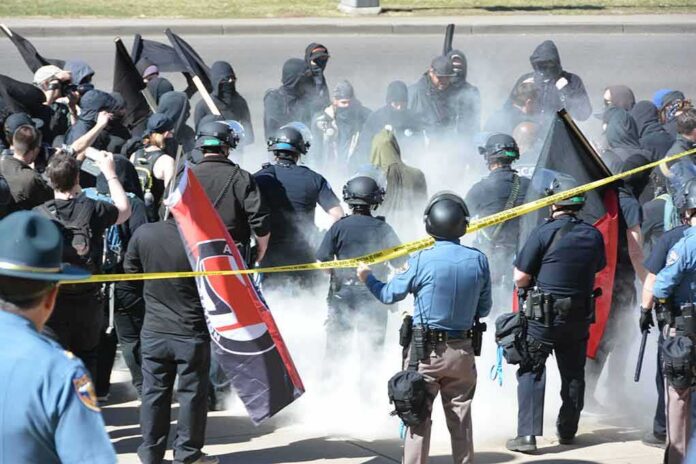
When protest policing collides with immigration politics, facts quickly become proxies for values: injury counts and “lethal” threats on one side, civil-liberties violations and crowd-control overreach on the other. The Los Angeles clash between LAPD Chief Jim McDonnell and mayoral candidate Nithya Raman is a case study in how those narratives form, what evidence they rest on, and why discerning readers should separate rhetoric from the record.
The Short Version
- McDonnell says anti-ICE unrest in 2025 involved extraordinary violence, injuring 52 LAPD officers and prompting tactics like tear gas; he defends the response as necessary amid fireworks, Molotovs, and vehicles used against police.
- Raman argues LAPD under McDonnell and Mayor Karen Bass tear-gassed protesters and chilled First Amendment activity; she calls for new leadership and culture change focused on protecting residents rather than shielding federal immigration operations.
- Raman’s “fascist liars” video triggered backlash; her campaign later said the phrase targeted ICE and the Trump administration, not McDonnell or Bass.
- The core dispute mirrors a recurring pattern: police control early operational data; critics surface counter-evidence via videos, litigation, and later reviews, often documenting injuries and protocol violations in crowd control.
What the competing claims actually say
Chief Jim McDonnell’s account is blunt: during the wave of anti-ICE protests, officers faced unprecedented assaults — commercial-grade fireworks launched directly at skirmish lines, Molotov cocktails, and vehicles used as weapons. He reports 52 injured officers, with some suffering hearing loss and concussive trauma; he characterizes the overall response as “remarkably well” executed under extreme conditions. In this framing, crowd-control tools, including tear gas in defined deployments, averted further escalation and were proportionate to the threat.
Raman’s case is equally categorical but addresses a different harm: she contends that LAPD under McDonnell and Bass tear-gassed protesters — “something they weren’t even doing in 2020” — and infringed Angelenos’ First Amendment rights. She argues the department’s posture prioritized protecting federal immigration activity over the safety and rights of residents, and she has pledged leadership change to reorient culture and accountability. When a campaign video appeared to label Bass and McDonnell “fascist liars,” her team said the line referred to ICE and the Trump administration, not local officials.
How protest policing works in real time
Operationally, a modern large-city department relies on layered tactics: visible skirmish lines and mobile field forces to channel movement; dispersal orders calibrated to statue and policy; and, when commanders judge an imminent risk of serious injury, “less-lethal” munitions and chemical agents to create standoff space. In practice, those tools are blunt: sponge-rounds and 40mm impact projectiles carry real risks of bone and eye injury if fired at the head or at too close a range; tear gas can cause intense respiratory distress, panic, and crowd stampedes. Departments justify them as last resorts to break cycles of violence; civil-rights advocates emphasize how quickly a “last resort” becomes a default in chaotic streets, and how easily mixed crowds of violent actors and peaceful demonstrators are treated as a single threat profile.
This asymmetry drives post-incident discourse. Police hold near-term custody of injury logs, body-worn footage, and deployment records; the public, journalists, and advocates work from live streams, field videos, and medical reports that accrete over weeks and months. The result is a predictable sequence: initial law-enforcement briefings foreground danger to officers; subsequent investigations surface protester injuries and protocol violations, including misuse of kinetic projectiles or chemical agents, especially in interagency operations that blend federal and local command cultures.
Where the evidentiary fulcrum sits
Two claims warrant close scrutiny because they anchor the debate. First, the assertion that 52 officers were injured — a concrete, verifiable number. Multiple outlets carried McDonnell’s on-the-record statement, including specifics about concussive and auditory injuries; absent an official audit in the provided record, the number sits as a public, attributable fact from the accountable official who controlled the operation. Reasonable readers can accept it provisionally while recognizing that later independent reviews, if and when they emerge, sometimes revise tallies or recategorize injuries by severity.
Second, the claim that LAPD tear-gassed protesters. Raman has repeated it across venues, situating it as a departure from 2020 practice; McDonnell’s camp characterizes tear gas usage as targeted to prevent escalation. In comparable protest cycles elsewhere, reputable human-rights monitoring has documented extensive injuries from both kinetic impact munitions and chemical agents used by mixed federal–local forces — evidence that underscores Raman’s civil-liberties concerns without deciding the specific legality or proportionality of LAPD’s deployments in Los Angeles. The contest here is not over whether tear gas can harm or chill speech — it can — but whether this department’s 2025 uses met necessity and policy. That is a question answered best by independent after-action reviews and, when appropriate, courts.
The politics embedded in the policing
Protest scenes around immigration enforcement are uniquely combustible because purpose and identity align: federal agents operate under a national mandate; local leaders answer to residents; and community members see deportation as an existential state intrusion. When police stage between federal operations and crowds, they inherit the policy hostility aimed at Washington and the constitutional obligations owed to Angelenos. McDonnell’s emphasis on “lethal” threats and officer heroism is designed to sustain institutional legitimacy in that crossfire; Raman’s emphasis on tear gas and First Amendment harms seeks to restore public primacy and recalibrate who is being protected, and from what.
The “fascist liars” flap illustrates how fast narratives harden. A provocative line, an edited post, and outraged responses from both the chief and the mayor became the storyline; the campaign’s clarification that the phrase targeted ICE and the Trump administration did little to unwind the initial association. For voters trying to evaluate public-safety leadership, this is the wrong focal point. The durable questions are policy and supervision: rules of engagement in mixed crowds; interagency command during immigration operations; munitions training, certification, and accountability; documentation and public release of use-of-force data; and the speed and independence of after-action reviews when things go wrong.
What a serious standard looks like going forward
There is a stable template for judging protest policing in a constitutional city. Start with clearly published crowd-control policies that narrow discretion, require on-scene supervisory sign-off for chemical agents and projectiles, and mandate audible, repeated dispersal orders with viable egress. Require granular deployment logs and rapid preservation and release of body-worn footage in defined circumstances. Track officer and civilian injuries with the same rigor and public transparency. When federal tasking is involved, publish written command-and-control agreements so the public knows who made which call. Then submit the entire operation to independent review with public hearings and binding recommendations — not a perfunctory internal memo.
Against that standard, readers can weigh both sides of this dispute. McDonnell’s account of officer injuries and violent tactics used against police is specific and on the record; in the absence of contradictory official data, it deserves weight. Raman’s criticism — that tear gas and posture toward immigration enforcement chilled speech and harmed Angelenos — aligns with a well-documented pattern of crowd-control harms in analogous events and warrants an equally rigorous, public accounting. The argument we should stop rewarding is the one that treats injury counts or incendiary slogans as dispositive. The measure of sound leadership is whether, after the smoke clears, the city can show its work.
Sources:
nypost.com, nbclosangeles.com, abc7.com, latimes.com, kabc.com, ground.news