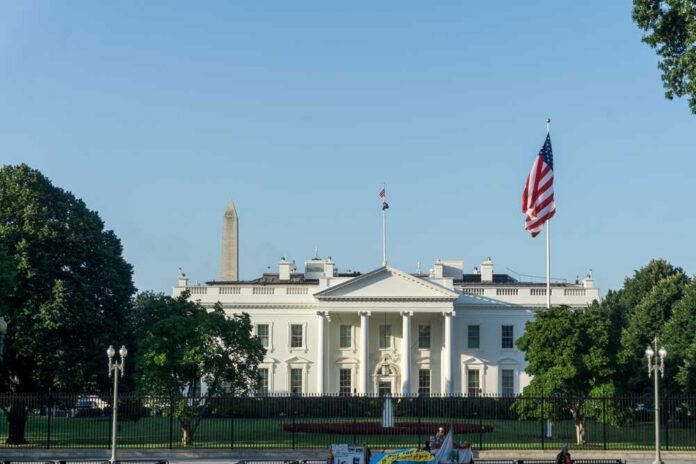
A $400 million White House ballroom plan has become a test of whether any president can bypass Congress and standard reviews by calling construction a matter of security.
Story Snapshot
- A trial judge initially found no clear statute authorizing the president to proceed without Congress and paused work pending approval [1].
- An appeals panel ordered the judge to reassess national security implications before halting related construction activities [1].
- Preservation advocates argue required historic and planning reviews must occur before work continues [2].
- The fight highlights recurring clashes between executive building projects, preservation law, and spending controls [2].
Trial Court’s Finding on Presidential Authority
U.S. District Court proceedings in Washington centered on whether the administration had lawful authority to build a new White House ballroom without express congressional approval. According to reporting on the March 31 order, the judge concluded that no statute clearly granted the sweeping authority asserted and barred work from proceeding without congressional approval, signaling that appropriations and authorization guardrails still apply at the White House itself [1]. That ruling elevated a process dispute into a constitutional turf fight over the power of the purse.
Preservation groups led litigation that targeted the project’s pace and process. Their stated objective focused on pausing construction until applicable historic preservation and planning reviews were completed, including those typically required for significant changes to protected federal properties in the capital region [2]. Their filings framed the controversy as a rule-of-law case about mandatory reviews and public accountability, rather than a referendum on aesthetics. That argument resonated with the trial court’s initial insistence on congressional approval before major work advanced [1][2].
Appeals Court Emphasis on Security Risks
A federal appeals panel complicated the picture by directing the district judge to reassess how halting construction could affect presidential and White House security. The panel reported lacking sufficient information to determine what parts of the project, if any, could safely pause and remanded for a more granular evaluation [1]. One judge pointed to an existing statute that may authorize certain presidential improvements to the White House, indicating the administration’s legal position is not frivolous and that security considerations deserve careful, specific treatment alongside statutory limits [1].
The remand does not greenlight the entire project, but it narrows the focus to which activities, timelines, and components might present unacceptable risk if stopped. That inquiry could yield a mixed outcome: discrete security-related elements might proceed while other features await congressional action and full review. The panel’s approach acknowledges that modern protective needs can be real while still bounded by law, documentation, and process. The next filings will likely map project phases to particular authorities and risks [1].
Why This Fight Resonates Beyond Washington
This case sits within a broader pattern where executive-branch construction collides with preservation law, environmental review, and appropriations controls. Disputes often turn not on political popularity but on whether officials can point to specific statutory or delegated powers and show they followed required reviews before spending public money or altering protected sites [2]. Advocates in this case describe a familiar sequence: pause, conduct the reviews, and then decide, rather than recasting the project as exempt because it is associated with the presidency [2].
In a new court filing, the DOJ describes Saturday’s shooting outside the White House as the second assassination attempt against the President in a month and argues lawsuit against the ballroom project should be dismissed.
The filing also reveals some of what is being built:
•… pic.twitter.com/LzZayB5wE2— Libbey Dean (@LibbeyDean_) May 25, 2026
For citizens across the spectrum who suspect Washington’s rules bend for the powerful, the ballroom dispute reinforces concerns about accountability. Conservatives wary of unchecked spending see a nine-figure project pressing forward without clear appropriations. Liberals worried about process and public input see mandatory reviews at risk of being sidelined. The courts now face a narrow but consequential question: how to weigh credible security needs against laws designed to prevent end-runs around Congress and public oversight [1][2].
Sources:
[1] Web – Federal appeals court sends White House ballroom construction …
[2] YouTube – National Trust sues Trump admin over ballroom plans