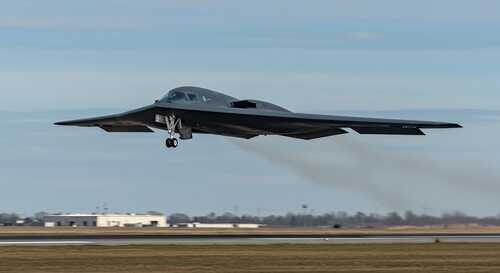
America’s plan to build only 100 B-21 Raider stealth bombers hands China a strategic advantage on a silver platter, leaving our nation dangerously unprepared for the multi-theater conflicts looming on the horizon.
Story Snapshot
- U.S. Air Force plans for just 100 B-21 Raiders fall drastically short of the 200-250 bombers experts say are needed to counter China and Russia simultaneously
- Defense analysts warn this shortage creates a critical vulnerability that benefits adversaries, particularly as China develops its H-20 stealth bomber program
- The B-21 program runs 28% under budget, yet expansion discussions remain stalled despite urgent calls from military leadership for 220+ total bombers
- Recent operations exposed fleet inadequacy when seven B-2 bombers were needed for a single Iranian target, highlighting what 100 B-21s cannot accomplish across multiple theaters
Strategic Shortfall Threatens National Security
The U.S. Air Force’s commitment to procure only 100 B-21 Raider stealth bombers creates a dangerous gap in American military readiness at precisely the wrong moment. Gen. Thomas Bussiere of Air Force Global Strike Command testified that the nation requires 220 total bombers, including 145 B-21s alongside 75 B-52Js, to maintain credible deterrence. The Center for Strategic and Budgetary Assessments pushes this number even higher, recommending 288 B-21s to absorb combat attrition and suppress advanced air defenses in peer conflicts. This isn’t bureaucratic number-crunching; it reflects the hard reality that 100 aircraft cannot sustain operations against China’s anti-access defenses in the Pacific while simultaneously deterring Russian aggression.
China’s H-20 Program Exploits American Hesitation
While Washington debates procurement numbers, Beijing accelerates development of its H-20 stealth bomber, projected to field 50-100 aircraft by the 2030s. China’s nuclear expansion and readiness timeline targeting 2027 for potential Taiwan contingencies underscore the urgency. The B-21’s technological superiority over China’s non-stealthy H-6K bombers means nothing if we lack sufficient numbers to project power. Northrop Grumman CEO Kathy Warden confirmed the Air Force is considering expansion, and Secretary Frank Kendall expressed openness to increasing force size. Yet these discussions have produced no firm commitments, allowing adversaries to calculate that American bomber capacity remains capped at levels inadequate for two-theater wars.
Obama-Era Budget Decisions Haunt Current Capabilities
The 100-aircraft target stems from Obama-era budgeting constraints that prioritized cost containment over strategic requirements. This mirrors the disastrous B-2 Spirit procurement, slashed from 132 planned aircraft to just 20, leaving today’s Air Force with only 19 operational B-2s. Recent operations illustrated this scarcity when Operation Midnight Hammer against Iranian nuclear facilities required seven B-2 bombers for a single target. The B-21 program, developed by Northrop Grumman since the 2015 contract award, costs $203 billion with development at $25.1 billion—running 28% under budget. This fiscal discipline should enable expansion, not justify maintaining insufficient fleet sizes that undermine deterrence against increasingly capable adversaries.
Production Success Demands Scaling Up Now
As of January 2026, Plant 42 houses 5-10 B-21s in final assembly, with Tail 2 conducting flight tests for weapons and radar systems. Low-rate initial production covers 21 aircraft across five lots, with full-rate production possible by fiscal year 2025. The B-21’s open-system architecture allows rapid technology upgrades, intercontinental range, and austere base operations without the B-2’s climate-controlled hangar requirements. Defense analysts like Mark Gunzinger advocate for a minimum of 225 B-21s to counter China and Russia effectively. The program’s under-budget performance validates industry capacity to scale production beyond the anemic 4-5 aircraft annual rate originally planned. President Trump previously urged establishing a second production line, recognizing that American strength depends on overwhelming capability, not bare-minimum inventory that invites aggression.
China’s Wish Come True: The Air Force’s Coming B-21 Raider Stealth Bomber Shortagehttps://t.co/rV4cC5b8XT
— 19FortyFive (@19_forty_five) January 27, 2026
The path forward requires rejecting the false economy of insufficient procurement. Pacific allies including Australia and forward bases in Guam face vulnerability to Chinese bomber threats while America’s stealth bomber fleet remains capped at levels guaranteeing operational overstretch. The B-21 maintains U.S. technological edges through stealth, drone integration, and network capabilities that non-stealthy Russian and Chinese platforms cannot match. But technological superiority becomes irrelevant when fleet numbers cannot sustain multi-theater combat operations, absorb attrition, and maintain continuous deterrence presence. Expanding to 200-250 B-21s with necessary tanker support represents the minimum investment to preserve American air dominance against adversaries who celebrate every indication that we lack the resolve to build what our military commanders say they need.
Sources:
China’s Wish Come True: The Air Force’s Coming B-21 Raider Stealth Bomber Shortage
Speed up B-21 Raider stealth bombers to counter China
B-21 – Air & Space Forces Magazine
How China’s H-20 Stealth Bomber Could Break America’s Pacific Defense
Forget AUKUS Nuclear Submarines: Australia Needs the B-2 Spirit Stealth Bomber