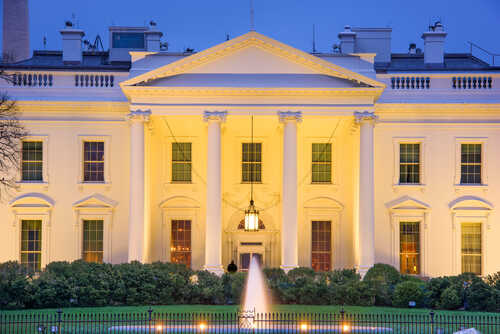
Republicans are racing to harden the White House after a gala shooting—yet their solution is a $400 million ballroom bill that tests Washington’s promises, priorities, and respect for taxpayer dollars.
Story Snapshot
- Senate Republicans led by Sen. Lindsey Graham introduced legislation to authorize $400 million for an 89,000-square-foot White House East Wing ballroom tied to new security infrastructure.
- The proposal follows a shooting at the White House Correspondents’ Dinner, with supporters arguing a fortified on-campus venue reduces risk for high-profile events.
- The plan relies on offsets including national park user fees and customs fees, rather than direct “new spending,” but it still raises a taxpayer accountability debate.
- A federal judge previously halted above-ground construction pending congressional approval; the Justice Department moved to lift that injunction within hours of the bill’s rollout.
What Republicans Are Proposing and Why It Changed
Senate Republicans, with Sen. Lindsey Graham as a lead sponsor, introduced legislation authorizing roughly $400 million for President Donald Trump’s long-planned East Wing ballroom. The project is described as an 89,000-square-foot event space paired with underground security features, including a Secret Service annex and military-related facilities. Supporters argue the shooting at the White House Correspondents’ Dinner sharpened the case for a more controlled, hardened venue near the executive complex.
The controversy is less about whether the White House needs security upgrades—most Americans agree it does—and more about how quickly the financing story shifted. Trump had previously said the ballroom would be privately funded through donations, with no cost to taxpayers. The new legislation, however, explicitly authorizes federal funding, with Graham suggesting private money could still cover decorative items while public funds handle construction and security-related components.
The Legal Roadblock: A Judge, an Injunction, and a DOJ Countermove
The ballroom push is unfolding against an unusually direct legal constraint. U.S. District Judge Richard Leon issued an injunction in March blocking above-ground construction without congressional approval, emphasizing that the White House is a public asset managed by elected officials, not personal property of any president. An appellate court later allowed construction to continue temporarily until early June, keeping the dispute alive while lawmakers weigh formal authorization.
Hours after Senate Republicans rolled out the $400 million bill, the Justice Department filed a motion seeking to lift the injunction. That timing matters because it signals the administration’s intent to treat congressional authorization and courtroom permission as parallel tracks, rather than waiting for one before advancing the other. For voters already skeptical of “government by maneuver,” the optics reinforce a familiar frustration: institutions moving fast when elites want something, and slow when ordinary Americans need relief.
How the Bill Would Be Paid For—and Why Offsets Still Sting
Republicans backing the bill say the spending would be offset through revenue streams such as national park user fees and customs fees. In Washington terms, that is meant to blunt the criticism of deficit spending. In real life, fees are still money extracted from the public, and shifting them to a marquee White House project can feel like a shell game to Americans who want basic fiscal clarity: if the project is necessary for security, make the security case cleanly—and if it is largely ceremonial, don’t disguise it.
The numbers have also moved over time, with early estimates nearer $200 million and later reporting placing the total between roughly $332 million and $400 million. That kind of escalation is common in federal construction, but it is exactly why voters distrust big, symbolic projects sold as tidy line items. If the ballroom’s underground components are truly essential for operational security, lawmakers will need to explain why those capabilities cannot be achieved more cost-effectively through targeted upgrades.
The Political Reality: A 60-Vote Senate Wall and GOP Pressure Tactics
Even with Republicans controlling Congress, the Senate’s 60-vote threshold for most legislation means Democrats can still block the bill unless it attracts bipartisan support. That procedural reality is why some Republicans are discussing alternative pathways, including unanimous consent requests and attaching the ballroom money to major homeland security or immigration funding packages. Rep. Chip Roy has pushed to connect ballroom funding to DHS priorities, a strategy designed to raise the political price of a “no” vote.
Republican Lawmakers Move On Legislation To Build And Fund Trump's $400 Million Ballroom https://t.co/DPN4QZbYts
— zerohedge (@zerohedge) April 29, 2026
For the public, the bigger takeaway is how rapidly Washington can reframe a project once a crisis hits. A shooting at a media gala created a new justification for an expansion that had already been in motion, and it set up a familiar fight: security versus optics, and urgency versus process. The strongest case for the bill depends on specifics—what security functions the underground build adds, why they are needed now, and how costs will be controlled—yet the reporting to date offers limited technical detail beyond broad descriptions.
Sources:
Senate Republicans Push Legislation to Build and Fund Trump’s $400 Million White House Ballroom
Extraordinary Trump-style filing asks to lift ballroom injunction
Republican lawmakers move on legislation to build and fund Trump’s $400 million White House ballroom
Republicans push legislation to build, fund Trump’s White House ballroom