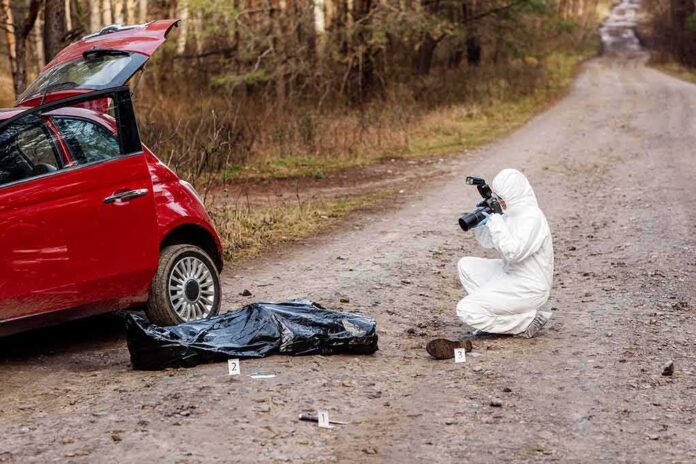
The real story here is not that police found a murder victim in rural New South Wales; it is that a field reading that looked like a homicide scene collapsed, under forensic scrutiny, into a lifelike sex doll. That distinction matters because it shows how quickly realism, clothing, hair, and surface markings can pull investigators and the public toward the most serious interpretation before laboratory examination restores the facts.
Intro Header
- Police in regional New South Wales initially treated a suitcase discovery near Oallen as a possible homicide.
- Forensic examination later determined the item was not human remains but a realistic doll with clothing, hair, a nose piercing, and marks resembling bruises and grazes.
- The case is a clean example of how convincing synthetic objects can trigger a full death investigation before the evidence is tested.
- The episode also shows why early scene assessment and later forensic confirmation often tell very different stories.
The initial scene read like a murder case
Two men stopped on Wolgon Road near Oallen, south of Goulburn, and found what appeared to be a body inside a suitcase. Police responded as they would to a suspected unlawful death: a crime scene was established, detectives were brought in, and the item was sent for forensic examination. That sequence is not melodrama; it is standard procedure when officers are confronted with something that could plausibly be human remains. In such cases, the first obligation is to preserve evidence and protect the possibility that a serious crime has occurred.
What made the scene so convincing was not just the shape of the object, but the accumulation of details that mimic life. Police later said the item was a lifelike doll, dressed in clothing, with hair and a nose piercing, and that it had markings resembling bruises and grazes. Those are precisely the kinds of features that can defeat a casual visual check. A realistic doll is not merely a toy scaled up; it is a deliberately engineered object designed to reproduce skin texture, hair, facial detail, and bodily ornamentation. In low light, at a roadside, inside a suitcase, the human eye is an unreliable instrument.
Forensics, not first impressions, settled the question
The correction came only after forensic examination at the Forensic Medicine laboratory, where police confirmed the item was not of human origin. Superintendent Linda Bradbury said officers acted on the information available and that the response followed proper protocol; by Monday, police said there was no suspicious death to investigate. That is the key institutional lesson of the episode. Police do not get to wait for certainty before securing a scene, but they also do not get to call a homicide before the body has been tested. The system is built to move from probable to confirmed, and this case moved all the way back out of the homicide lane once science took over.
The turnaround also explains why the first public description of the scene can be so misleading. Early reports often speak in the language of appearance: a “body,” a “woman,” a “decomposing” remains discovery. Later statements, after examination, replace that language with one that is narrower, cooler, and more exact. Here, the gap between those two stages was large enough to create a brief national curiosity cycle, but it was not a substantive contradiction. It was the normal correction that follows a false positive in a high-stakes environment.
Why this kind of mistake happens
Cases like this are not bizarre because they are impossible; they are bizarre because they expose how thin the line can be between a convincing object and a convincing corpse. Realistic dolls are increasingly manufactured with enough detail to be mistaken for a person, especially when they are partially obscured, damaged, or found in a context that preloads the mind toward suspicion. Once an item is placed in a suitcase beside a road, the setting itself supplies the most alarming narrative available. Human beings are pattern machines; police, journalists, and bystanders are no exception.
That broader pattern has been documented elsewhere. Similar misidentifications have occurred when police or members of the public discovered objects they believed were bodies, only to learn later that they were dolls or mannequins. The common thread is not incompetence so much as the practical limits of scene-based judgment. A body bag, a suitcase, clothing, and apparent injuries can create a convincing tableau. Forensics exists precisely because appearances are not evidence enough.
Seriously NSW Police?
FFS, how much did this cost NSW tax payers?
So, they mistake a sex doll stuffed into a suitcase for a real dead person. Anyone with half a brain would have flagged no bad smells at the so called crime scene.
Obviously the cops were on the piss or high. 😂… https://t.co/2vrtMCKD1T
— GeekMish🛡️🇦🇺🦘 (@MishGeek) August 10, 2026
What the case says about modern policing and public reporting
This incident is a reminder that homicide protocols are designed to err on the side of caution. That caution is not wasted effort; it is what prevents a real death from being overlooked because the initial witness report sounded implausible. The downside is public confusion when the early framing is dramatic and the correction arrives later, after the first wave of attention has already crystallized. In practice, the police must respond to the worst credible reading of the scene while remaining willing to discard that reading when laboratory work rules it out.
It is also a lesson in media timing. The first headline is often the least reliable one, not because reporters are careless, but because the raw facts are still moving. In this case, the line between “possible body” and “realistic doll” was crossed only after forensic verification, and that second stage is the one that should anchor the final account. The underlying event was strange enough without embellishment: a roadside suitcase prompted a homicide investigation, and the investigation ended with a doll.
Sources:
insiderpaper.com, nzherald.co.nz, malaymail.com, theguardian.com, youtube.com, abc13.com