
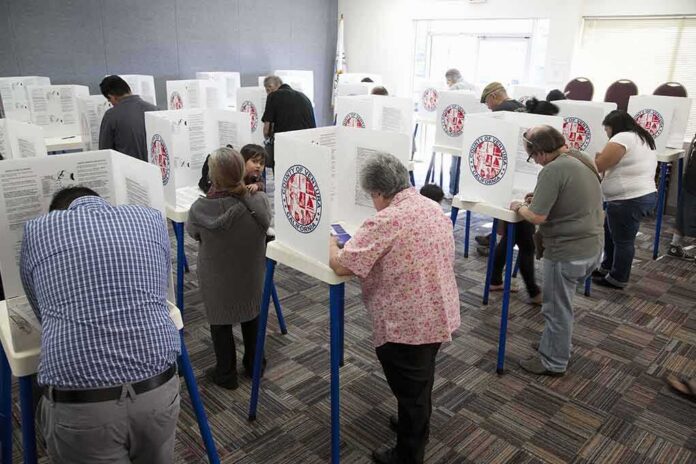
The integrity question raised here is simple and high-stakes: if a poll worker tells someone who says he is not a U.S. citizen that he can vote in a U.S. Senate race, that advice conflicts with federal and Michigan law—and it collapses the distinction between a clerical mistake and a federal offense.
The Short Version
- Undercover video shows a Dearborn poll worker, speaking in Arabic, telling a person claiming to be a noncitizen he could vote in races other than president, including U.S. Senate.
- Federal law makes it illegal for noncitizens to vote in elections for federal office, including the U.S. Senate, with narrow statutory exceptions not implicated by ordinary ballots.
- Michigan requires voters to be U.S. citizens for any state or federal election and has voters affirm citizenship under penalty of perjury at multiple steps.
- The episode centers on poll-worker guidance; it does not, by itself, establish that any illegal ballot was cast or counted.
What the video shows and why it matters
James O’Keefe’s outlet published footage from a Dearborn, Michigan polling place in which an undercover operative, presenting himself as a noncitizen, asks a poll worker—speaking in Arabic—whether he can vote. According to the published exchange, the worker says the operative cannot vote for U.S. president but “the others you can,” and responds affirmatively when asked about voting in the U.S. Senate race, naming the Democratic candidate referenced by first name. The clip’s core representation is straightforward: a poll worker green-lighted participation in at least one federal contest despite a declared lack of U.S. citizenship.
That matters because federal law bans noncitizen voting in elections for federal office. Title 18, section 611 of the U.S. Code makes it unlawful for an alien to vote in an election held “in whole or in part” to choose a Member of the Senate, among other federal offices; the statute carries criminal penalties and includes narrow exceptions that typically do not reach ordinary federal ballots. If the worker understood the person to be a noncitizen and genuinely advised he could vote for Senate, the guidance was legally wrong—flatly so.
The law: clear prohibitions and narrow exceptions
Two legal regimes intersect here. First, federal law prohibits noncitizen voting in federal elections—president, Senate, House—subject to tightly cabined exceptions (for example, certain local elections entirely unconnected to federal contests and a limited reasonable-belief safe harbor). Where a ballot includes any federal race, the prohibition applies. Second, Michigan law is categorical for state administration: only U.S. citizens may register or cast a ballot in any state or federal election, and voters attest to citizenship under penalty of perjury during registration and, if necessary, again at the polls. The Secretary of State’s guidance states the rule plainly: only U.S. citizens are eligible to register or vote in Michigan elections.
These frameworks are designed to foreclose the very misunderstanding captured in the clip—the notion that a noncitizen might be permitted to participate in “down-ballot” races while excluded only from the presidential contest. There is no such carve-out for the U.S. Senate. A poll worker who conveys otherwise is not narrowing a gray area; he is misstating black-letter law.
What poll workers do—and where errors arise
Election workers—often titled election inspectors—are front-line personnel responsible for administering the process inside the polling place: they verify eligibility, check names in the poll book, issue ballots, and assist voters with rules and procedures. Dearborn’s program reflects that standard description: inspectors staff precincts, guide voters through lawful steps, and support the chain of custody for ballots and materials. It is demanding, detail-intensive work done by temporary staff who must internalize significant training in a compressed period; the system therefore relies on both preparation and clear escalation paths when a question exceeds a worker’s knowledge.
In that light, two points separate the incident’s implications. The first is the accuracy of the worker’s advice in this singular exchange—it was inconsistent with law if the translation and context are as represented. The second is the inference some audiences leap to from one video to a judgment about systemic practice. Those are different questions with different evidentiary burdens. Empirically, documented instances of noncitizen voting in modern U.S. elections are rare; a study surveying officials overseeing 23.5 million ballots in 2016 identified roughly 30 suspected noncitizen votes referred for investigation across 42 jurisdictions—on the order of one in a million ballots. That base rate does not excuse a bad instruction; it cautions against extrapolating a practice from an anecdote.
Election administration context in Dearborn and Michigan
Michigan’s election administrators routinely manage high-turnout, high-scrutiny cycles; they also field episodic, unrelated pressures—equipment hiccups, observer behavior, and voter surges. Around the same period, state officials flagged that some Department of Justice election monitors in Dearborn asked poll workers for training materials—conduct the DOJ coordinator said was outside the monitors’ training and would be corrected—illustrating how even well-intentioned actors can misapprehend permissible roles inside a polling place. None of that changes the citizenship rule; it explains the operational noise in which a single mistaken statement can occur.
Michigan’s voter-identification procedure can also confuse casual observers. The state permits a voter without photo ID to sign an affidavit and receive a regular ballot; this process still sits atop the prerequisite that only citizens may register and vote, and the sworn statements attach penalties for false attestation. The absence of a photo ID requirement does not open the door to noncitizen voting; it simply prevents eligible citizens without ID from being disenfranchised while preserving accountability through perjury law.
What the Dearborn clip does—and does not—establish
As presented, the video establishes that a poll worker appeared to tell someone claiming to be a noncitizen that he could participate in certain races, including the U.S. Senate. It does not, on its own, demonstrate that a noncitizen was registered or that any ballot from such an individual was issued, cast, or counted. The legal stakes nonetheless are real: federal criminal liability attaches to a noncitizen casting a ballot in a contest that includes federal offices, and election jurisdictions seek to prevent such acts through training, attestation, and procedural checks.
The appropriate administrative response to a credible instance of incorrect poll-worker guidance is equally clear: identify the worker and precinct, review training and supervision, reinforce correct instruction statewide, and document any remedial steps. That is not a political judgment; it is how election administrators preserve confidence—by treating misstatements as errors to be audited and corrected, not as fog to be waved away.
🚨 Dearborn, Michigan
Poll Worker, Speaking in Arabic, Tells Undercover Reporter He Can Vote for U.S. Senate Despite Saying He’s Not a U.S. Citizen — Just Not President
Under 18 U.S.C. § 611, noncitizens are prohibited from voting in federal elections, including U.S. Senate.. pic.twitter.com/iwx0cMC1eB
— THE REAL Q GLOBAL RESET (@the_realqg) November 4, 2026
How to think about “scale” and consequence
Two truths can co-exist. First, the law is unambiguous: noncitizens cannot vote in federal elections, and Michigan limits all election participation to citizens. Any poll-place instruction that contradicts that is wrong and potentially consequential if acted upon. Second, a single recorded exchange does not, by itself, rewrite the empirical record on noncitizen voting prevalence; the best available survey research of local administrators points to vanishingly small numbers of referred incidents relative to total ballots cast. The responsible path forward is procedural, not rhetorical: clarify, retrain, and, where facts warrant, investigate and enforce.
Sources:
thegatewaypundit.com, uscode.house.gov, dearborn.gov, okeefemediagroup.com