

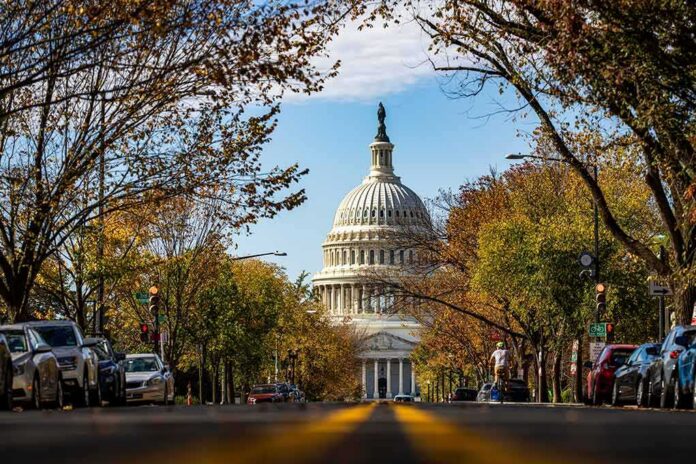
When a narrow House majority treats attendance as optional, procedure—not ideology—decides outcomes; Speaker Mike Johnson’s blunt reminder that members are paid to show up was less a scold than a recognition that, in a lame-duck Congress, presence is power.
At a Glance
- Johnson publicly pressed House Republicans to attend votes, citing missed roll calls that stalled the agenda.
- Post-election absences reached double digits on most roll calls; leadership pulled a rule vote and canceled a Friday session as a result.
- The clock was tight: roughly a dozen legislative days remained and a December 11 funding deadline loomed.
- Participation patterns in lame-duck sessions historically erode, but the GOP’s slim margin magnified the consequences.
Why Johnson’s Attendance Push Mattered
Speaker Mike Johnson’s message to colleagues in the final stretch of the 119th Congress was unvarnished: finish the work, and that starts with showing up. In remarks to reporters, he framed attendance not as symbolism but as the precondition for running “through the tape and finish[ing] strong”—a nod to both the limited days left on the calendar and the party’s threadbare margin on the floor. He acknowledged frustration inside leadership and said it would be addressed directly with members, linking presence to the ability to move the conference’s priorities in the term’s closing weeks.
This wasn’t rhetoric in search of a problem. In the period immediately after the midterm elections, roll-call data showed unusually soft participation: 12 of 13 votes registered double-digit absences, and several crossed the 30-member mark. On one Thursday, 32 members did not vote, including 21 Republicans—numbers that convert from annoyance to operational constraint in a chamber where a handful of missing members can flip a result. The effect was immediate and concrete: GOP leaders withdrew a procedural rule vote they judged unlikely to survive the absences, and they scrubbed a planned Friday voting day, conceding—at least for that week—that they lacked the bodies to govern the floor.
The Mechanics: When Headcounts Become Strategy
In a House governed by close margins, attendance is strategy. The majority’s control of the Rules Committee and the floor only matters if it can pass a rule—the procedural gate that brings a bill up and sets debate terms. Fail the rule, and the bill stalls without a policy vote. Leadership pulled back precisely there, reading the room (and the absences) and deciding the risk of an on-record failure outweighed the benefit of forcing the issue.
Calendar pressure compounded the math. Accounts at the time tallied only 12 or 13 legislative days remaining before the Congress expired, with a government funding deadline bearing down on December 11. That compressed window favored well-whipped, fully attended sessions; the opposite was happening. Johnson’s plea mapped neatly to the job in front of the House: move appropriations and remaining conference priorities before gavels fell for the last time that term.
The Data Problem Was Real—And Typical of Lame-Duck Sessions
To be clear about the baseline: lame-duck sessions tend to depress participation. Scholars and policy analysts have long documented that, once electoral incentives loosen, members—especially those not returning—miss more votes and stray more often from party lines. Estimates place ordinary House vote-missing around nine percent, rising by several points in lame-duck periods—a roughly 40–50% increase in absenteeism relative to the norm. Johnson’s admonition thus sat at the intersection of institutional history and present arithmetic: what is typical in December becomes determinative when the majority is narrow and deadlines immovable.
That institutional frame helps explain why leadership frustration peaked. Republicans were not merely missing ceremonial votes; they were surrendering leverage at the procedural chokepoint where a majority proves it can still organize itself to legislate. And while individual absences may be justified—health, family, official travel, or genuine security concerns were cited in some reporting—the collective effect was a conference unable to risk a rule vote on its own agenda.
Leadership, Scheduling, and Accountability
Could scheduling have lightened the load or coaxed better turnout? The record shows the House adjourned early for Thanksgiving and canceled a Friday session amid the attendance slump. Those decisions cut both ways in public perception: they acknowledged reality on the ground and reduced the odds of a public failure, yet they also ceded valuable days on a shrinking calendar and invited questions about floor management. Johnson, for his part, turned to norms-based accountability—reminding colleagues that pay continues and work remains—rather than naming or sanctioning specific members.
His own voting record underscored the standard he was urging. A contemporaneous compilation listed Johnson at 100% participation—268 of 268 roll-call votes that year as of November 17. The point was plain: if the Speaker could clear his schedule to be on the board every time, so could rank-and-file members asked to secure the majority’s procedural footing.
Security and the Edge Cases
One complicating factor surfaced beyond routine end-of-term fatigue: at least one member reportedly told Johnson they stayed away due to concern about a reported Iranian “dirty bomb” plot in Washington. Security advisories, even when speculative or broadly scoped, can shift risk calculations for individuals and offices. Leadership must weigh those considerations carefully against institutional imperatives; the Speaker’s public framing—focus on showing up, acknowledge frustration—tracked that balance without trivializing safety.
Still, the political cost of repeated no-shows in a razor-thin majority is steep. Every canceled vote is a headline; every pulled rule is a public reminder that numbers, not messaging, decide the fate of an agenda. That negative feedback loop is especially punishing in lame-duck sessions, where the calendar offers no long runway to recover momentum and where some departing members will not be swayed by whip pressure they will never again face at the ballot box.
What It Means for Governing in Narrow Majorities
The episode is a case study in the iron law of headcounts. Parties that win slim control must plan not only legislative content but also attendance resilience: redundancy on committees, tighter travel windows, pre-cleared proxy arrangements where allowed, and more aggressive early-week vote blocks to reduce attrition risk. In a post-election session, that also means identifying nonreturning members early, confirming their planned in-person availability, and prioritizing floor time for measures whose margins can tolerate inevitable leaks at the edges.
Johnson’s approach—public expectation-setting paired with tactical retreat from a likely failed rule—reflected those constraints. The message to members was cultural and practical: this is still your job, and the institution’s capacity to function in December depends on you. The decision to pull back from a doomed procedural test protected the majority from an avoidable defeat while reinforcing the core point. In a chamber that runs on numbers, attendance is not a courtesy to leadership; it is the currency of power.
Sources:
redstate.com, eastbaytimes.com, congresscountdown.com, washingtonexaminer.com, edition.cnn.com, heritage.org