

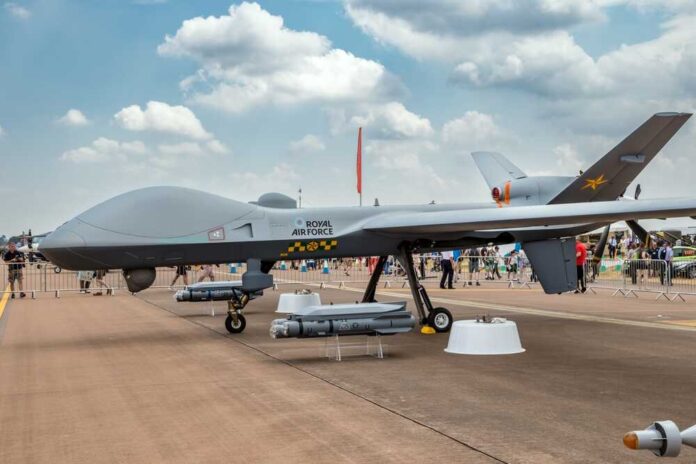
The Marine Corps is quietly turning its MQ‑9B Reaper drones into AI‑driven “brains in the sky” that can watch, listen, and decide faster than ever before.
Story Snapshot
- The Marines are installing a new Knox‑5 onboard “brain” in MQ‑9B Reapers to run AI and data‑heavy missions without relying on distant servers.
- These upgrades aim to turn the Reaper from a simple video platform into a networked command, targeting, and communications hub.
- Open‑architecture design means new sensors, software, and capabilities can be added quickly as threats evolve.
- Combined with new network pods and extended‑range airframes, the Corps is betting big on unmanned power in contested environments.
Marines Turn Reapers Into Smart, AI‑Enabled Battlefield Brains
Under a recent contract, the U.S. Marine Corps is buying nine Knox‑5 processors from Ultra Intelligence & Communications to serve as a new onboard “brain” for its MQ‑9B Reaper fleet. The goal is to let each aircraft process and fuse massive amounts of sensor data in the air instead of sending everything back through vulnerable, bandwidth‑hungry links to far‑away operations centers. That shift toward edge processing is crucial for faster targeting and decision‑making in any high‑threat fight.
The Knox‑5 module is built around an open‑architecture, SOSA‑aligned design, which means it is engineered from the start to plug into a broader family of modular, standards‑based systems. For the Marines, that technical choice matters because it makes it easier to bolt on new sensors, electronic warfare packages, or AI algorithms as they mature, without waiting years for a full avionics overhaul. It also gives the service more leverage and flexibility instead of being locked into one proprietary solution.
From “Video Truck” To Multi‑Mission Network Node
The MQ‑9 Reaper started life as a medium‑altitude, long‑endurance UAV built by General Atomics Aeronautical Systems for intelligence, surveillance, reconnaissance, and precision strike. Over time it gained more range, payload, and sensor options, but still operated largely as a remotely piloted “video truck” streaming imagery back to analysts. The Marine Corps’ current push for MQ‑9A and MQ‑9B reflects a different vision: a long‑range, networked platform supporting maritime awareness and expeditionary advanced base operations.
That shift shows up in several recent moves. Marine Unmanned Aerial Vehicle Squadron 3 already flies MQ‑9s in theater and is scheduled to be the first squadron to deploy with new capabilities in 2026. The Corps also accepted an MQ‑9A Block 5 Extended Range aircraft for its VMX‑1 operational test squadron to refine tactics, techniques, and procedures. Layered on top of these airframe upgrades, the Knox‑5 processor gives the Reaper the onboard computing muscle needed to manage multiple sensors, data streams, and AI‑driven applications at once.
SkyTower II Pods Turn Reapers Into Flying Network Hubs
Processing power alone is not enough; the drones also need a way to move information across the force. Naval Air Warfare Center Aircraft Division and Air Test and Evaluation Squadron UX‑24 have integrated the SkyTower II network extension pod onto Marine MQ‑9s to address that challenge. SkyTower II is designed to act as an airborne relay, bridging different communication systems and connecting Marines who would otherwise be “disadvantaged users” with weak or no links back to higher headquarters.
Engineers have been running power‑on checks and electromagnetic testing of the combined MQ‑9 and SkyTower II package at NAS Patuxent River, including in anechoic chambers used to reduce integration risk. Program officials describe the pod’s delivery and rapid test schedule as a major milestone for distributed operations. Current plans call for VMU‑3 to become the first unit to deploy MQ‑9s carrying SkyTower II in 2026, pairing the new networking payload with the broader push toward smarter onboard processing.
Edge Computing, Open Systems, And The Future Of Marine UAS
Bringing Knox‑5 onto MQ‑9B fits a wider pattern inside the Pentagon: moving from centralized, reach‑back architectures to distributed, open‑system platforms that can keep operating even when satellite links are jammed or bandwidth is scarce. With a powerful processor on the aircraft, the Marines can run AI tools to help spot, classify, and track targets quickly, assist operators in managing crowded skies, and even oversee smaller unmanned systems launched from the Reaper itself during complex missions.
https://nextgendefense.com/mq9b-brain-heavy-missions/#:~:text=The%20integration%20will%20allow%20operators,latency%20data%20exchange%20across%20domains.
In the near term, VMX‑1 and VMU‑3 will use these upgraded Reapers as testbeds for new concepts of operation, software applications, and sensor packages. Over the longer term, a SOSA‑aligned “brain” should make it easier and cheaper to keep MQ‑9 variants relevant, extending their service life while the Corps experiments with additional unmanned platforms. That combination of edge AI, resilient networking, and open architecture positions the Marine MQ‑9 not just as a camera platform, but as a key node in future joint and coalition battle networks.
Sources:
MQ‑9B Drone Picks Up a New ‘Brain’ for Data‑Heavy Missions
Marine Corps MQ‑9 Reapers Enhanced by Advanced Payload Upgrade
GA‑ASI Delivers MQ‑9A Block 5 Extended Range UAS to USMC
MQ‑9A Remotely Piloted Aircraft
Marine Corps Plans Massive Drone Training and Procurement Push
USMC MQ‑9 Reapers Receiving New Payload and Processing Upgrades